Block Malicious and Adult Web Sites with DNS Filtering
DNS filtering is a simple way to protect yourself from malicious websites. All you have to do is configure a DNS server setting to ensure that you never accidentally load a malicious site. Learn more at:

One of the best ways to keep malware from infecting your computers is to avoid visiting websites designed to do just that. No one intentionally visits loadmetogetinfected.com, but malware authors employ all sorts of tricks to lure unsuspecting users into viewing malicious sites. Various tools can help, but the easiest free technique is called DNS filtering.
DNS, which is short for Domain Name System, is the Internet technology that maps human-readable computer names like www.apple.com to the numeric IP address of Apple’s server, 17.254.0.91. Every time you click a link to visit a new Web page, your Mac queries a DNS server to learn the IP address associated with the domain name embedded in the link—it all happens seamlessly and instantaneously in the background.
Typically, your Mac will automatically use the DNS servers specified by your Internet service provider. However, you can change your DNS servers manually, and one good reason to do so is to take advantage of DNS servers that look at your Mac’s DNS requests and refuse to resolve names associated with malicious sites. Such DNS filtering is great since it protects you from malicious sites without you having to do anything special. Such sites simply won’t load at all.
One more thing. DNS filtering can also block porn sites. That’s helpful if you want to avoid accidentally loading adult content or to ensure that those in your office don’t, in order to reduce the chances of a sexual harassment complaint. As with malicious sites, filtered adult sites just won’t load.
Setting up DNS filtering is easy. All you have to do is replace your current DNS server addresses with the IP address of a particular public DNS service—the steps are later in this article. The two providers we recommend are Quad9 and Cloudflare, both of which are free and run by reputable companies. Of the two, Quad9 is more focused on user privacy, but Cloudflare offers additional DNS filtering capabilities that may be useful.
The options are:
Quad9 malware blocking: 9.9.9.9 with a secondary of 149.112.112.112
Cloudflare malware-only blocking: 1.1.1.2 with a secondary of 1.0.0.2
Cloudflare malware and adult content blocking: 1.1.1.3 with a secondary of 1.0.0.3
You should always enter the secondary DNS server in case the primary server goes down. Otherwise, you wouldn’t be able to connect to any sites at all.
However, don’t mix in other DNS servers. If you use Cloudflare’s adult content filter as your primary DNS server with your ISP’s DNS server as a secondary, when Cloudflare refuses to resolve an adult site, macOS will drop down to the secondary ISP server, which will resolve it happily, thus eliminating the utility of the Cloudflare’s filtering.
One final note before you get started. Apple’s iCloud Private Relay service (in beta in macOS 12 Monterey, iOS 15, and iPadOS 15) sends all your traffic through two proxy servers, which prevents DNS filters like Quad9 and Cloudflare from working. That’s unfortunate since iCloud Private Relay is a useful way to hide your IP address and browsing activity from your network provider and the websites you visit. Apple is clear about this limitation, noting in its various DNS server interfaces:
DNS requests are being routed by iCloud Private Relay for this network. Turn off Private Relay to manually configure DNS settings.
If you need to turn off iCloud Private Relay on the Mac, open System Preferences > Apple ID and deselect the checkbox next to Private Relay. On an iPhone or iPad, open Settings > Your Name > iCloud > Private Relay and flip the switch to Off.
Set Up DNS Filtering in macOS
To use DNS filtering on the Mac, follow these steps, which should work in any version of macOS. We’re using Quad9 as the example here, but replace the primary and secondary IP addresses as desired if you want to use one of the Cloudflare filters.
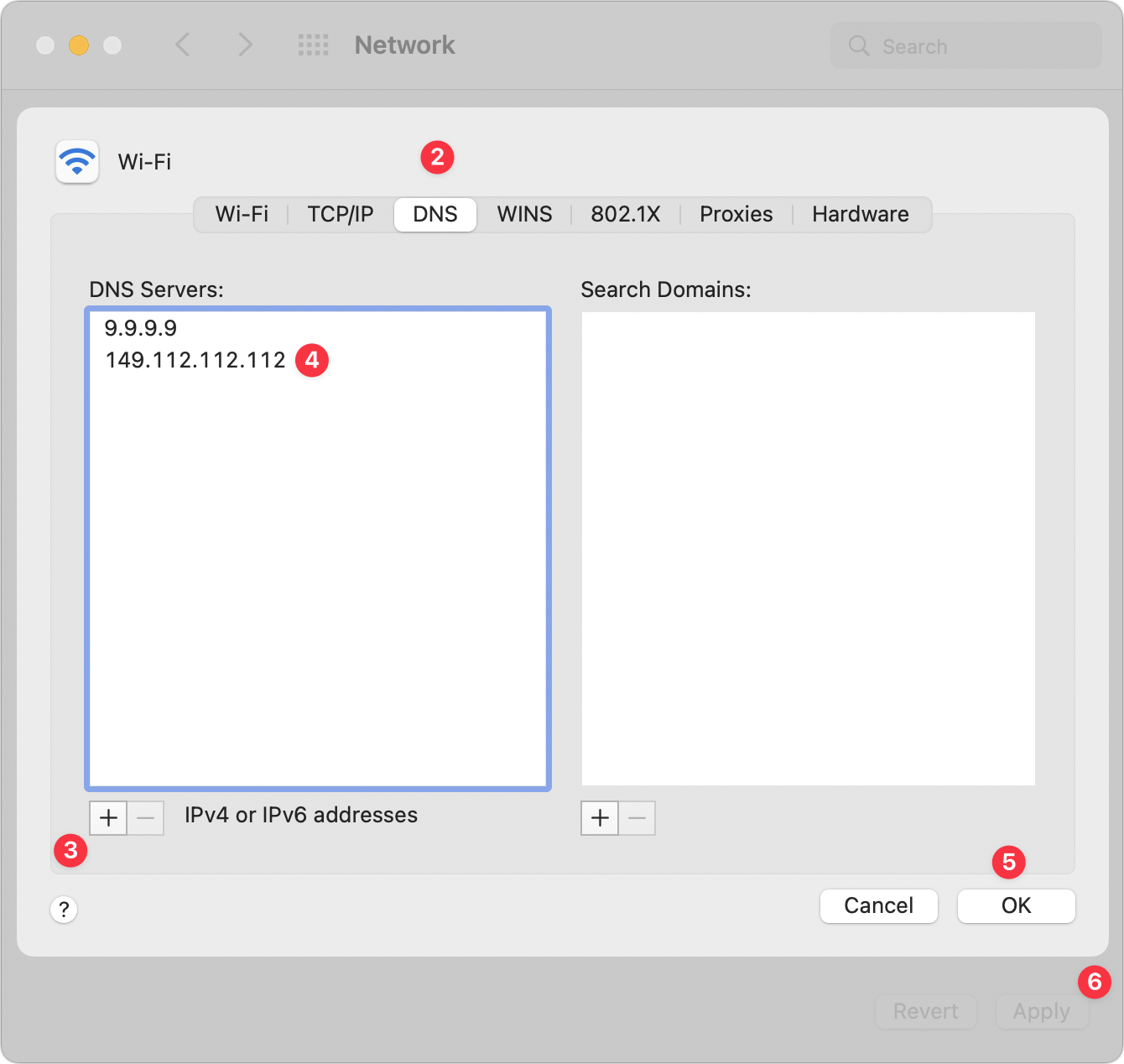
Open System Preferences > Network, and select the adapter you use (likely Wi-Fi or Ethernet) in the sidebar.
Click the Advanced button, and in the sheet that appears, click DNS.
Click the + button under the DNS Servers list and enter 9.9.9.9.
Click the + button again and enter 149.112.112.112.
Click OK to dismiss the Advanced preferences, and click Apply.
Close the Network preference pane.
It’s difficult to perform a real-world test to tell if Quad9 or Cloudflare’s malware blockers are active since there’s no way to know which sites they block. However, Quad9 provides a test page at on.quad9.net that should help. If you use Cloudflare’s adult content filter, you can tell if it’s working because your Web browser will refuse to load adult sites.

Set Up DNS Filtering in iOS and iPadOS
The steps for setting up DNS filtering in iOS and iPadOS are a bit different. For this example, we’ll use the Cloudflare malware filter, but again, you should replace the IP addresses below with the filter you want to use.
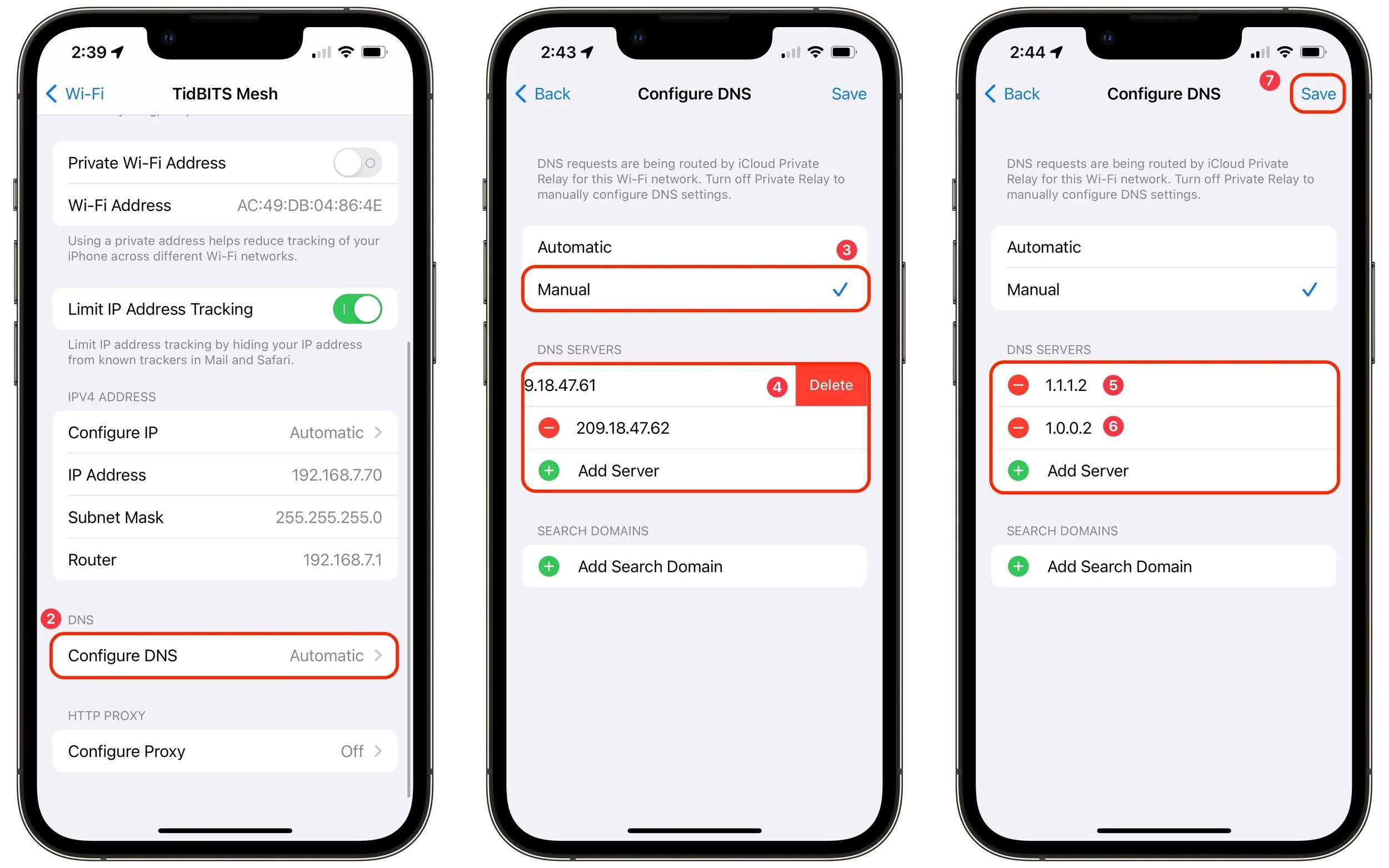
Open Settings > Wi-Fi and tap the “i” button next to your current Wi-Fi network.
Scroll down and tap Configure DNS, which is probably set to Automatic.
On the Configure DNS screen, tap Manual.
In the list of DNS servers, tap the red delete buttons next to any entries there.
Tap the green Add Server button and enter 1.1.1.2.
Tap the green Add Server button again and enter 1.0.0.2.
Tap Save in the upper-right corner.
That’s it! You should have no trouble using either Quad9 or Cloudflare, but if you need to revert to your previous DNS servers, it’s easy to do. On the Mac, just delete the manual entries you created—macOS will automatically use the DNS servers provided by your ISP. On an iPhone or iPad, select Automatic in the Configure DNS screen to replace the manually entered DNS servers with those from your ISP. In either case, if you’re not going to use DNS filters, it’s worth turning on iCloud Private Relay. We hope that Apple adds DNS filtering options to iCloud Private Relay so you could additionally choose to filter out malicious sites and adult content.
(Featured image by iStock.com/Funtap)
Copy and Paste Like a Pro with a Clipboard Utility
You use Copy and Paste, but did you know that, with a clipboard utility, you can paste previously copied items and filter or edit data on the clipboard? Here are three utilities that supercharge copying and pasting:

For our money, perhaps the most unheralded innovation of the computer age is Copy and Paste. No one thinks about the clipboard—that virtual shelf where copied text and images sit—because it just works. We all use Command-C to copy something and Command-V to paste it without having to retype the text, reimport the graphic, or whatever. Copy and Paste is a huge timesaver because it lets you reuse or build on work already done.
What if you could make Copy and Paste even more powerful? With the right clipboard utility installed on your Mac, you gain two major new features:
Use clipboard history to access previously copied data. Every time you copy something to the clipboard, it replaces whatever was there before. With a clipboard utility, though, you can see a list of items you’ve previously copied to the clipboard and paste any one of them, which is vastly easier than finding and copying the data again. Clipboard utilities even preserve your clipboard history across restarts.
Filter or edit the data on the clipboard before pasting. This capability is useful, for instance, if you copied styled text but want to paste plain text, if there’s a mistake in the contents of the clipboard that would be hard to fix after pasting, or if you want to replace all double spaces in the copied text with single spaces.
Which clipboard utility is right for you depends on what else you might want it to do, or you might even have one installed without realizing it. That’s because clipboard enhancements are a bit like blades in a Swiss Army knife: they tend to be bundled into other utilities. You won’t go wrong with any of these clipboard boosters: the dedicated clipboard helper Copy ’Em, the launcher LaunchBar, and the macro utility Keyboard Maestro. And while we’re highlighting these three, there are innumerable other great utilities that offer similar features.

Copy ’Em ($14.99) focuses on clipboard enhancements, bundling nearly every clipboard-related feature you could want into an attractive interface. It offers a full clipboard history, makes it easy to paste multiple items quickly or in a batch, can transform pasted text in various ways, and lets you organize clippings into groups. It also enables you to edit text clippings, search for text in your clippings, and ignore apps whose clipboard changes clutter your clipboard history. There’s even a separate version for the iPhone and iPad, should you want to share your clipboard history with your other devices. Other well-known clipboard utilities include CopyPaste ($30), Paste ($14.99 per year), and Pastebot ($12.99).

LaunchBar ($29) is a keyboard-focused launcher, so its primary feature is opening or switching to an application or file by typing a hotkey followed by a few letters from the name of the app or file. That’s hugely useful in its own right, but LaunchBar also maintains a filterable clipboard history across restarts, lets you paste a clipping as plain text, and can merge copied text with whatever is already on the clipboard. Other apps in this category include Alfred (with the optional £34 Powerpack), Butler ($20), and QuickSilver (donationware).

Keyboard Maestro ($36) is a macro utility, which means that it lets you string together a series of actions—copy this, switch apps, click there, paste, and switch back, for instance—and then invoke that series with a trigger such as a hotkey, menu command, timer, or system activity. Keyboard Maestro offers hundreds of actions and numerous triggers, but from the clipboard perspective, it provides a persistent clipboard history, multiple named clipboards, filtering of clipboard contents when pasting, removal of styles from pasted text, and a user-specified hotkey for anything you want to do.
Regardless of which of these utilities you choose, you’ll soon be juggling the contents of your clipboard like a pro…and wasting a lot less time!
(Featured image by iStock.com/LightFieldStudios)
Universal Control Arrives in macOS 12.3 and iPadOS 15.4
With macOS 12.3 Monterey and iPadOS 15.4, you can now use your Mac’s keyboard and pointing device to control up to three other Macs or iPads with Apple’s new Universal Control. Learn more at:
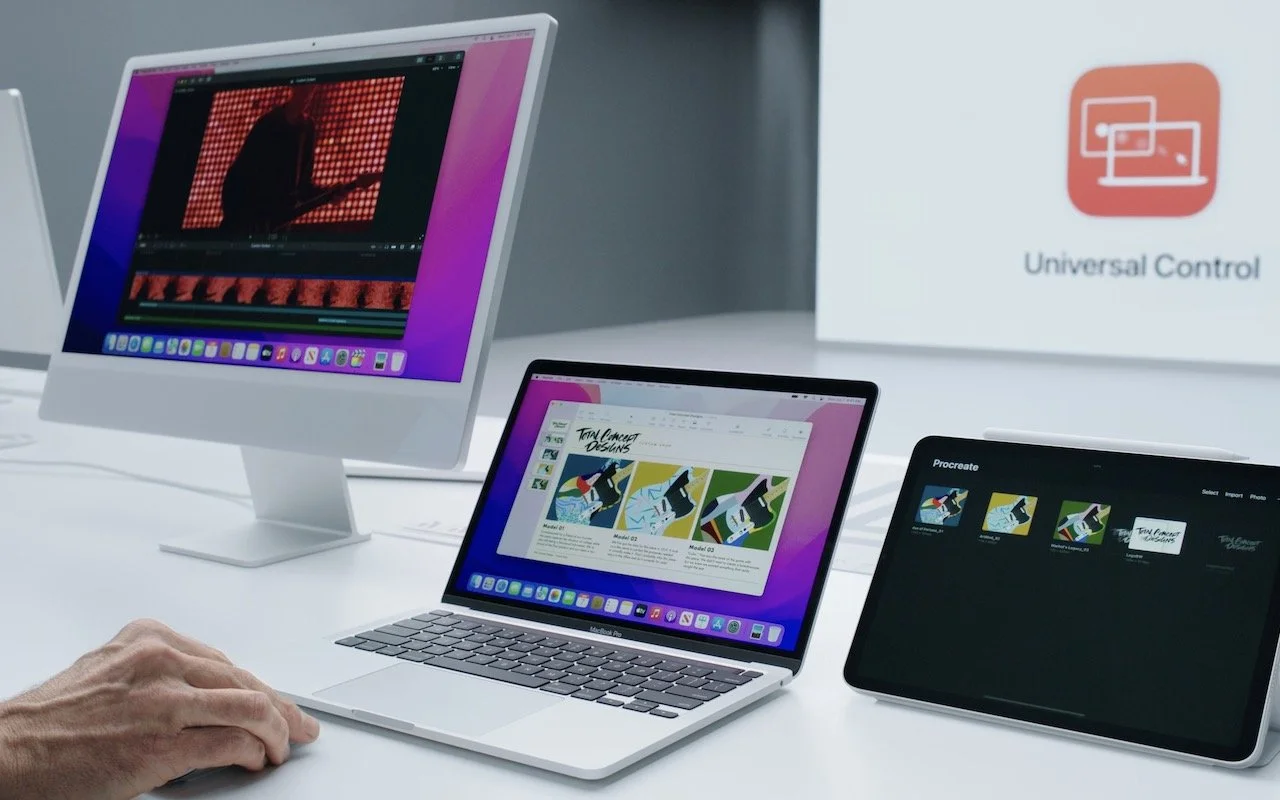
With the recent release of macOS 12.3 Monterey and iPadOS 15.4, Apple shipped Universal Control, the last major technology promised in its 2021 operating system upgrades. Universal Control enables you to use the keyboard and mouse or trackpad attached to one Mac to control up to three other Macs or iPads—you can even copy and paste or drag items between devices. It’s a great way to make more of your Apple devices while staying on task—no longer do you need to stop using your Mac to accomplish something on your iPad, and if you have both an iMac and a MacBook Air, it becomes trivially easy to use them simultaneously.
Universal Control can simplify grabbing a file from your MacBook Air while using your iMac, or it might make it easy to check something in an iPad-only app without switching from your familiar Mac keyboard and trackpad. For those who would benefit from more screen space, Universal Control simplifies keeping a Web browser window open on one Mac while you’re writing about it on another.
First, make sure all the Macs and iPads you want to use with Universal Control meet its system requirements. macOS 12.3 and iPadOS 15.4 are essential, and most (but not all) Macs and iPads that can run those versions are compatible. All the devices must be signed in to the same iCloud account, that account’s Apple ID must have two-factor authentication enabled, and no device can be sharing its Internet or cellular connection. Bluetooth and Wi-Fi must be turned on, and Handoff must be enabled in System Preferences > General on the Mac and in Settings > General > AirPlay & Handoff on the iPad. That may sound like a lot, but most of those are defaults.
Apple says everything must be within 30 feet (10 meters), but in nearly all cases, you’ll want the devices to sit next to one another so you can easily see what you are doing on all the screens.
The only trick with setting up Universal Control is that it must be initiated from a Mac. Open System Preferences > Displays, click the Universal Control button, and in the dialog that appears, enable all three switches. Only the first one is necessary; the other two make connecting in the future easier.
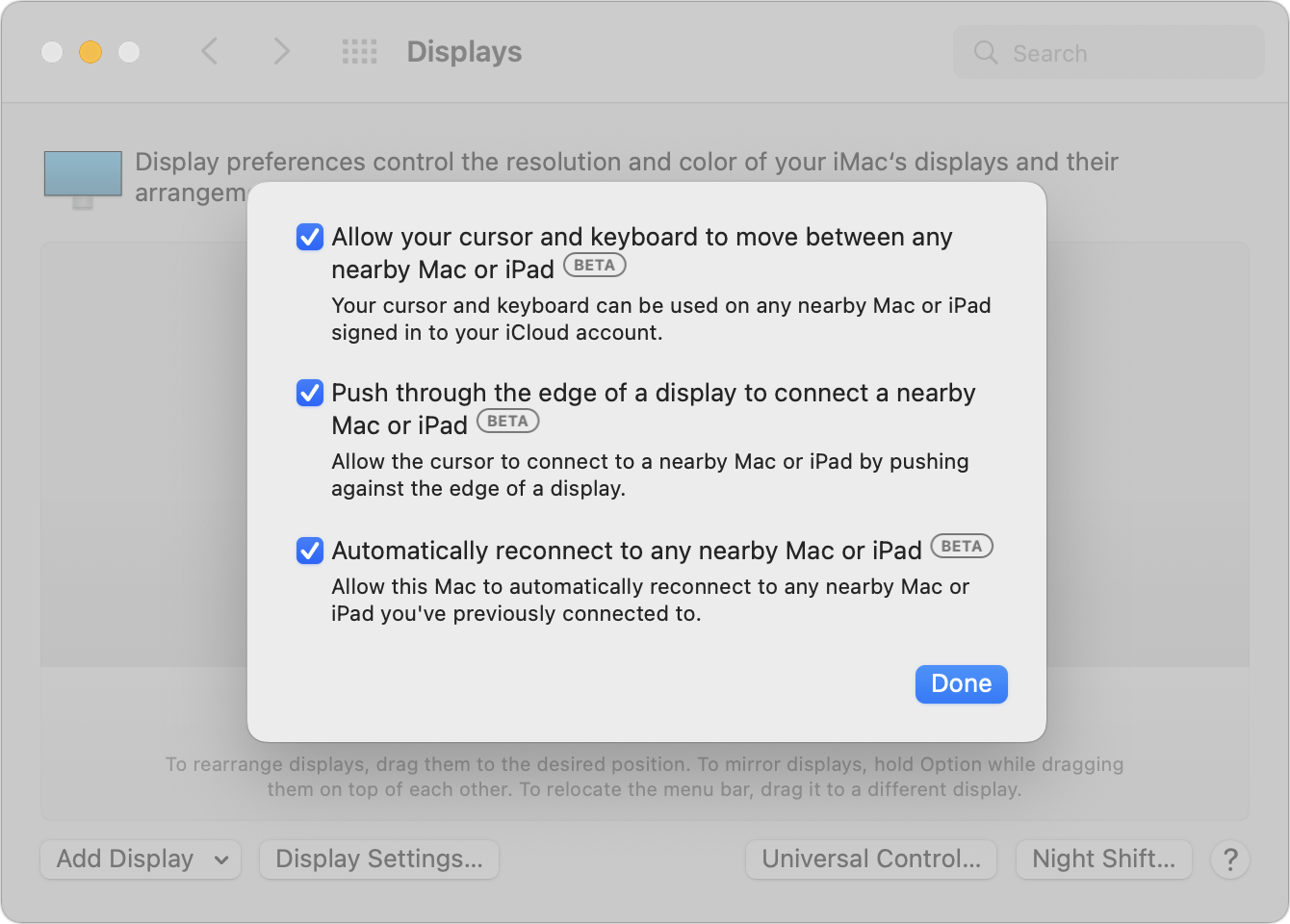
After you click Done, you’ll return to the Displays preference pane, where any available Macs and iPads should appear, much like they were external monitors. If they don’t show up, click the Add Display pop-up menu and select the device you want to control under “Link Keyboard and Mouse.” You can also select them in Control Center, after clicking Displays. As long as you’ve selected “Automatically reconnect to any nearby Mac or iPad,” you shouldn’t have to repeat this step.
(The “Mirror or Extend to” section of the Add Display pop-up menu is where you select devices to use as external displays for your Mac. Macs running Monterey appear here courtesy of AirPlay, as do Apple TVs; iPads appear thanks to Apple’s Sidecar technology.)
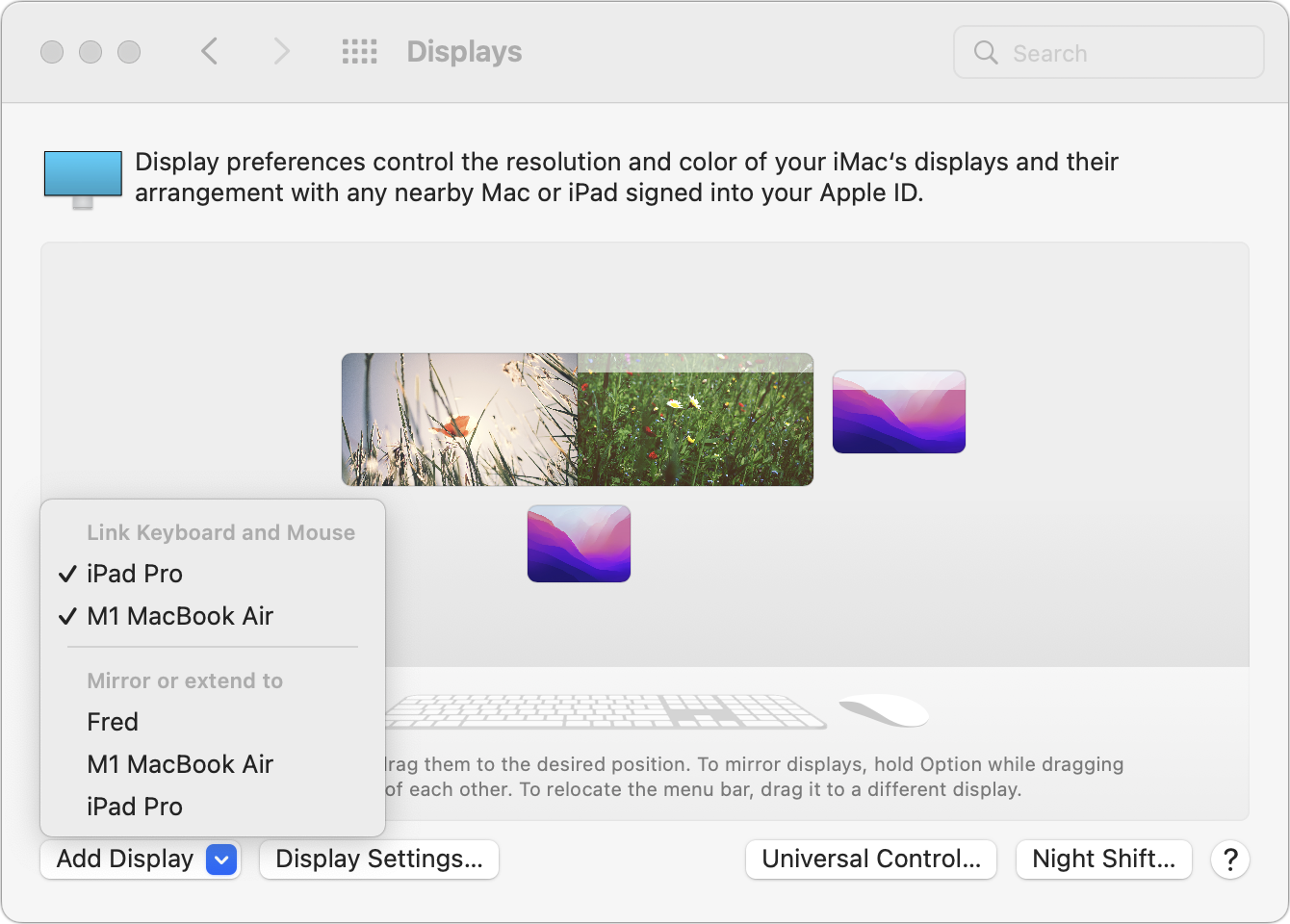
Drag the device screen icons to match where they sit on your desk. The screenshot above indicates that you’d move the pointer from the double-screen iMac to the right to control the MacBook Air and down from the middle of the iMac screens to control the iPad.
When your pointer moves to another device’s screen, everything you do from then on will affect apps on that Mac or iPad, with one caveat. After the pointer moves to another device, you usually need to click once to create “focus,” which means specifying which window should receive subsequent clicks and keystrokes. If you forget to do this (it will become second nature quickly) and start typing, keystrokes will go to the previous device.
To help you move data between your devices, Universal Control offers two addition-al features beyond clicking and typing:
Copy and paste: As you might expect, you can copy data on one device with Command-C, move the pointer to another device, and paste it into an app on the second device with Command-V.
Drag and drop: Alternatively, you can drag files and other types of data from one device to another. This works well between Macs, and you can also move data between Macs and iPads in many situations, such as dragging an Apple Pencil sketch from an iPad and dropping it in a graphics app on the Mac. If a drag doesn’t work, try copy and paste or fall back on sharing the data via AirDrop or iCloud Drive.
Keep in mind that once you’ve turned it on, Universal Control has no concept of primary and secondary devices. In practice, you’ll probably use one keyboard and pointing device to control everything, but that’s not necessary. You can use a trackpad and keyboard connected to any device to control any other device, switching whenever you’d like.
Since Apple labels Universal Control as a beta, you may experience occasional dropouts or rough edges. If it loses track of a device, try putting the device to sleep and waking it again, and if that doesn’t work, open the Displays preference pane and select the device from Add Displays again.
Controlling one Mac from another is extremely fluid because the pointer and keyboard act exactly as expected. However, if you haven’t previously used a trackpad and hardware keyboard with an iPad, you may find its approach somewhat surprising. It’s a hybrid between a traditional pointer and a touchscreen, so the pointer is attracted to Home screen icons and many other controls, transforming it into a selection highlight. Either way, Universal Control just works. Give it a try!
(Featured image by Apple)
Three Tricks for Dealing with Duplicated Contacts
Everyone eventually seems to end up with duplicates in Apple’s Contacts app. Follow our steps to merge duplicates in the same account or link those in different accounts.

In today’s world, there’s no reason to remember our contacts’ phone numbers or email addresses—that’s a job for our Macs, iPhones, and iPads. This sort of data is so core to using digital devices that Apple has long provided an ecosystem-wide solution in the form of Contacts and syncing through iCloud.
Unfortunately, it’s all too common to end up with multiple cards for the same person in Contacts, either precise duplicates or versions that contain different details. Further muddying the situation, many of us have multiple contact accounts—such as from Google or Microsoft Exchange—and some contacts may be duplicated across several accounts.
This situation is sufficiently common that Apple has provided three ways to deal with duplicate contacts: manually merging selected contact cards, automatically merging duplicate cards, and linking cards replicated in multiple accounts. The first two can be done only in the Contacts app on the Mac; linking can also be accomplished on an iPhone or iPad.
Merge Contact Cards
Let’s say you’ve ended up with two or more contact cards for the same person in the same account. They’ll usually have the same name, but it doesn’t matter if the names are different. To merge them, which combines the data from each into a single card, select them in Contacts, and choose Card > Merge Selected Cards. You should now see just the single merged card.
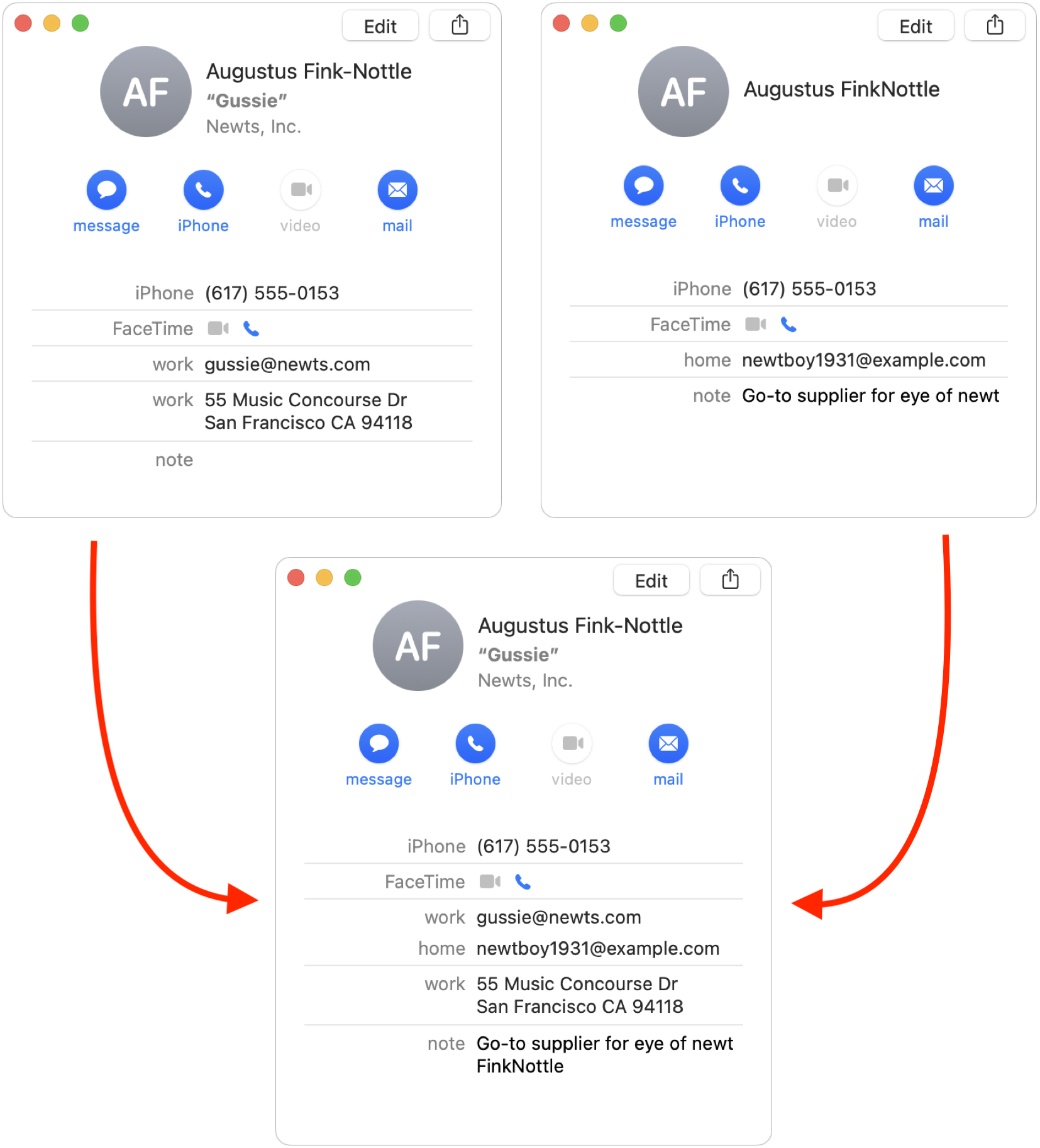
Contacts generally does a good job of identifying data that’s identical between the cards (like the iPhone numbers above), though different labels can sometimes trip it up. When there’s a conflict, Contacts creates a new entry for it. Name conflicts are added to the note field.
Look for Duplicates
Merge Selected Cards works if you have a small number of duplicates that you can identify easily. However, many people have found themselves in situations where tens or hundreds of contacts have been duplicated, often due to a hiccup in cloud syncing or importing. To help with that too-frequent occurrence, Apple added a feature that looks at all your contact cards and merges those that it determines are duplicates.
It’s simple to use—just choose Card > Look for Duplicates. After Contacts scans all your cards, it puts up a dialog telling you how many cards it found. Click Merge to combine all the duplicates.
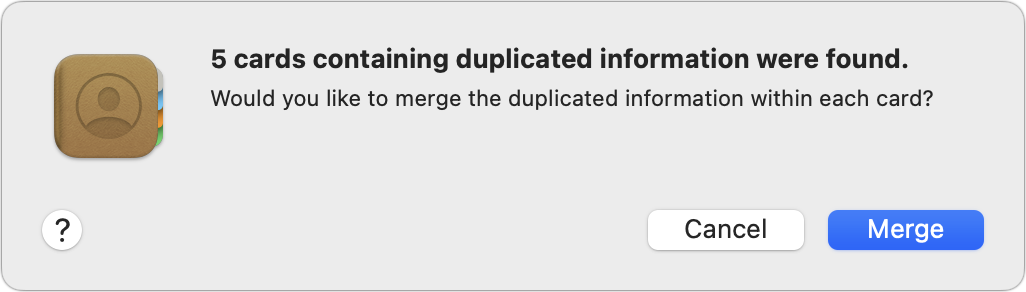
Although merging hundreds of cards can be stressful, it usually works very well, and it’s far faster and easier than the alternative, which is to select each set of duplicates manually and use Merge Selected Cards.
Link Contact Cards
The two previous solutions help when you have duplicate contacts in a single account. Equally annoying can be ending up with contact cards for the same person across multiple accounts. (Check to see what accounts are configured and enabled in Contacts > Preferences > Accounts.) At best, those duplicates will simply clutter your contact list; at worst, you might have to check multiple cards to find the right phone number or email address.
Apple helps you clean up your contact list by linking cards for the same contact across different accounts. (You mustn’t link cards for different people; that can result in people receiving texts meant for others and other confusions.) In essence, this works like Merge Selected Cards, but the separate contact cards remain in their accounts, with Contacts displaying just one card with the combined information.
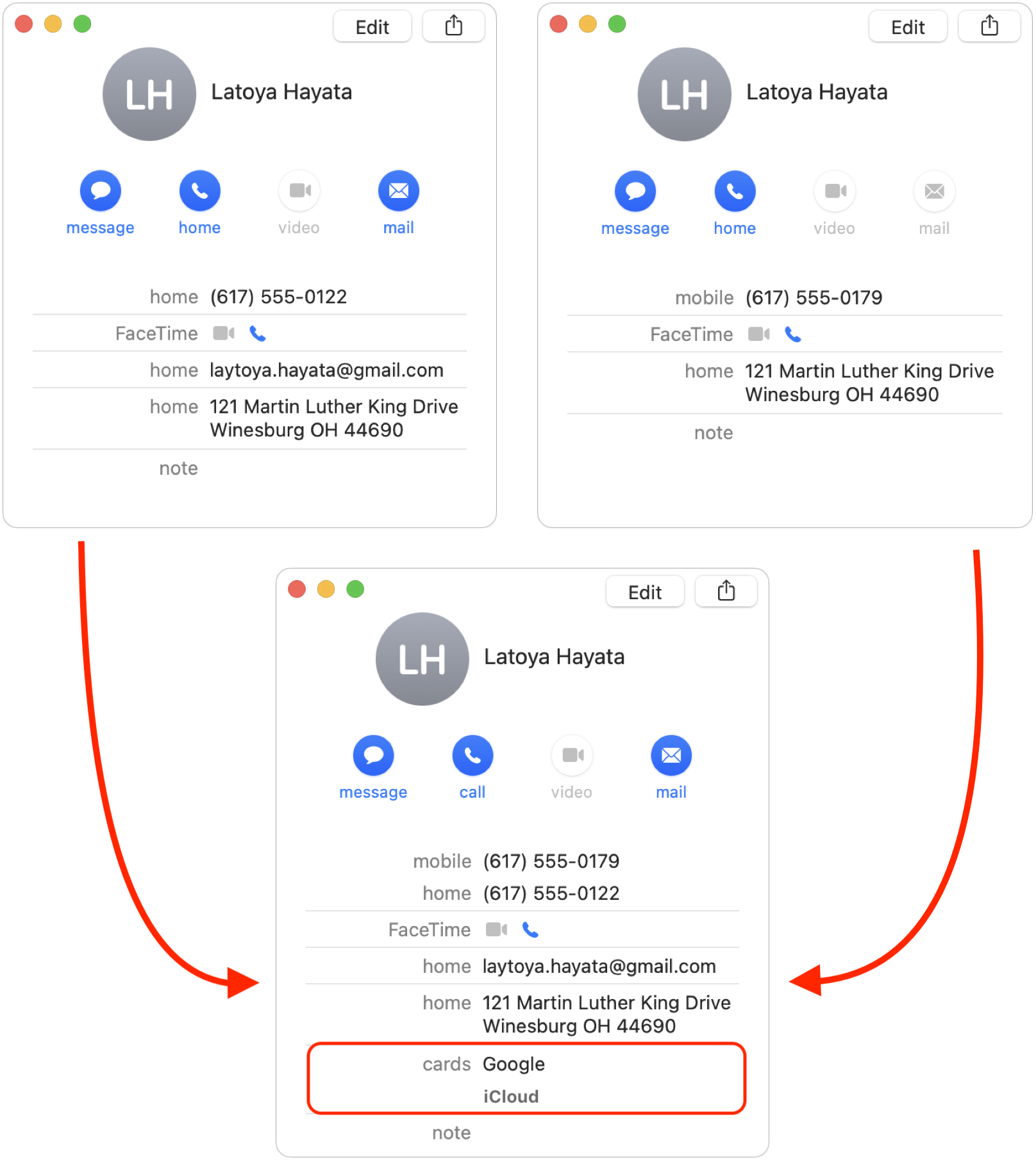
You can also link contacts using the Contacts or Phone apps on an iPhone or iPad, although the steps are much fussier than in Contacts on the Mac:
Find a person who is replicated across multiple accounts, and view one of their contact cards.
Tap Edit, scroll to the Linked Contacts section at the bottom of the card and tap the green + button.
In the contact list that appears, find and tap the second card for the person—it should either be showing or require scrolling up slightly.
Tap Link, and in the next screen, tap Done.
If you accidentally link the wrong cards and need to unlink them, edit the linked card and click or tap the red Remove button to break the link.
Changes you make to a combined card are saved to each separate card. However, if you want to edit one of the cards but not the other, you can view and edit each one separately by clicking the account name next to Cards on the Mac or tapping the appropriate card under Linked Contacts on an iPhone or iPad.
Cleaning up your contact list may not be the most exciting thing to do, but it’s worthwhile to eliminate duplicates that could cause confusion later on.
(Featured image by iStock.com/anyaberkut)
Increase Business Cybersecurity Awareness in Light of Russian Invasion of Ukraine
The Russian invasion of Ukraine is horrific, but the economic sanctions and other responses from Western nations mean that businesses of all sizes need to be more vigilant about cybersecurity. Read on for suggestions:

For several decades, Russia has targeted a wide variety of cyberattacks at countries with which it has had disputes. That includes the United States and other Western nations, which have recently levied unprecedented sanctions against Russia after it invaded Ukraine. President Biden has warned that “Russia could conduct malicious cyber activity against the United States” in response, encouraging the private sector to increase the protection of systems and networks. This isn’t theoretical—the US Cybersecurity & Infrastructure Security Agency lists numerous such attacks in the last five years.
It’s tempting to think that your business is too small or unimportant to be targeted in a Russian cyberattack. While that may be true of direct infiltration by individual Russian hackers, many cyberattacks are carried out indiscriminately by bots—the ultimate is the DDoS (distributed denial of service) attack that uses compromised computers and Internet-of-things devices to flood a targeted server or company with an unmanageable amount of random Internet traffic. Plus, a common hacking approach is to compromise an account on one seemingly unrelated system as a stepping stone to another, more secure system.
There’s nothing new here—we’ve been encouraging everyone to take cybersecurity seriously for years now. But the threat is now more serious than ever before. So, here’s what we suggest—if you need help with any of this, don’t hesitate to contact us.
Be vigilant: The most common way that hackers gain entry into computer systems is through an employee opening a malicious attachment or being fooled into entering credentials into a fake website. Implement or refresh security awareness training that teaches employees how to recognize suspicious email, identify phishing attempts, and report appropriately.
Use good password practices: Make sure that everyone uses strong, unique passwords that are created, stored, and entered using a password manager. Password managers also identify weak passwords and those that have been compromised in security breaches—ask everyone to audit their passwords and update any that aren’t secure. (But there’s no reason to change good passwords willy-nilly.)
Implement 2FA: Whenever possible, require two-factor authentication, which provides extremely strong protection against remote intrusion given that a compromised password is no longer sufficient.
Keep software up to date: Install all software and operating system updates on all platforms. In its security update notes, Apple often says that particular vulnerabilities are actively being exploited—it’s crucial to install such updates immediately. If you use anti-malware software (essential for Windows; less so for macOS), keep its signatures current.
Backup regularly: Ensure that all systems are backed up regularly, and for your most important data, make sure backups are protected from ransomware encryption by storing them offline or using object locking on a cloud storage service. Be sure to test your backups regularly as well—backing up is the first step, but being able to restore is what’s necessary.
Increase monitoring: Keep a centralized record of all employee reports of suspicious behavior to better identify attack patterns and targeted systems. Whenever possible, make sure server and network device logging is enabled so any incidents can be investigated more fully. Turn on any anomaly reporting capabilities in backup and other security-related apps.
Plan for the worst: Develop or revisit business continuity and crisis response plans. For instance, discuss how you’d deal with losing Internet connectivity, being locked out of key online accounts, or having all your data rendered inaccessible by ransomware.
There’s no reason to panic, but the increased threat from Russian cyberattacks is a good excuse to focus more attention on digital security. The Internet makes astonishing things possible, but it also opens us up to attacks that would previously have been inconceivable. Stay safe out there.
(Featured image by iStock.com/BeeBright)
How Much Memory Do You Need in an M1-Based Mac?
Unified memory in the M1-based Macs boasts increased efficiency and performance but can’t be expanded after purchase. How much should you get when you buy a new Mac? Read on for our advice:
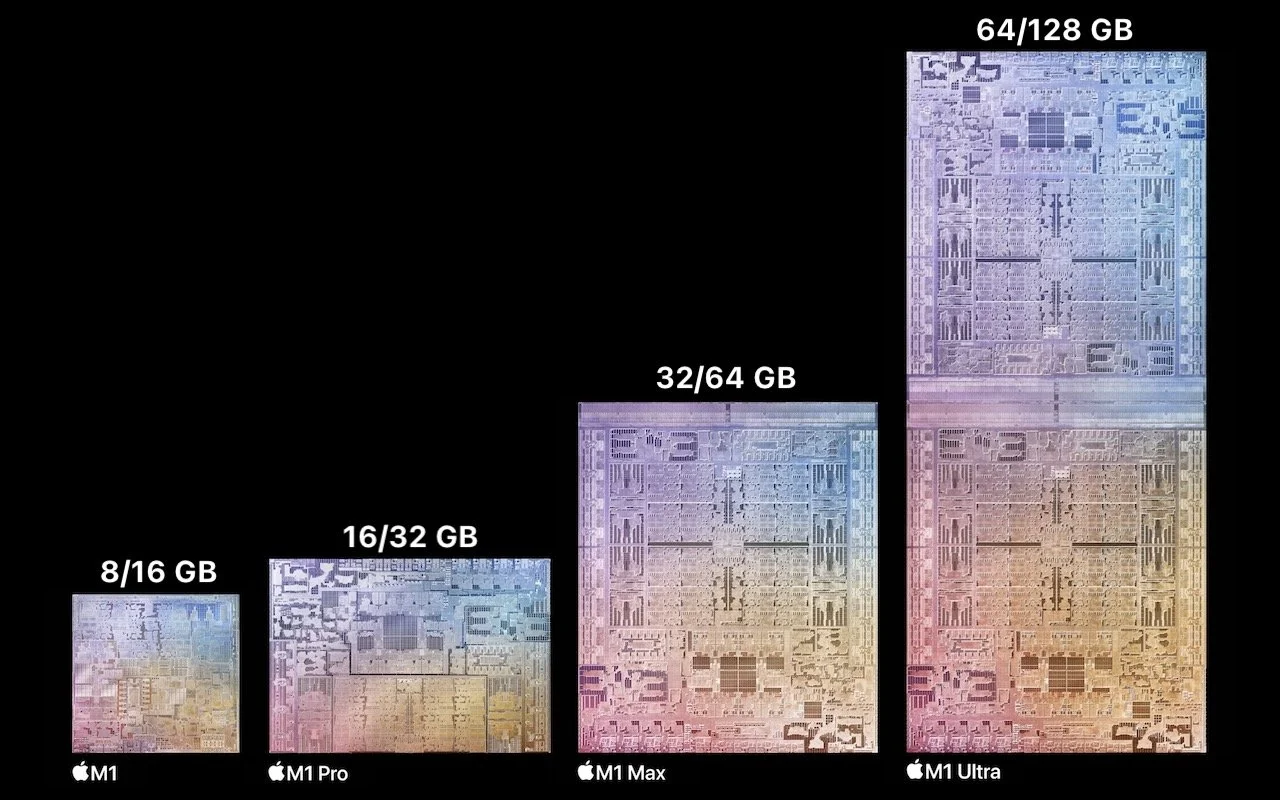
If you’re thinking about buying a new Mac, you’re almost certainly planning to get one that uses a chip from Apple’s M1 family—the M1, M1 Pro, M1 Max, and M1 Ultra. Only the Mac Pro and one Mac mini configuration still rely on Intel CPUs, and they will likely be discontinued before the end of 2022. That’s not a bad thing—the M1 chips offer astonishing performance combined with low power consumption. But the move from Intel chips to Apple silicon has changed the game when it comes to one decision: how much memory to get.
That’s because Apple completely rearchitected how M1-based Macs incorporate memory. On Intel-based Macs that have separate CPU and GPU chips, each chip has its own memory. For instance, the base level Mac Pro comes with 32 GB of RAM on user-replaceable memory sticks, while its Radeon Pro graphics card has 8 GB of memory. The main advantage of this approach is that you can install more system memory if you need it—up to 1.5 TB at purchase time or later—and you can opt for one or even two video cards with up to 64 GB of memory. But that sort of flexibility was available only for the Mac Pro, Mac mini, and now-discontinued 27-inch iMac—with Apple’s laptops, you couldn't upgrade memory because it was soldered onto the logic board, not socketed.
For M1-based Macs, Apple went even further and built “unified memory” directly on-to the M1 chip itself. This provides significant performance benefits for two reasons:
Shared memory pool: The M1 chips contain CPU cores, GPU cores, and Neural Engine cores, all of which need to use memory. By creating a shared pool of memory—hence the “unified memory” name—each processor can operate on the same data in memory rather than sending it back and forth from chip to chip. That’s both faster and more efficient.
Higher memory bandwidth: By building memory onto the M1 chips them-selves, Apple could also speed up the connection between memory and the various processors. Communication between on-chip components is much faster than when data has to travel back and forth between chips across the circuitry of the logic board and graphics card, as was the case for Intel-based Macs.
The downside of unified memory is that you’re stuck with how much you choose when you buy a Mac—there’s no way to upgrade the memory later. Given that only certain Macs have particular M1 chips, figuring out how much you need gets a little complicated.
For instance, if you want a MacBook Air, you can only choose between 8 GB and 16 GB of memory. However, if you are interested in the 14-inch MacBook Pro, you can get either an M1 Pro or M1 Max, and which chip you choose determines whether you can opt for 16 GB, 32 GB, or 64 GB of memory. Here are your choices, with each chip offering two options:
M1: 8 GB and 16 GB. Used in the MacBook Air, 13-inch MacBook Pro, Mac mini, and 24-inch iMac. The 16 GB option adds $200 to the price.
M1 Pro: 16 GB and 32 GB. Used in the 14-inch and 16-inch MacBook Pro. The 32 GB option adds $400 to the price.
M1 Max: 32 GB and 64 GB. Used in the 14-inch and 16-inch MacBook Pro and Mac Studio. The 64 GB option costs an additional $400, half the price per gigabyte of the M1 and M1 Pro memory upgrades.
M1 Ultra: 64 GB and 128 GB. Used solely in the Mac Studio. The 128 GB option costs an additional $800, matching the M1 Max’s price per gigabyte.
With all that background in your head, here are some questions to guide your decision:
What sort of user are you? For average users who use Safari, Mail, Photos, and the apps in Apple’s iWork suite, an M1 Mac with 8 GB is probably sufficient, although $200 isn’t that much more to pay for 16 GB. If you regularly work with photos, audio, or video, a Mac with an M1 Pro or M1 Max would likely be more appropriate, and the larger the files you work with, the more memory you should get. Only those with the highest performance demands, such as a video professional working with 8K video or data scientist, should consider a Mac Studio with an M1 Ultra—if you’re at that level, you probably know if you need 64 GB or 128 GB.
How much RAM do you have now? Another way to approach the problem is to think about how much RAM your current Intel-based Mac has, and if that’s enough. (Look at the Memory Pressure graph in the Memory tab of Activity Monitor—if it’s regularly yellow or red, you need more memory.) The increased performance and efficiency of memory use on the M1 chips suggest that you can get away with the same amount or even less than you have now while still enjoying improved performance. We recommended 16 GB as the minimum for Intel-based Macs, but 8 GB seems to be an acceptable base level for M1-based Macs.
Do you anticipate increased memory needs? The hardest part of the decision is looking into the future and thinking about whether a certain amount of memory will be sufficient in several years. It’s never a bad idea to buy more memory than you think you need now to plan for the future—just more expensive. For example, if you’re on the fence between 16 GB and 32 GB with an M1 Pro-based Mac, $400 may be a reasonable price to pay for some future-proofing.
In the end, you’ll never regret having more memory, though you may dislike paying for it now. If cost is a real problem, you’re probably better off getting more memory and less internal SSD storage, since you can always add more external storage. Regardless, feel to reach out for help choosing the right Mac and memory configuration.
(Featured image by Apple)
Apple Wows with Mac Studio and Studio Display, Updates iPhone SE and iPad Air
At its March 8th Peek Performance event, Apple unveiled the impressive new Mac Studio—powered by the M1 Ultra chip—and Studio Display. The company also introduced an updated iPhone SE and iPad Air. Read on for details:

At its March 8th Peek Performance event, Apple freshened its iPhone and iPad product lines with a new third-generation iPhone SE and fifth-generation iPad Air, along with new green hues for the iPhone 13 line. Then Apple focused on the big announcements of the day: the entirely new Mac Studio, powered by the insanely fast M1 Ultra chip and accompanied by the stunning 27-inch Studio Display.
Mac Studio with M1 Ultra and Studio Display Redefine the Mac Lineup
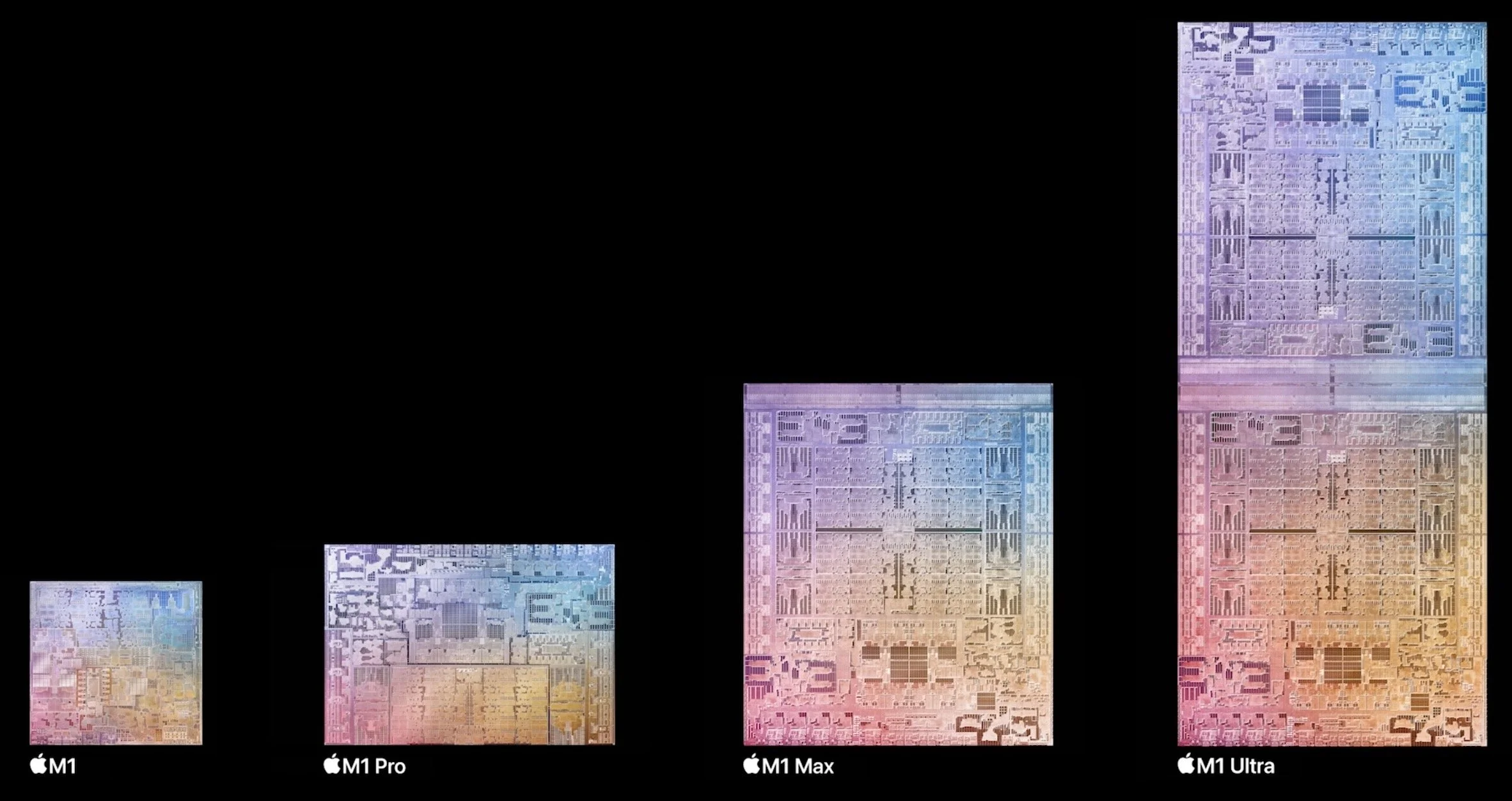
In 2020, Apple started to transition Macs away from Intel processors to Apple silicon, beginning with the M1 system-on-a-chip and a year later adding the even more powerful M1 Pro and M1 Max to the family. The performance of those chips, particularly when measured against their low power requirements, was stellar. Apple has now unveiled the M1 Ultra, which bonds two M1 Max chips together for double the performance.
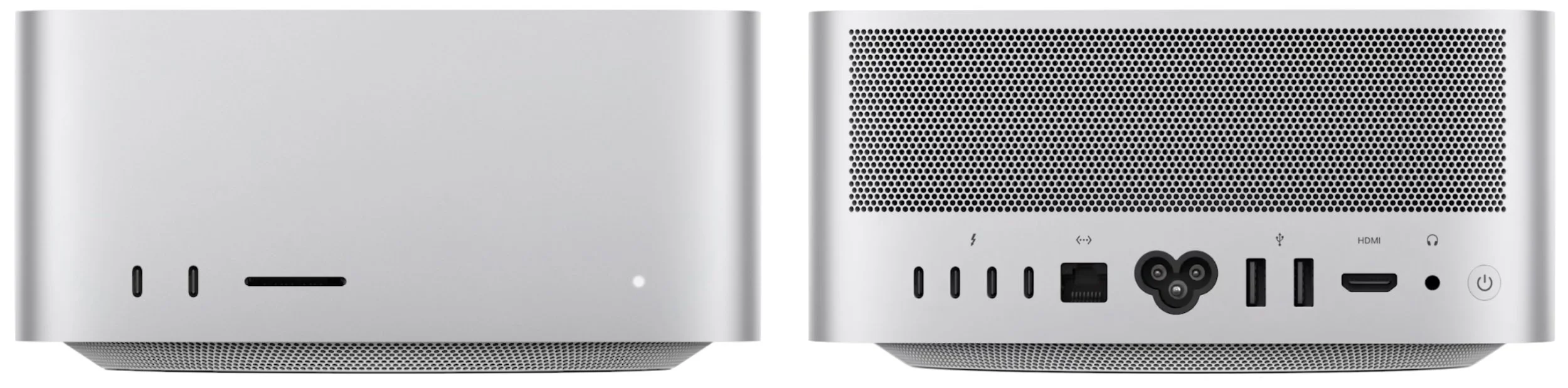
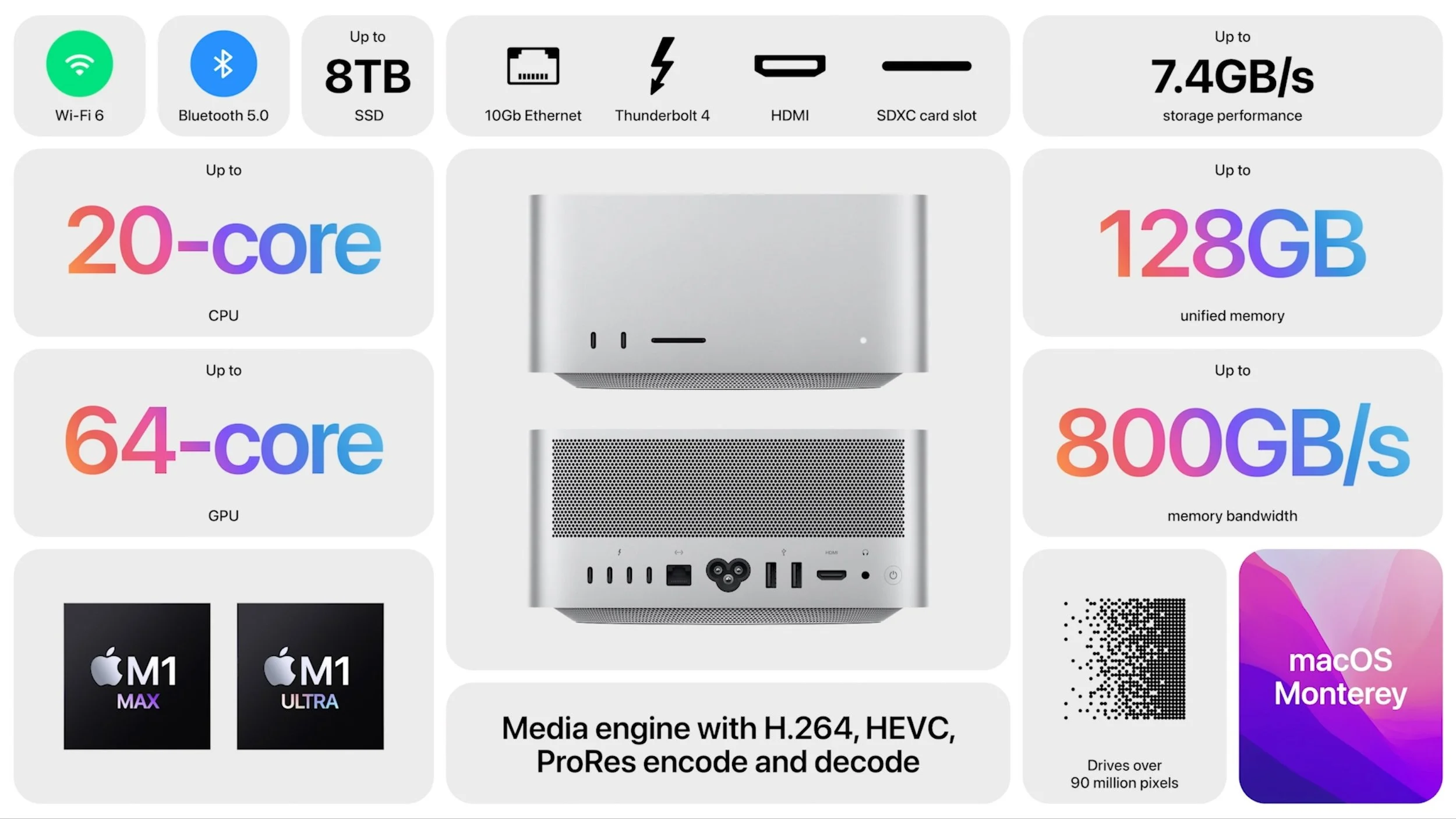
To hold the M1 Ultra—or a less expensive M1 Max—Apple introduced an entirely new Mac that looks like an inflated Mac mini. The Mac Studio has the same 7.7-inch (19.7 cm) square outline, but is more than twice as tall, clocking in at 3.7 inches (9.5 cm) high. Much of that vertical space is occupied by cooling fans, but Apple says the Mac Studio makes minimal noise.
The Mac Studio also expands the Mac mini’s price, with the M1 Max model starting at $1999 and the M1 Ultra model at $3999. You can kit a Mac Studio out with an impressive set of options:
Chip: For $1999, the M1 Max model offers 10 CPU cores, either 24 or 32 (add $200) GPU cores, and 16 Neural Engine cores. The $3999 M1 Ultra model doubles those numbers with 20 CPU cores, 48 or 64 ($1000) GPU cores, and 32 Neural Engine cores.
Memory: With the M1 Max, you can choose between 32 GB or 64 GB ($400) of unified memory. With an M1 Ultra, you can opt for either 64 GB or 128 GB ($800) of unified memory.
Storage: Internal SSD storage starts at 512 GB, with options of 1 TB ($200), 2 TB ($600), 4 TB ($1200), and 8 TB ($2400).
Because of Apple’s focus on creative professionals, the Mac Studio offers a solid set of ports. On the back, it has four Thunderbolt 4 ports, a 10-gigabit Ethernet port, two USB-A ports, an HDMI port, and a 3.5 mm headphone jack. 802.11ax Wi-Fi 6 is built in, as is Bluetooth 5.0. For ease of access, Apple finally put ports on the front, too. The M1 Max model features two USB-C ports, whereas the M1 Ultra model offers two Thunderbolt 4 ports. Both provide an SDXC card slot.
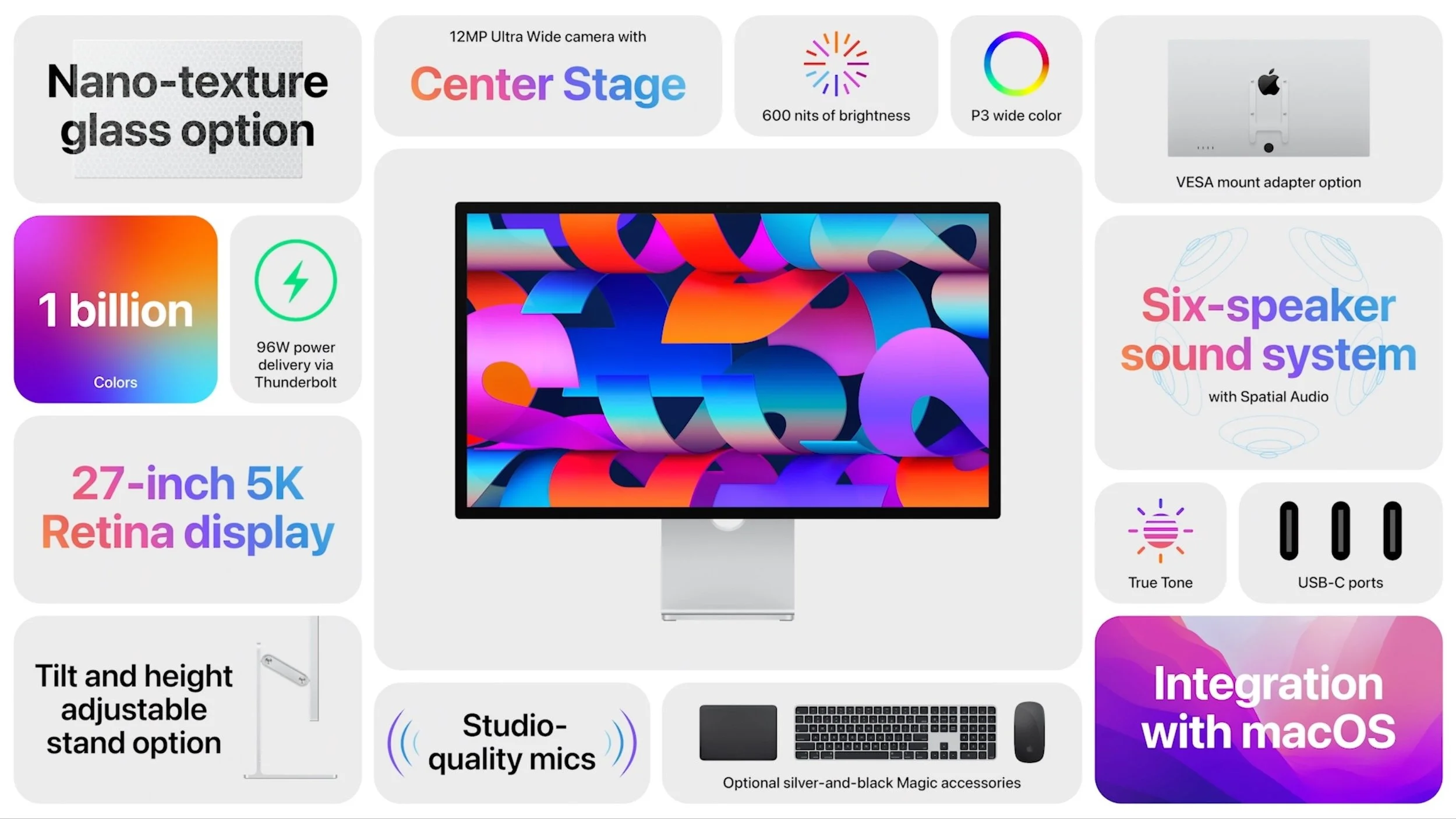
To address the Mac Studio’s lack of a screen, Apple introduced the $1599 Studio Display. It’s a 27-inch 5K Retina display with a native resolution of 5120-by-2800, P3 wide color, and True Tone technology. Nano-texture glass is a $300 option if you need less reflectivity. There are three stand options: a 30º tilt default, a VESA mount adapter, or a tilt- and height-adjustable stand for $400 more. Note that you can’t swap one for another later. The Studio Display offers one Thunderbolt 3 port to connect to a Mac—complete with 96-watt charging—and three USB-C ports for connecting peripherals.
What sets the Studio Display apart from other monitors is that it uses an A13 Bionic chip—the same brains in the iPhone 11—to power a 12-megapixel Ultra Wide camera with Center Stage (Apple’s technology for smoothly keeping you in the frame as you move around on a video call), a three-mic array with directional beamforming, and a high-fidelity six-speaker system. In short, this is the ultimate Mac videoconferencing setup. It even supports spatial audio when playing music or video with Dolby Atmos, and you can use “Hey Siri” with it.
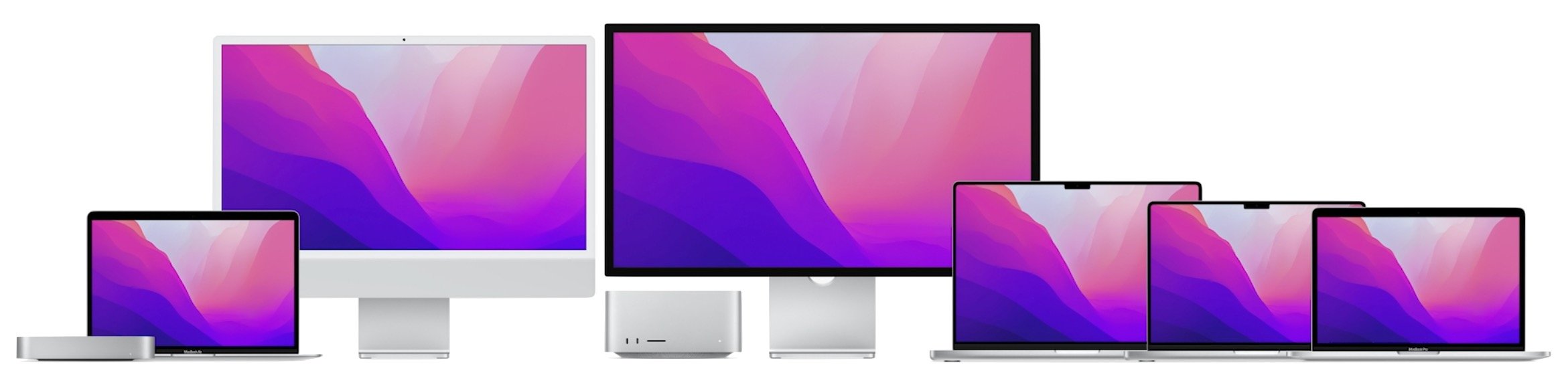
There’s one other fact you need to know before we put all this together: Apple said that the only remaining Mac to transition to Apple silicon is the Mac Pro, which means that it’s dropping the popular 27-inch iMac from the lineup. We’re sad since that iMac was a terrifically good deal, but if you’ve been waiting for an Apple silicon 27-inch iMac, the Studio Display suggests four alternative directions, depending on your needs. Remember that even the entry-level M1 chip outperforms the most recent Intel-based 27-inch iMac.
Minimize desktop cost: If keeping costs down while sticking with Apple-designed desktop gear is important to you, couple a Mac mini with the Studio Display.
Maximize desktop performance: Need the maximum performance on your desk? A Mac Studio driving one or more Studio Displays is the ultimate professional setup today.
Minimize portability cost: Those who need portability and desktop screen real estate can get both without breaking the bank by combining a MacBook Air or 13-inch MacBook Pro and the Studio Display.
Maximize portability performance: For top-notch portability, performance, and productivity, a 14-inch or 16-inch MacBook Pro is unbeatable when matched with one or even two Studio Displays.
Finally, don’t discount the 24-inch iMac. Although its screen is smaller than the 27-inch iMac’s, its Retina screen resolution isn’t far off, and it’s notably less expensive. If you mostly like the all-in-one nature of the 27-inch iMac and don’t need the performance of the Mac Studio or MacBook Pro, you won’t go wrong with a 24-inch iMac.
Both the Mac Studio and Studio Display are available to order now, with shipments starting on March 18th, although demand is already pushing some ship dates into April. Note that the Mac Studio doesn’t include any input devices, but Apple also introduced a new silver-and-black Magic Keyboard with Touch ID and Numeric Keypad ($199), Magic Mouse ($99), and Magic Trackpad ($149) designed to complement the Studio Display.
Third-generation iPhone SE Gains A15 Bionic and Better Camera
Not everyone wants—or at least wants to pay for—the latest and greatest. For those looking for a small iPhone at a reasonable price, the new third-generation iPhone SE is still a bargain. Prices start at $429 thanks to its 4.7-inch screen in an iPhone 8 design and Touch ID-enabled Home button. That’s $30 more than the previous generation, but you get the same A15 Bionic chip that’s in the iPhone 13 line and Apple’s promise that iOS will support it for years to come. The new iPhone SE also gains 5G support for faster cellular Internet connectivity, though it doesn’t support the fastest millimeter-wave flavor of 5G.
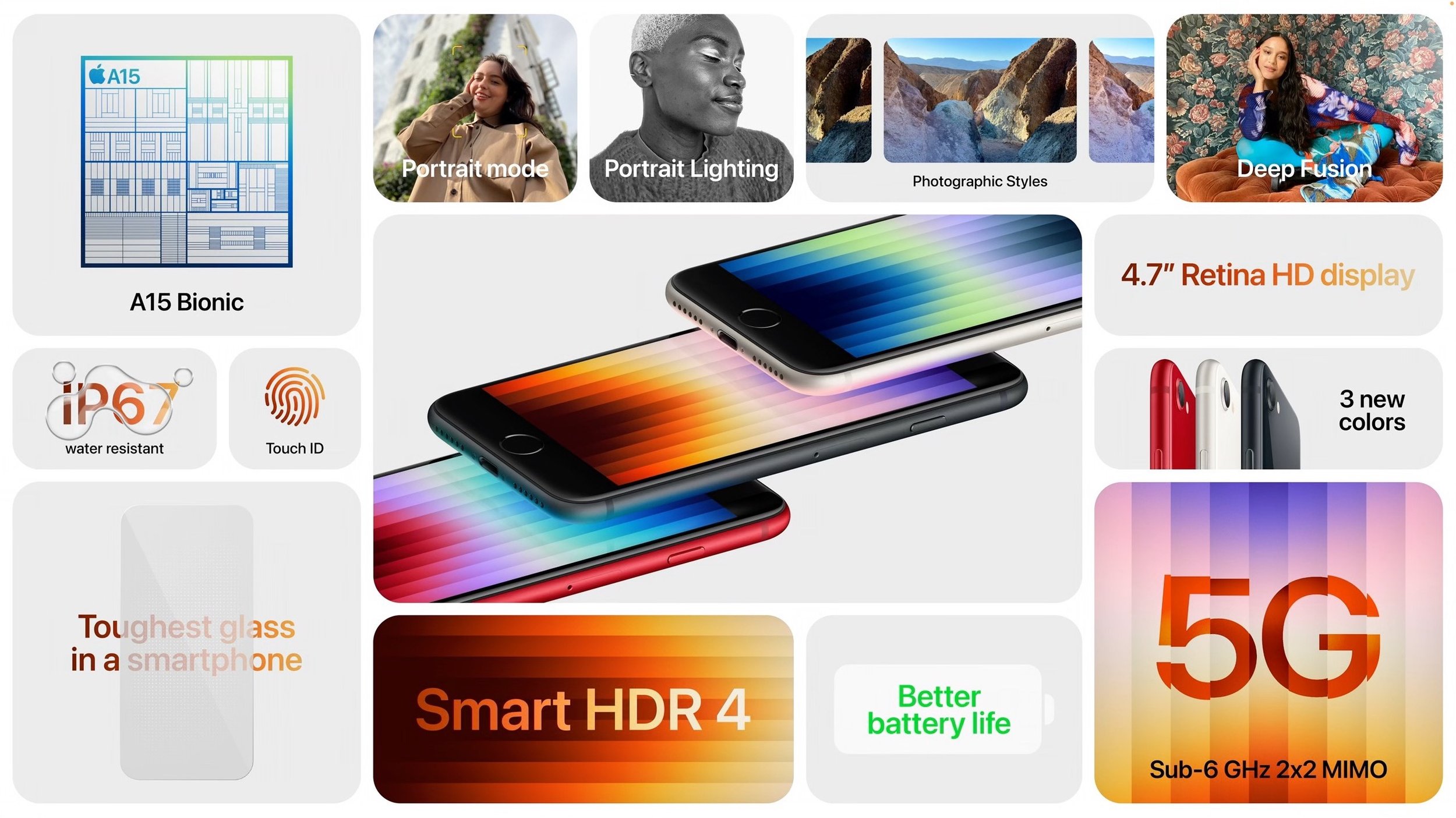
The A15 Bionic’s processing power enhances the 12-megapixel camera, providing computational photography capabilities like Smart HDR 4, Photographic Styles, Deep Fusion, and Portrait mode. The A15 Bionic’s image signal processor also improves video quality, particularly in low-light situations. Despite the increased performance, Apple says the new iPhone SE features better battery life than the second-generation iPhone SE and all previous 4.7-inch iPhone models. (Generally speaking, the bigger the iPhone, the better the battery life, thanks to additional room inside.)
You can order the new iPhone SE, which comes in midnight (black), starlight (white), and PRODUCT(RED), starting at 8 AM Eastern on March 11th, with delivery starting on March 18th. The 64 GB model costs $429, 128 GB costs $479, and 256 GB is $579.
Fifth-generation iPad Air Moves to M1 and 5G
For many people, the $599 iPad Air is the sweet spot of the iPad line, fitting nicely between the $329 iPad and the $799 11-inch iPad Pro. However, the fourth-generation iPad Air had fallen behind in a few ways, making its price less palatable.
The new fifth-generation iPad Air makes the price compelling again, thanks to the move to the same M1 chip used in the iPad Pro (and many Macs). It boasts up to 60% faster CPU performance than the previous model and twice the graphics performance. Even more noticeable in this age of videoconferencing is the addition of an Ultra Wide front-facing camera with Center Stage. Those who need speedy connectivity on the go will appreciate the new 5G support, though it doesn’t support the fastest millimeter-wave 5G. Apple also doubled the throughput for the iPad Air’s USB-C port, but it remains slower than the Thunderbolt port in the iPad Pro models.
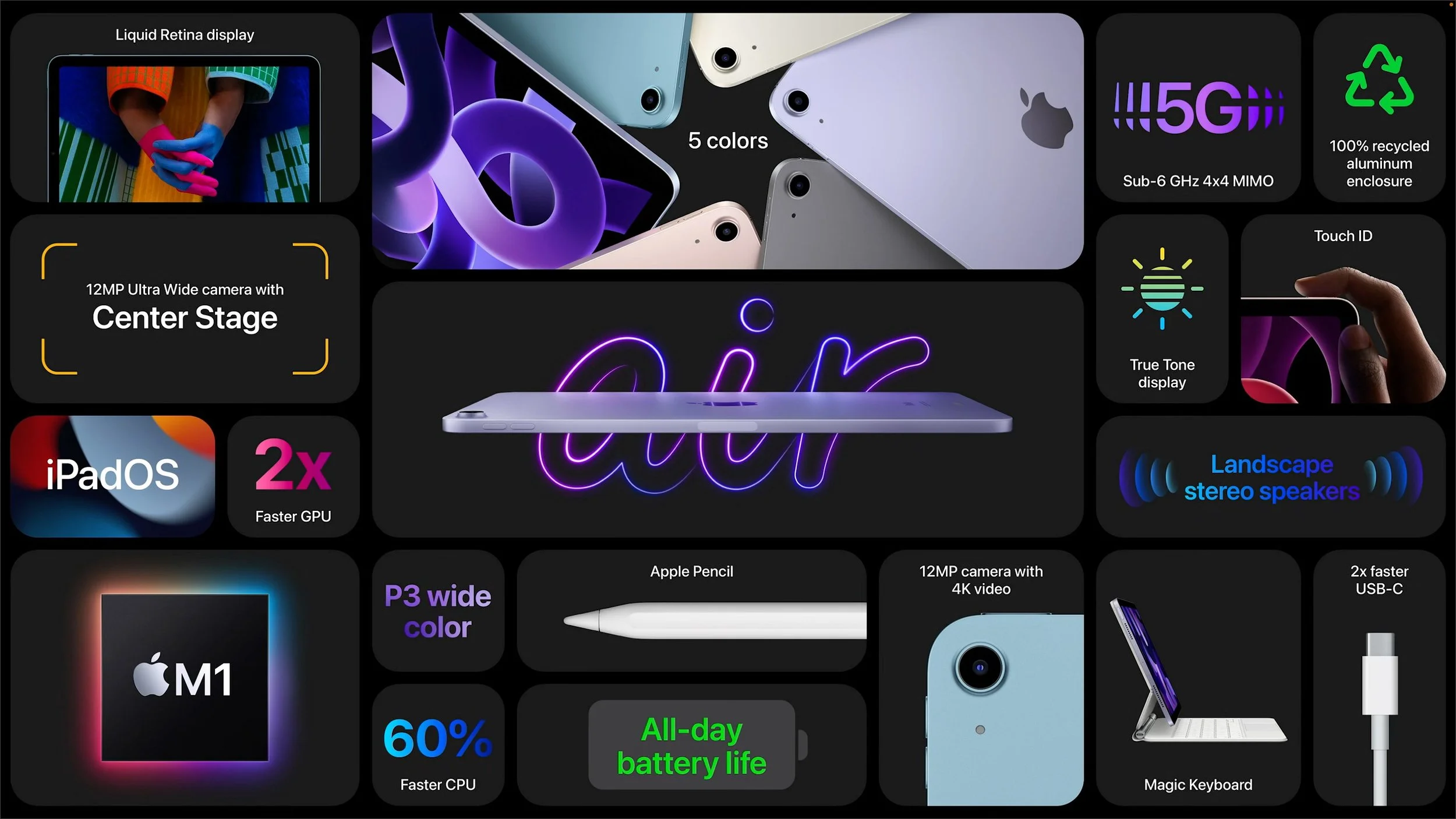
Other key specs remain the same, including the size and industrial design, Touch ID in the top button, support for the second-generation Apple Pencil, rear-facing camera, and battery life.
As with the new iPhone SE, pre-orders for the new iPad Air open at 8 AM Eastern on March 11th, with delivery starting on March 18th. It comes in five new colors: space gray, pink, purple, blue, and starlight (white). $599 gets you 64 GB of storage, whereas 256 GB costs $749. Add another $150 for a cellular-capable model.
(Featured image by Apple)
Apple Works to Improve Safety in the Wake of AirTag Stalking Reports
Media reports suggest that miscreants are trying to use Apple’s AirTag location trackers to stalk people. Apple has responded with personal safety advice and promised AirTag safety enhancements.
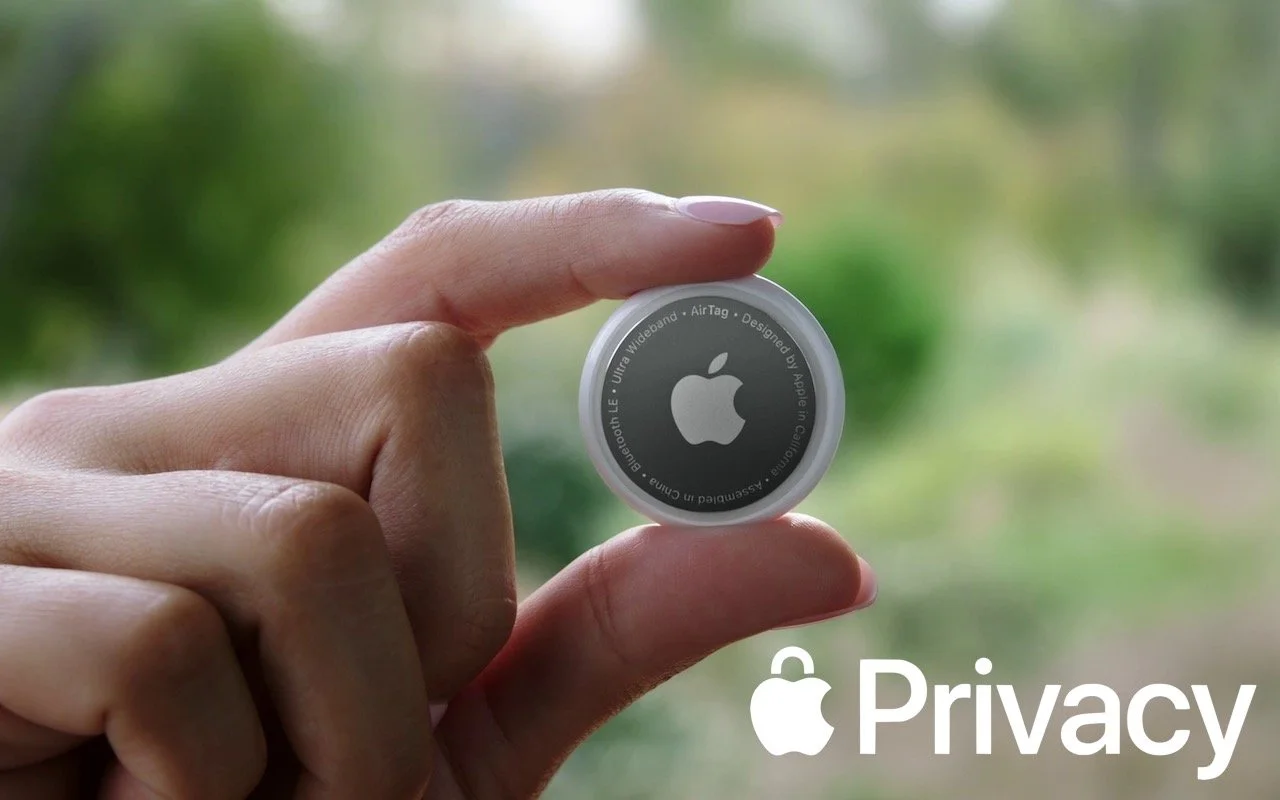
Over the past few months, there has been a spate of media reports about how people may have been tracked without their knowledge using AirTags, Apple’s elegant location trackers. Like many mainstream media forays into the tech world, the reports are often short on detail and sometimes unclear on the reality of how the AirTags work. Nor is it clear that there have been many successful cases of AirTag abuse, but the mere fact that people are trying to use AirTags to stalk others is concerning.
Apple put significant effort into preventing such abuses, revolving around three features:
Safety alerts: If you have an iPhone or iPad running iOS 14.5 or later and an unknown AirTag is traveling with you, your device will alert you to that fact. Although safety alerts aren’t available for those using Android smartphones, Android users can download Apple’s Tracker Detect app to scan manually.
Safety sounds: After an AirTag has been separated from its owner for several days, it will make a sound the next time it moves.
NFC identification: If you find an AirTag, you can hold it up to an iPhone or other NFC-capable smartphone to load a website that reveals the AirTag’s serial number and the last four digits of the owner’s phone number. The police can use this information to learn the owner’s identity from Apple.
Sadly, those precautions haven’t been sufficient either to dissuade all would-be stalkers or to educate potential stalking victims (and let’s be real—dissuading stalkers is also a matter of educating people that it’s unethical, likely dangerous, and often illegal to abuse an AirTag in this way). Apple has responded in two ways, one general, the other specific to AirTags.
Personal Safety User Guide
Apple documents its products and services quite well, but the company tends to generate many focused pages without much high-level organization. It’s all too easy to flail around within Apple’s support documentation looking for help if you don’t know what search terms are likely to work. In an effort to mitigate that problem for issues surrounding personal safety, Apple has created the Personal Safety User Guide website, also available as a downloadable 56-page PDF.
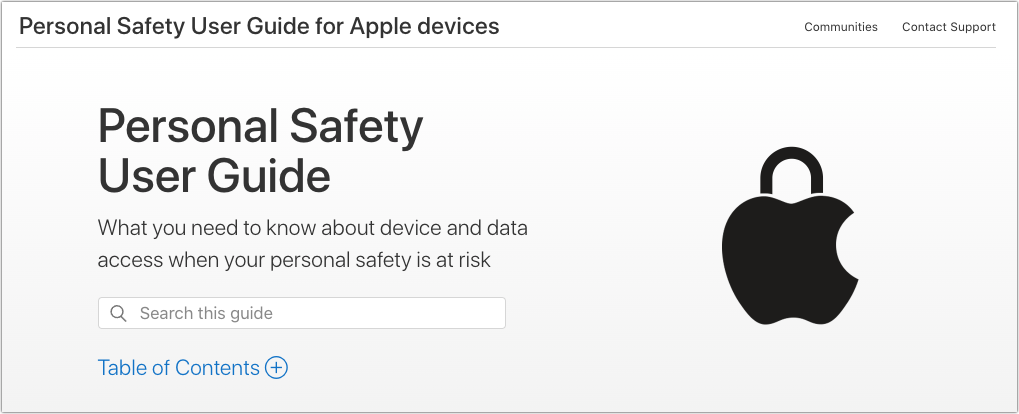
The Personal Safety User Guide brings together numerous Apple support articles in two main sections:
Review and take action: The first section helps you review how your devices and apps are set up, with a focus on settings that could expose you to harm. It helps you manage sharing settings, look at location sharing, control your Home accessories, and more. You’ll also learn how to block unknown sign-in attempts, document suspicious activity, delete suspicious content, and avoid fraudulent requests to share information, among much else. The main criticism here is that the section on AirTag safety doesn’t explain or link to all the features Apple provides.
Safety and privacy tools: The second section is a bit more generic, providing support documentation that encourages you to take advantage of the features Apple has provided to protect your safety and privacy. Among other topics, it discusses passcodes, setting up Face ID and Touch ID, using two-factor authentication, seeing which apps are accessing your data, blocking unwanted calls and messages, and using Emergency SOS.
The Personal Safety Guide ends with three checklists, each of which walks you through a series of steps. These are extremely useful because almost no one would necessarily know or remember all the places to check. The checklists help you:
See who has access to your device or accounts
Stop sharing with someone
Control how someone else can see your location
The Personal Safety User Guide website is best when you want an answer to a specific question, but it doesn’t lend itself to reading front to back. For that, we recommend downloading the PDF, which you can read at whatever depth you desire. But do at least scan the entire thing to get a sense of what it contains should you need that information later.
Apple AirTag Announcement
Shortly after releasing the Personal Safety Guide, Apple also posted a short but detailed statement on its website. In it, the company makes it clear that it is actively working with law enforcement on all cases involving AirTag abuse. Apple also says that it has updated its unwanted tracking documentation to explain AirTag safety features more clearly to users and to include resources for those who feel their safety is at risk.
Apple also outlined important advancements that will be coming to the AirTag and Find My network systems via software updates later this year:
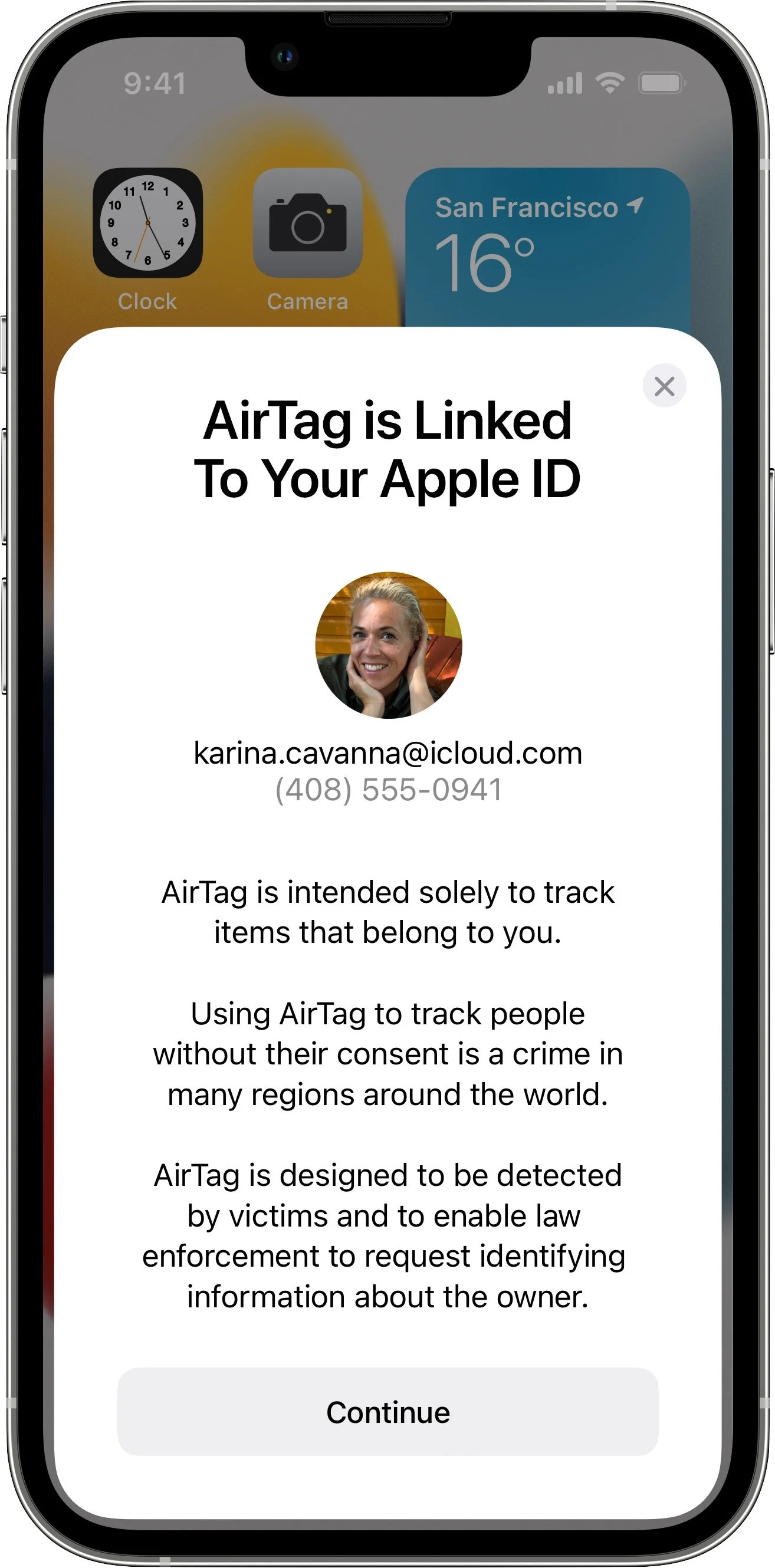
New privacy warnings during AirTag setup: To ensure that everyone understands the utility of AirTags and the implications of abuse, people setting up an AirTag for the first time will see a message that clearly states that AirTags are meant to track their own belongings, that tracking people without their consent is a crime in many places, that AirTags are designed to alert victims to their presence, and that law enforcement can request identifying information about the owner of an AirTag.
Better alerts for AirPods: Instead of an “Unknown Accessory Detected” alert when your iPhone detects Find My network-compatible AirPods traveling with you, the alert will specify that AirPods are involved, not an AirTag. (There are third-party Find My network accessories that will still generate this alert, such as the Chipolo ONE Spot.)
Refined unwanted tracking logic: Apple will be updating its unwanted tracking alert system to notify users sooner that an unknown AirTag or Find My network accessory is traveling with them.
Precision Finding for unknown AirTags: Those with an iPhone 11, iPhone 12, or iPhone 13 will be able to take advantage of Find My’s Precision Finding feature to home in on the location of an unknown AirTag. Previously, this capability was limited to your own AirTags.
Display alerts with unknown AirTag sound: When an unknown AirTag emits a sound to alert anyone nearby to its presence, and it’s detected moving with your iPhone or iPad, an alert will also appear to help you play the sound again or use Precision Finding, if available. This should help when an unknown AirTag is in a place that blocks sound or if its speaker has been disabled.
More obvious AirTag alert sound: Apple will be adjusting the tone sequences to make an unknown AirTag’s alert sound easier to hear and find.
Overall, these changes are welcome, and it’s a testament to the care Apple took when designing the AirTag and Find My network systems that it can make such enhancements through software updates—no hardware changes are necessary. It’s also good to see Apple taking the problem—however small it might actually be—seriously and working to reduce it even further.
(Featured image by Apple)