
Use the Hidden Album in Photos to Hide Private Images
Although it’s safest to keep all NSFW images off your iPhone entirely, if you have photos that could be embarrassing or legally troublesome if the wrong person were to stumble across them, protect them using the Hidden album in Photos.

We’ve recently heard from people who have been embarrassed when they gave their iPhone to someone to swipe through some innocuous photos of a vacation, only to have the person swipe too far and end up at some NSFW (not safe for work) images. Ouch.
Embarrassment might be low on the list of problems such photos could cause. It’s not hard to imagine a male supervisor innocently sharing photos with a female employee but ending up embroiled in a sexual harassment situation if she were to stumble across the kinds of NSFW photos that regularly land politicians in hot water.
It’s safest to avoid taking NSFW photos to start, especially if the iPhone is a work-managed device. If that’s unrealistic, we recommend deleting any NSFW images from the iPhone as soon as feasible. A third option may be the best solution in the modern world—the Hidden album Apple provides in the Photos app on the iPhone, iPad, and Mac. On the iPhone and iPad, you’ll find it with other albums in the Utilities collection. On the Mac, it appears in the sidebar under Photos. (If you don’t see it, you may have hidden it—we explain how to unhide it below.)
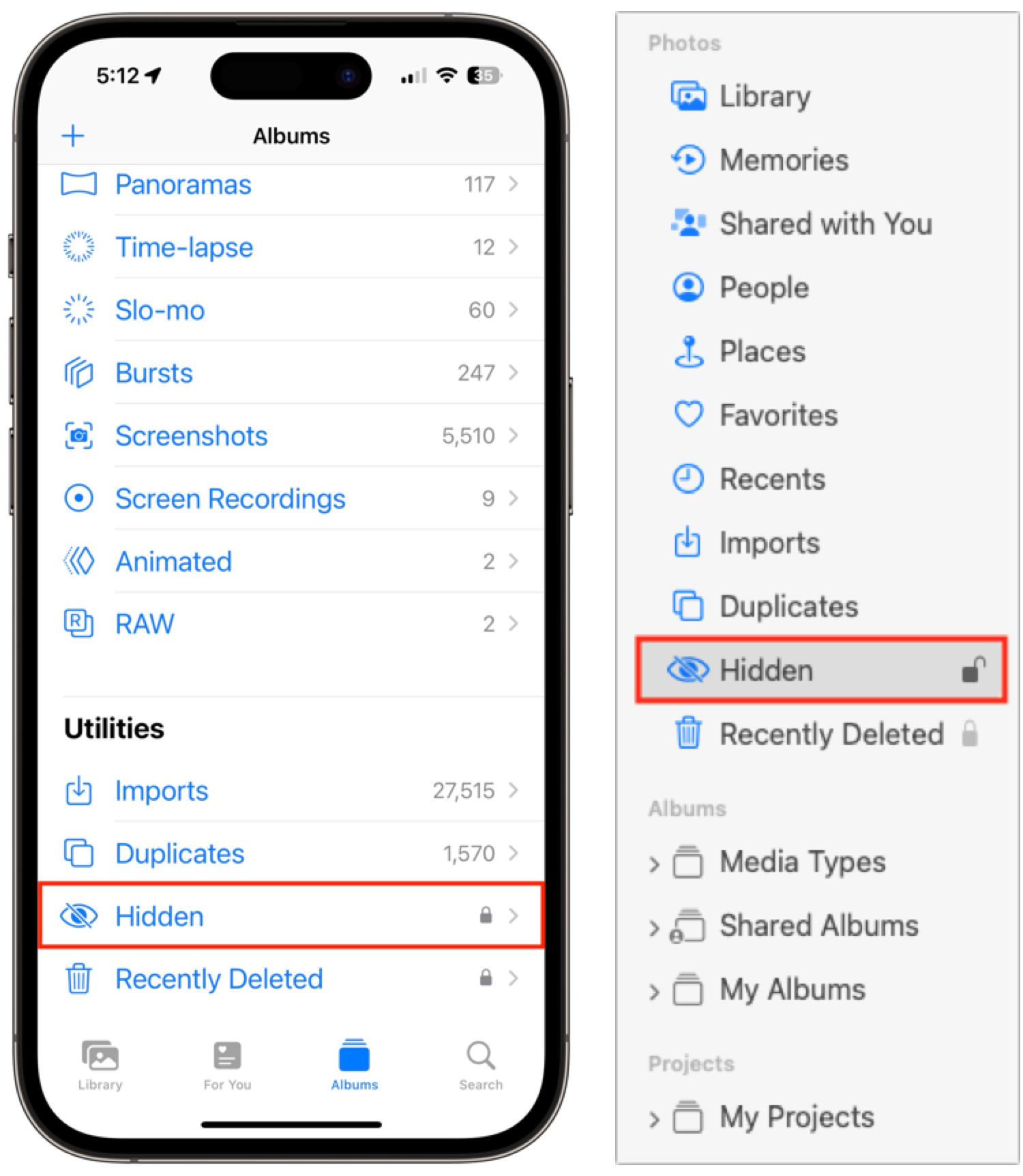
There are four essential things to know about the Hidden album:
You don’t add photos to the Hidden album by dragging or using an Add to Album option. Instead, you choose Hide from a contextual menu. On the iPhone and iPad, touch and hold a photo (or a set of selected photos) and tap Hide in the menu that appears. Or tap the ••• button and choose Hide. On the Mac, select one or more photos, Control-click them, and choose Hide X Photos. To remove a photo from the Hidden album, use the same approach with the Unhide command.
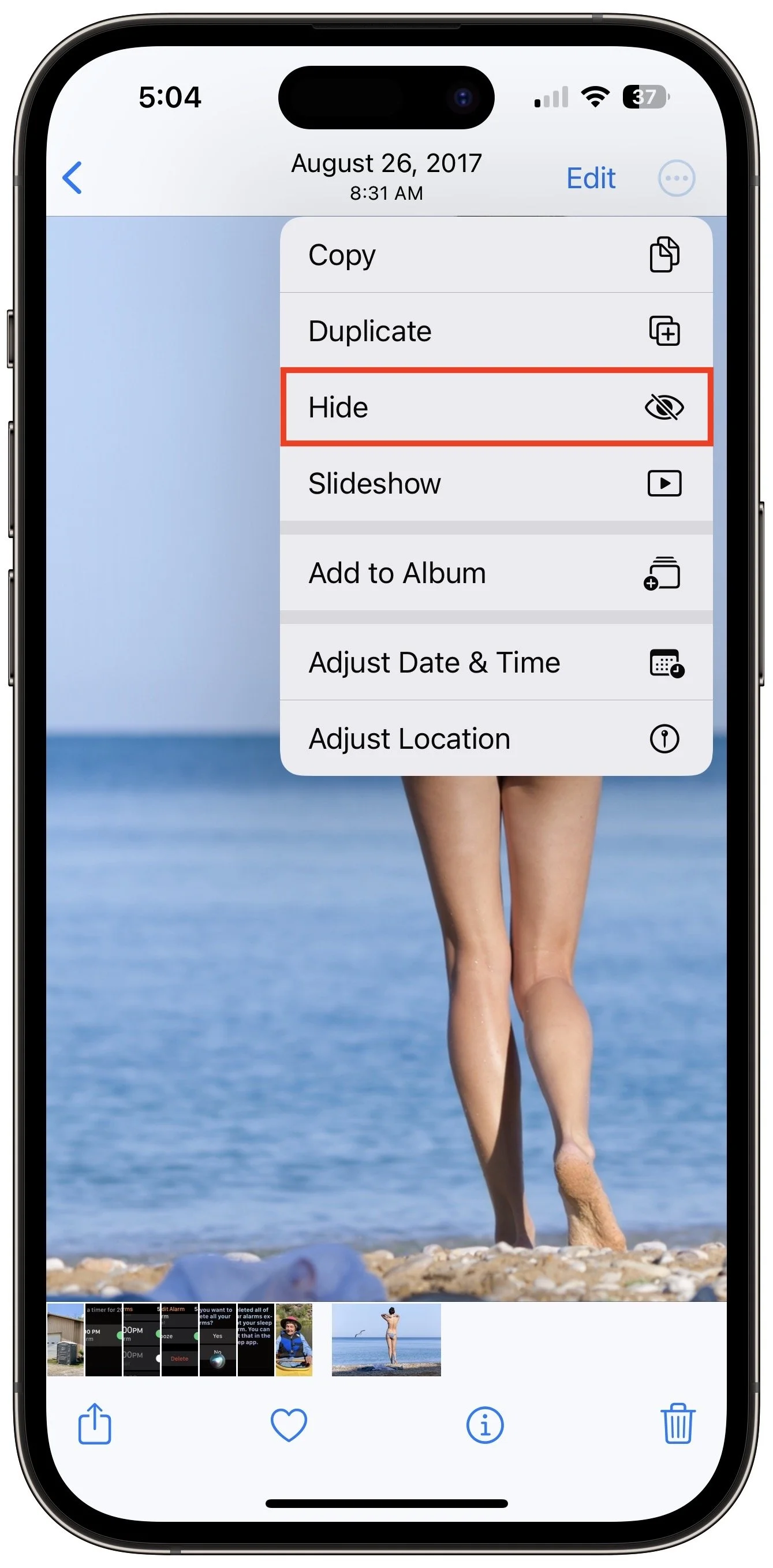
Unlike regular albums, whose photos also appear in All Photos, photos in the Hidden album won’t appear anywhere else, including in searches. That’s the point of the feature.
You can hide or show the Hidden album on each of your devices independently. On the iPhone and iPad, control whether it shows up in the Utilities album collection with Settings > Photos > Show Hidden Album. In the Photos app on the Mac, control whether it appears in the sidebar using View > Show/Hide Hidden Photo Album. Obviously, if you’ve hidden the Hidden album, you must show it to look inside.
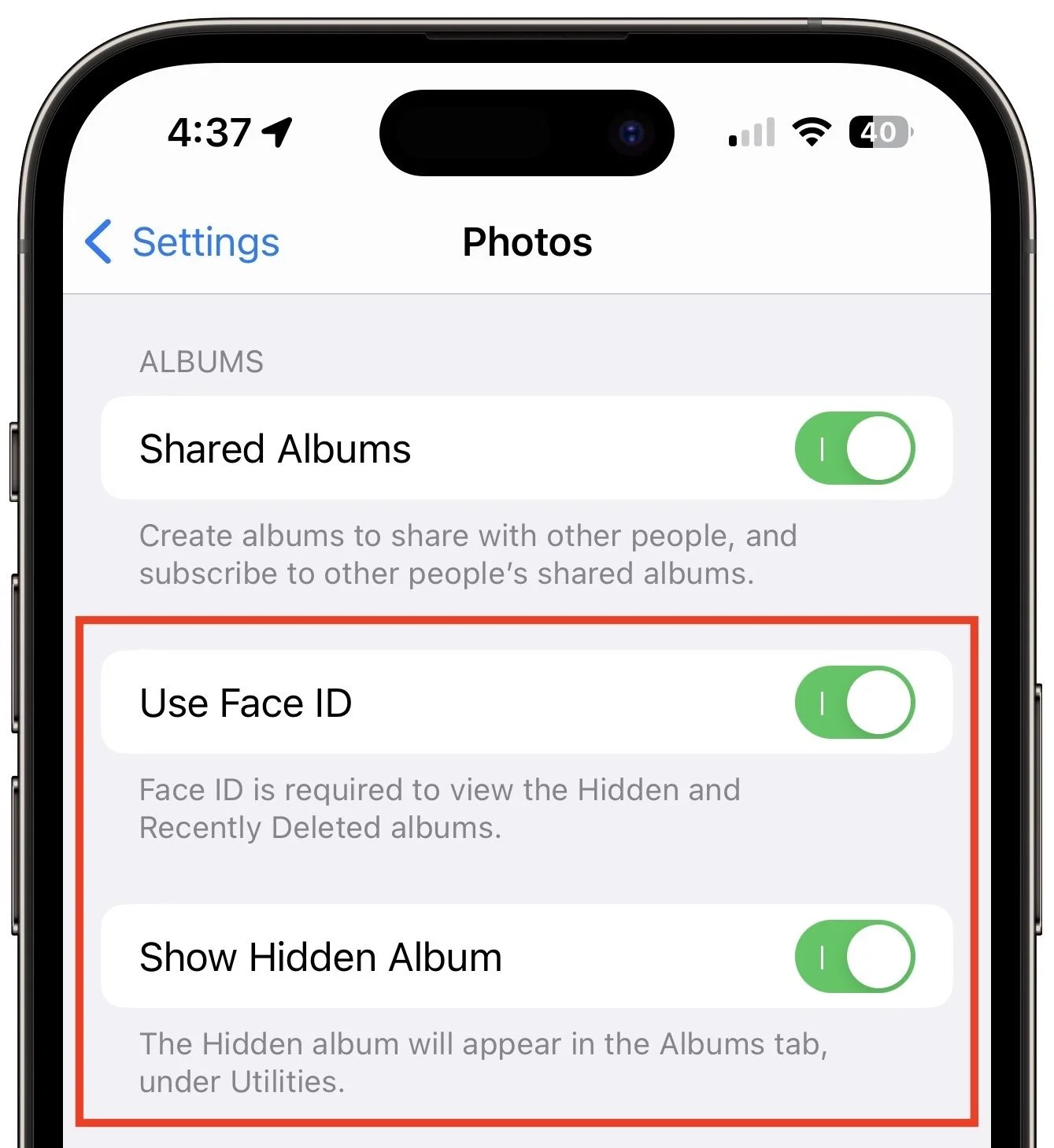
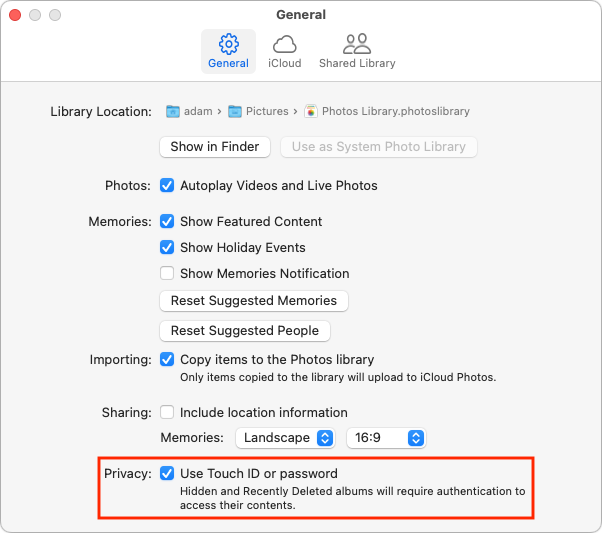
If you use the Hidden album, we strongly recommend protecting it (and the Recently Deleted album) with Face ID or Touch ID so only those with biometric access to your device can view it. On the iPhone and iPad, enable Settings > Photos > Use Face/Touch ID (see above). On the Mac, go to Photos > Settings > General and select “Use Touch ID or password.” Again, these settings are per-device, so what you set on the iPhone won’t automatically carry over to other devices. But really, turn it on everywhere.
Overall, the Hidden album is a welcome feature, and if you have any photos that could embarrass you if someone were to stumble across them, put them in the Hidden album and turn on the biometric protection.
(Featured image based on an original by iStock.com/AlexZabusik)
Web Workers of the World, Give Arc a Try
An elegant new browser called Arc makes using the Web more fun, especially for people who use a lot of websites and Web apps. Arc offers many productivity features and a rethink of how users can best organize their many bookmarks and tabs.

Although Web browsers have added productivity features over the years, most have not been overhauled to support modern usage patterns. We have bulging bookmarks bars, tabs by the trillions, and inefficient habits like using searches to load even regularly used websites. Arc, an innovative new Web browser for the Mac from The Browser Company, addresses these issues and could radically improve your productivity. It is a free download.
Based on Chromium, the open-source foundation under Google Chrome, Arc is in some ways a more capable, more attractive version of Chrome. It supports Chrome extensions, and Web apps designed to perform best in Chrome run equally well in Arc.
Spaces Give You Room to Work
What sets Arc apart from Chrome—and all other browsers—is how it enables users to organize their work into Spaces. Spaces are color-coded sidebars for different types of activities, so you can set them up based on what distinctions make sense to you. You might have Spaces for home and work, and perhaps another for a club or hobby. You could put all your news reading and social media into a Space or make a Space for financial or healthcare websites. If you’re a freelancer or consultant, you could create a Space for each client, and each Space can have its own Profile that maintains separate logins, history, saved passwords, extensions, and more.
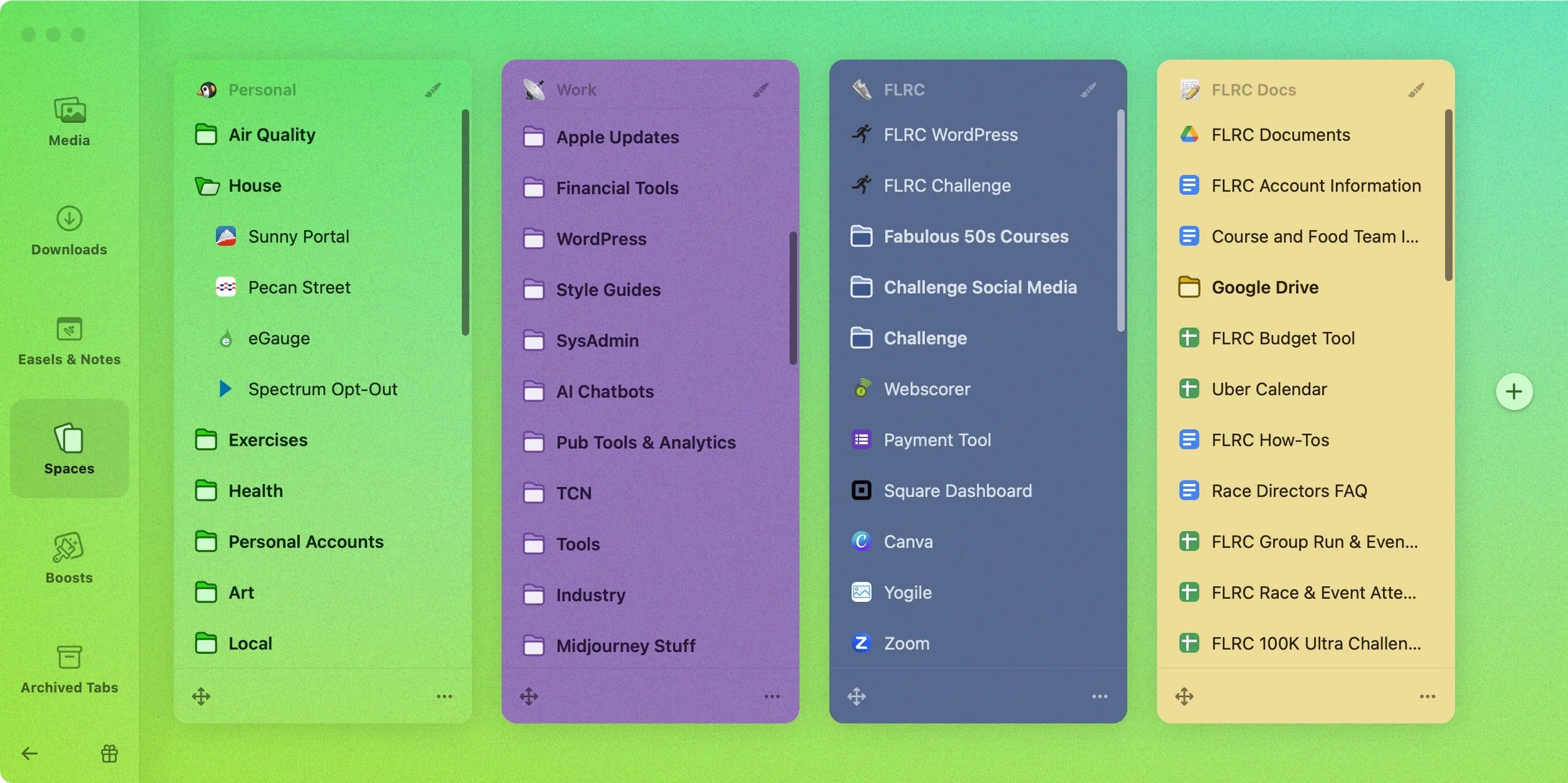
Space Sidebars Hold Pinned Tabs and Regular Tabs
Spaces are only the start of the clever ways Arc helps you focus on your work and load Web pages more efficiently. Each Space sidebar hosts its own persistent pinned tabs for Web apps, sites, and pages. Once you are logged in to a website and have a page open that you return to often, you can make that into a pinned tab—after which you can return to it with one click. Optional folders can hold related pinned tabs for additional organization.
You can change the name and icon of pinned tabs so they’re easier to differentiate. A click on a pinned tab’s icon takes you back to the original pinned URL if necessary, and Control-clicking a pinned tab lets you update a pinned tab’s incorrect URL rather than recreating it. For example, if a pinned tab takes you to a website’s public home page, you should update it with the personalized dashboard page you see after logging in.
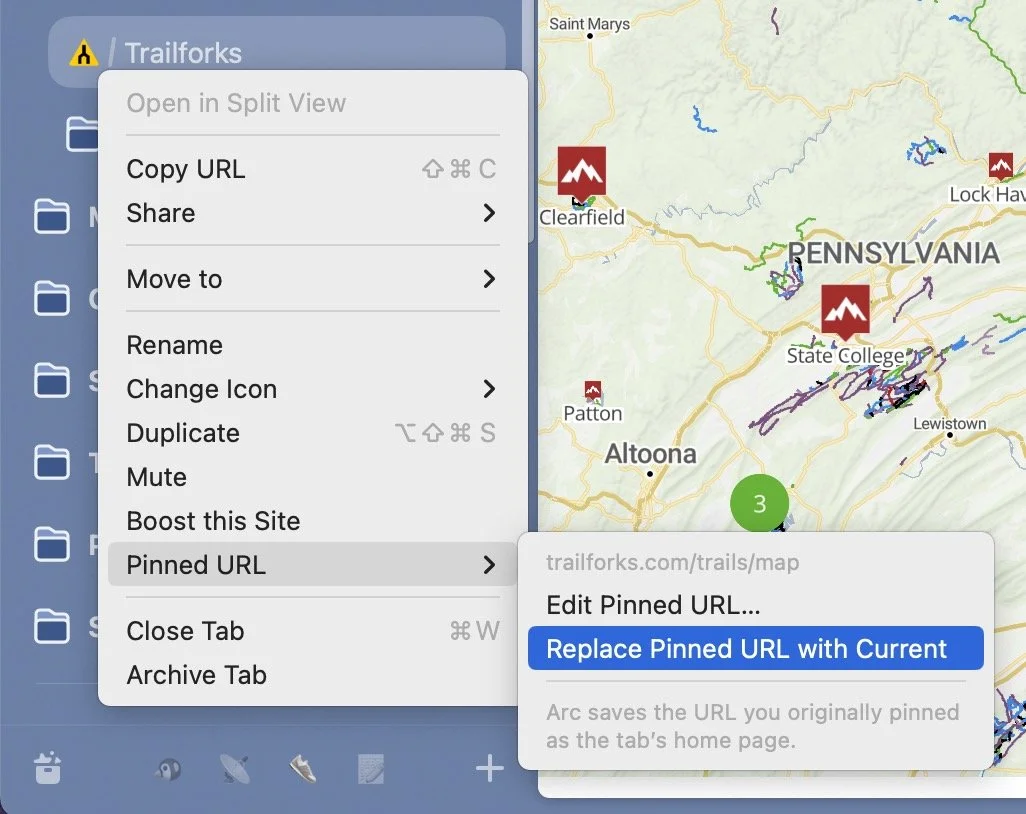
Think of pinned tabs as better bookmarks—they’re always visible in the sidebar rather than hidden in a menu, and you can switch among pinned tabs fluidly without losing your place, whereas using bookmarks constantly creates new tabs interspersed with all the old ones. If switching back and forth between two tabs is clumsy, for example, while you’re writing in one tab and researching in another, you can open them in Arc’s Split View. Option-click any tab to add it to a Split View; press Command-W to close the active tab.
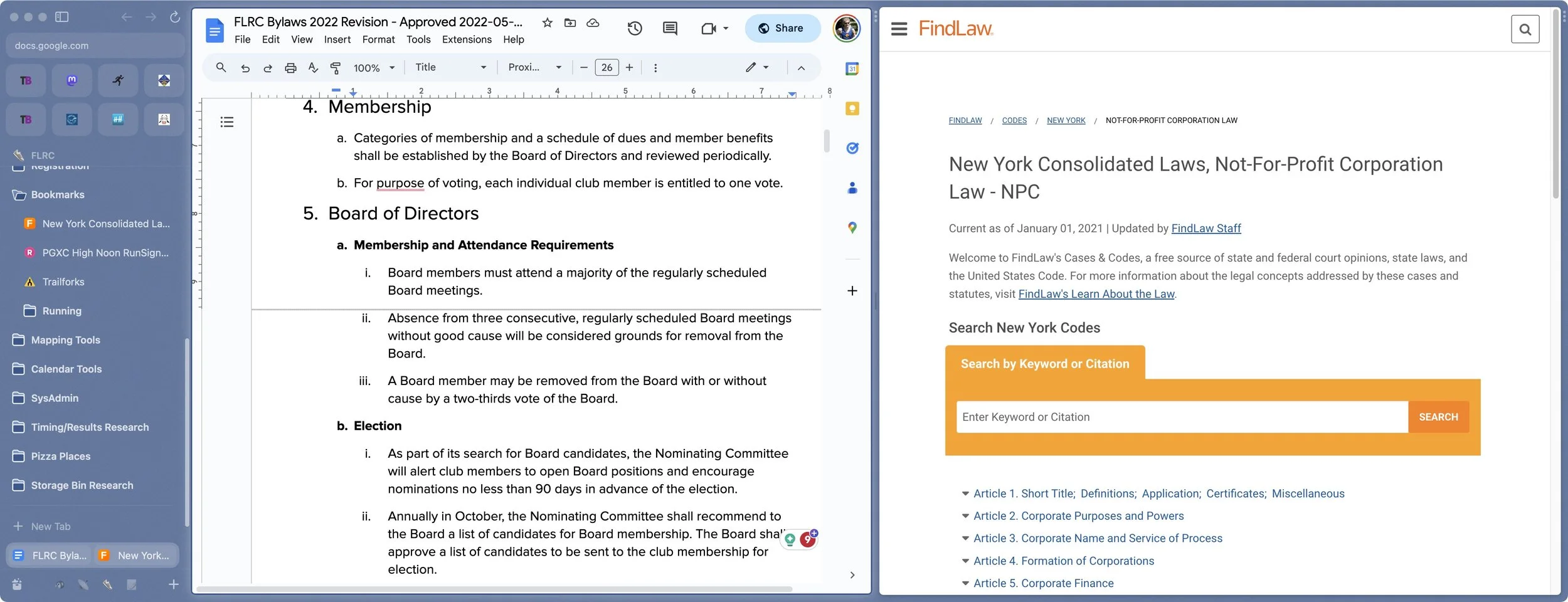
Of course, many tabs don’t need to be persistent, and below your pinned tabs, you’ll see standard tabs that work like regular tabs in other browsers. Arc’s innovation here is that it automatically archives these tabs after a user-specified time to prevent tab overload.
For those who work on multiple Macs, Arc syncs your setup instantly between devices, ensuring that you can stop working on your iMac and pick up later on your MacBook Air without reloading tabs and finding sites. You need to set up an account for syncing and reporting bugs, but Arc has a solid privacy policy.
When a Tab Is Too Much: Peeks and Little Arc
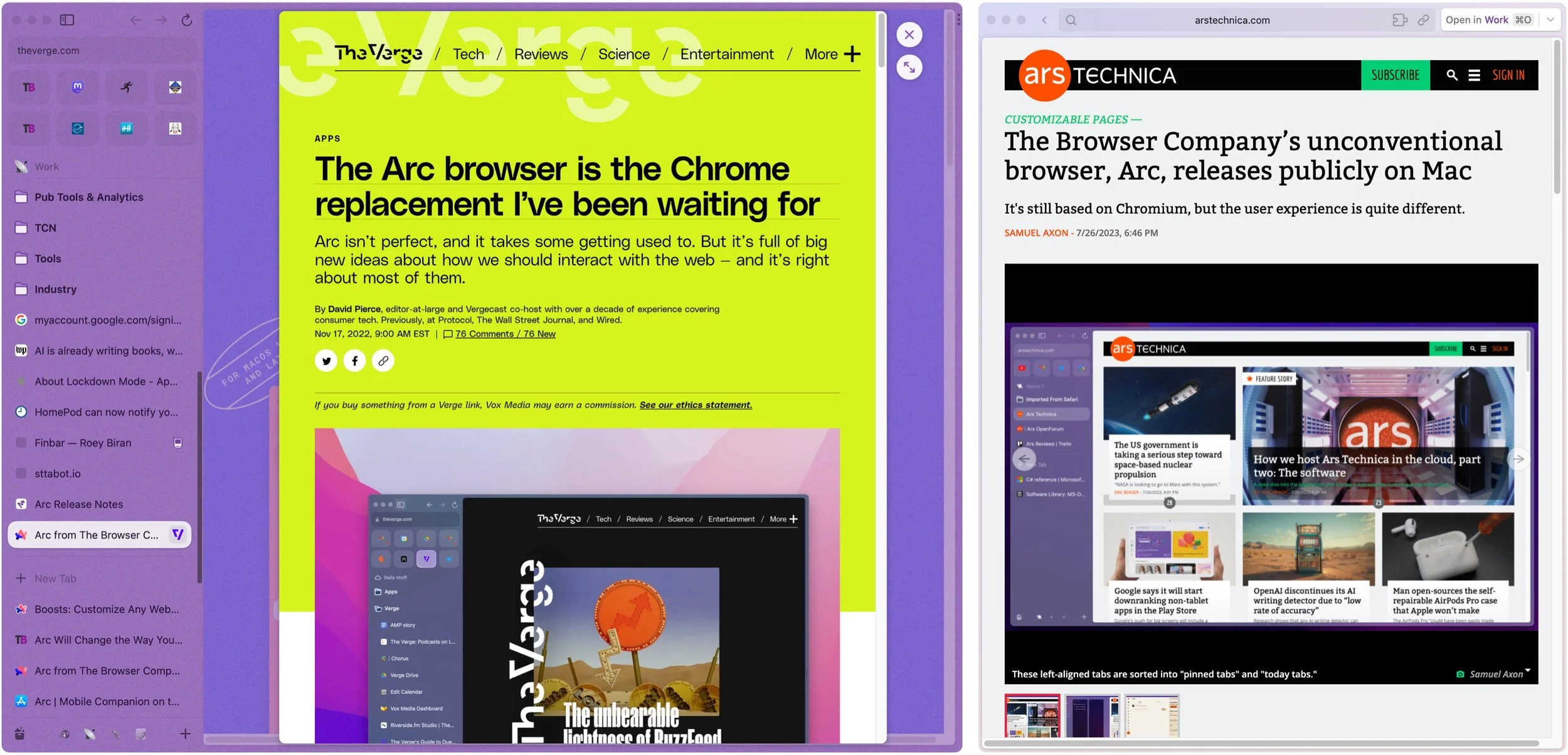
Arc understands that you often need to read a Web page only briefly. By default, when you are working in a pinned tab, if you click a link to another site, Arc opens it in a Peek—a sort of overlaid window (below left)—that you can close after reading or retain as a standard tab.
Another default setting opens links clicked in other Mac apps in Little Arc, a sidebar-free browser window that provides a focused look at a page without distracting you with everything else that’s open in Arc (below right). Again, when you’re done, you close the Little Arc window or open it in a Space.
Arc Allows Many Usage Styles
Like any good Mac app, it’s easy to use the mouse to get around, but Arc is wired with many easily discovered keyboard shortcuts that help increase productivity—it’s one of those apps that offers a lot to users who take the time to master a few nuances.
For example, to open a new tab in Arc, you can just click the New Tab item in the current Space’s sidebar to open the Command Bar and then type your URL or web search. Press Command-T also opens the Command Bar. Once you get used to using the Command Bar to search the Web, note that you can also type words in the name of an Arc command (try “downloads” to access the View Downloads command) to issue it quickly—this is often faster than looking for the command in Arc’s menus.
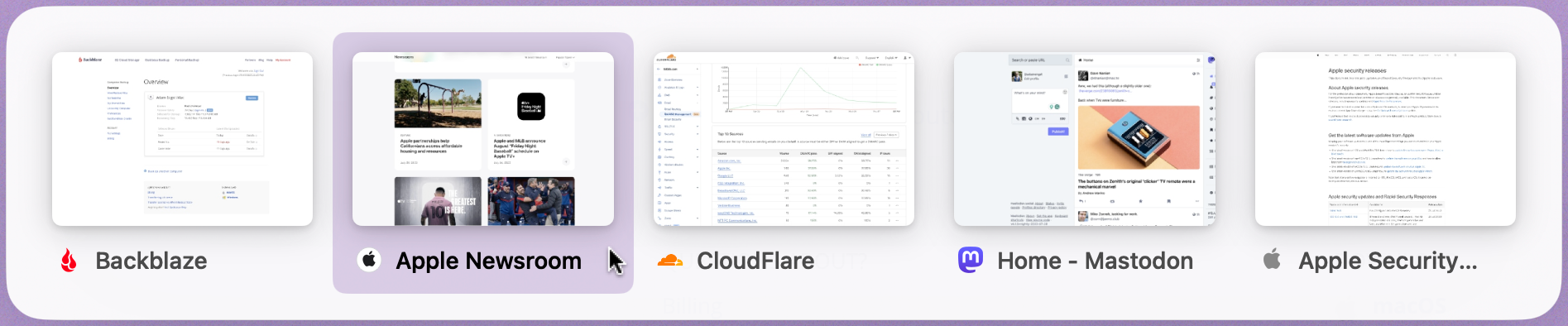
Another particularly useful keyboard shortcut is Control-Tab. Press it to switch back and forth between your two most recent tabs, or pause briefly to display a graphical switcher with the five most recent tabs—it works just like the Mac’s Command-Tab app switcher.
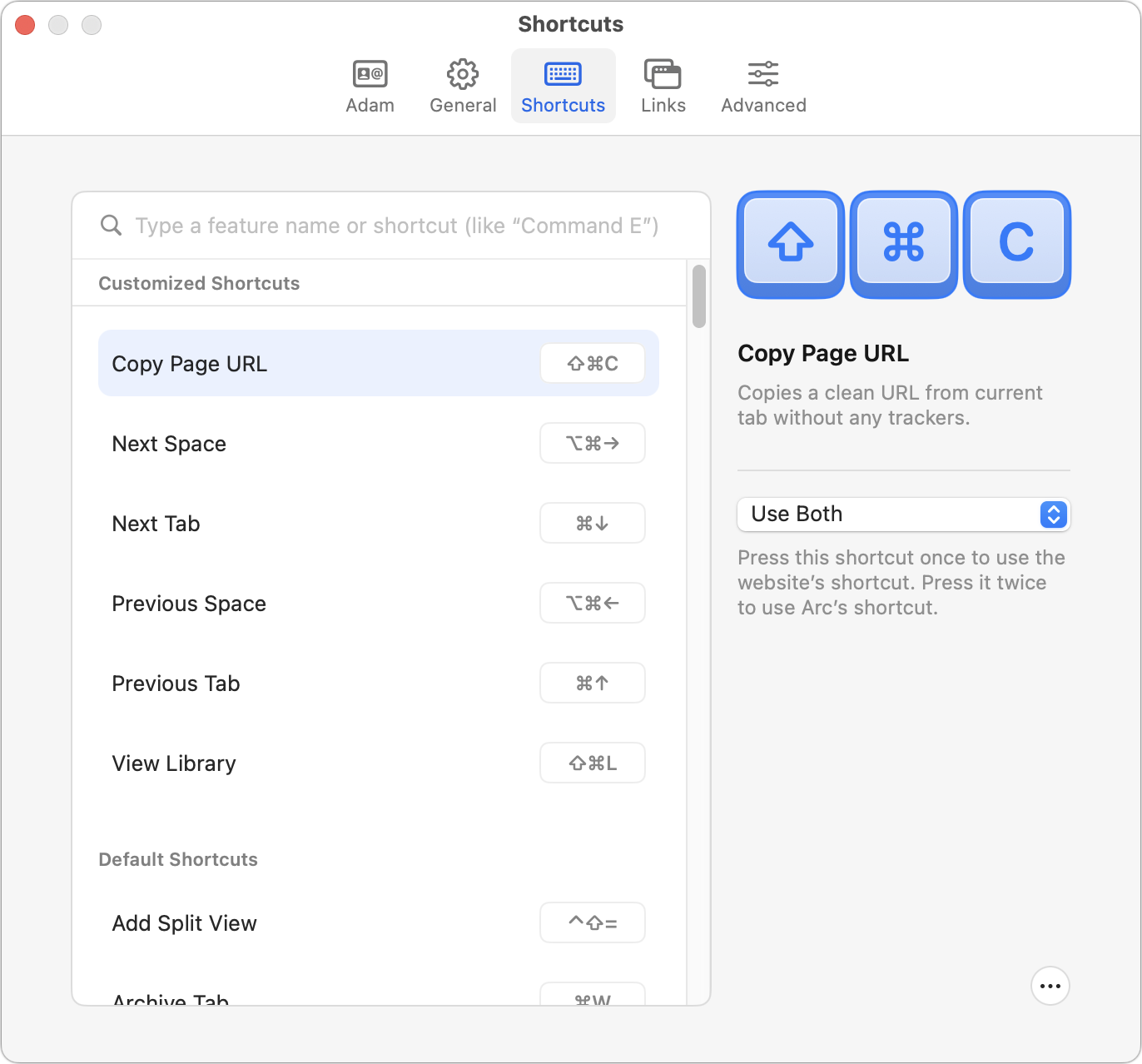
Arc offers many other clever shortcuts: One of our favorites is pressing Command-Option-N to open the Command Bar from within any app, generating a Little Arc window with the results. You can also press Command-Shift-C to copy the current page’s URL. This is great when your boss asks you to “toss me that URL in the chat” while in a video call. Bloggers will love pressing Command-Shift-Option-C to copy the current URL in Markdown format. And then there’s Command-Option-V, which creates a new tab from the contents of the clipboard, either by loading a URL or performing a search.
If Arc’s default keystrokes don’t work for you, you can customize them to be more memorable, with settings that control whether Arc or a website gets preference for conflicting shortcuts.
Arc Goes Beyond Basic Web Browsing
Arc has a few genuinely unusual features that we are enjoying experimenting with.
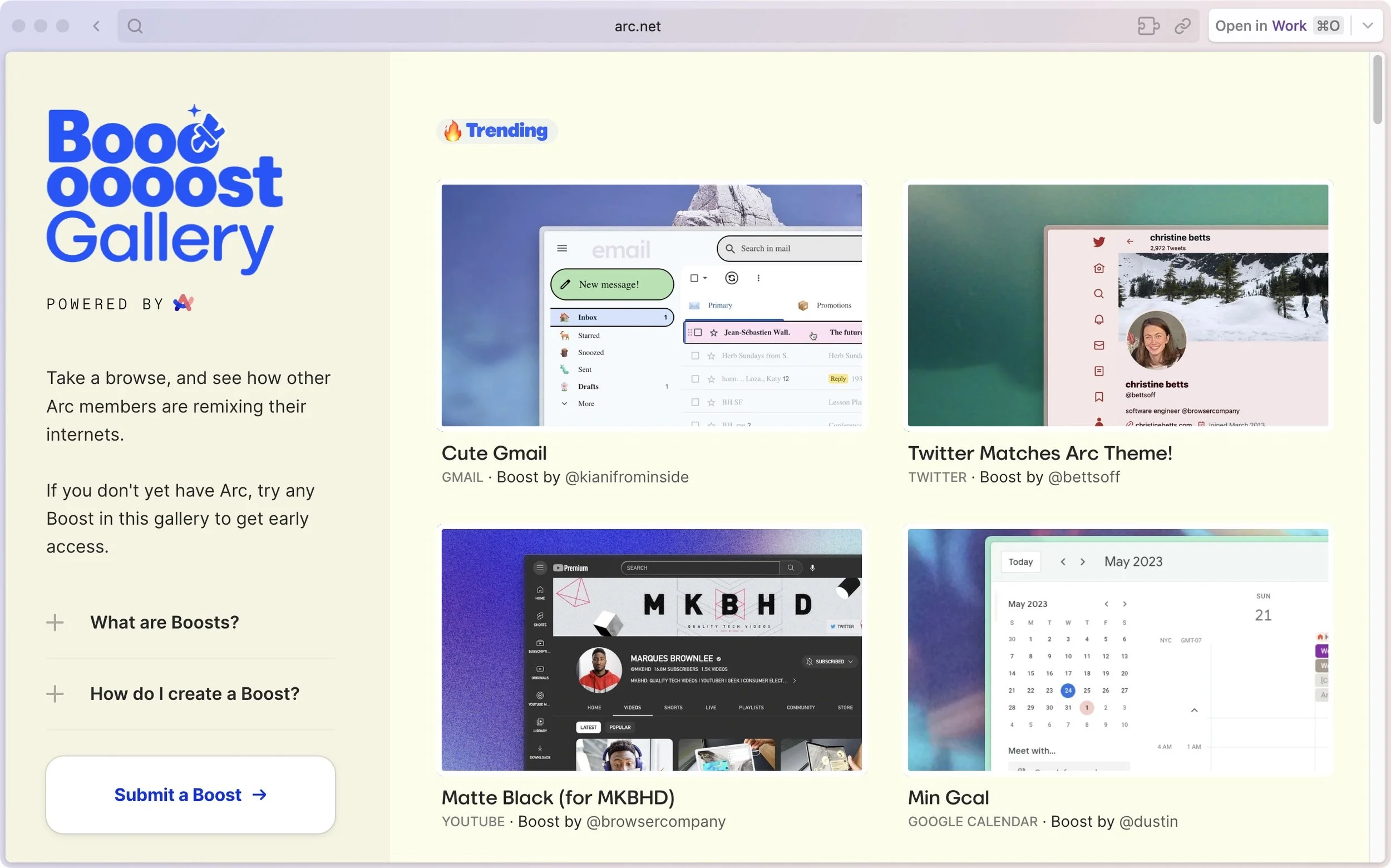
Boosts: A graphical editor lets you change how any website looks whenever you load it, enabling you to tweak website colors, fonts, font sizes, and more. You can even delete particular interface elements. Along with fun uses and fixing sites with significant design lapses, Boosts are an accessibility win, letting users with vision issues adjust websites for easier reading. A Boost Gallery lets you see what others have done.
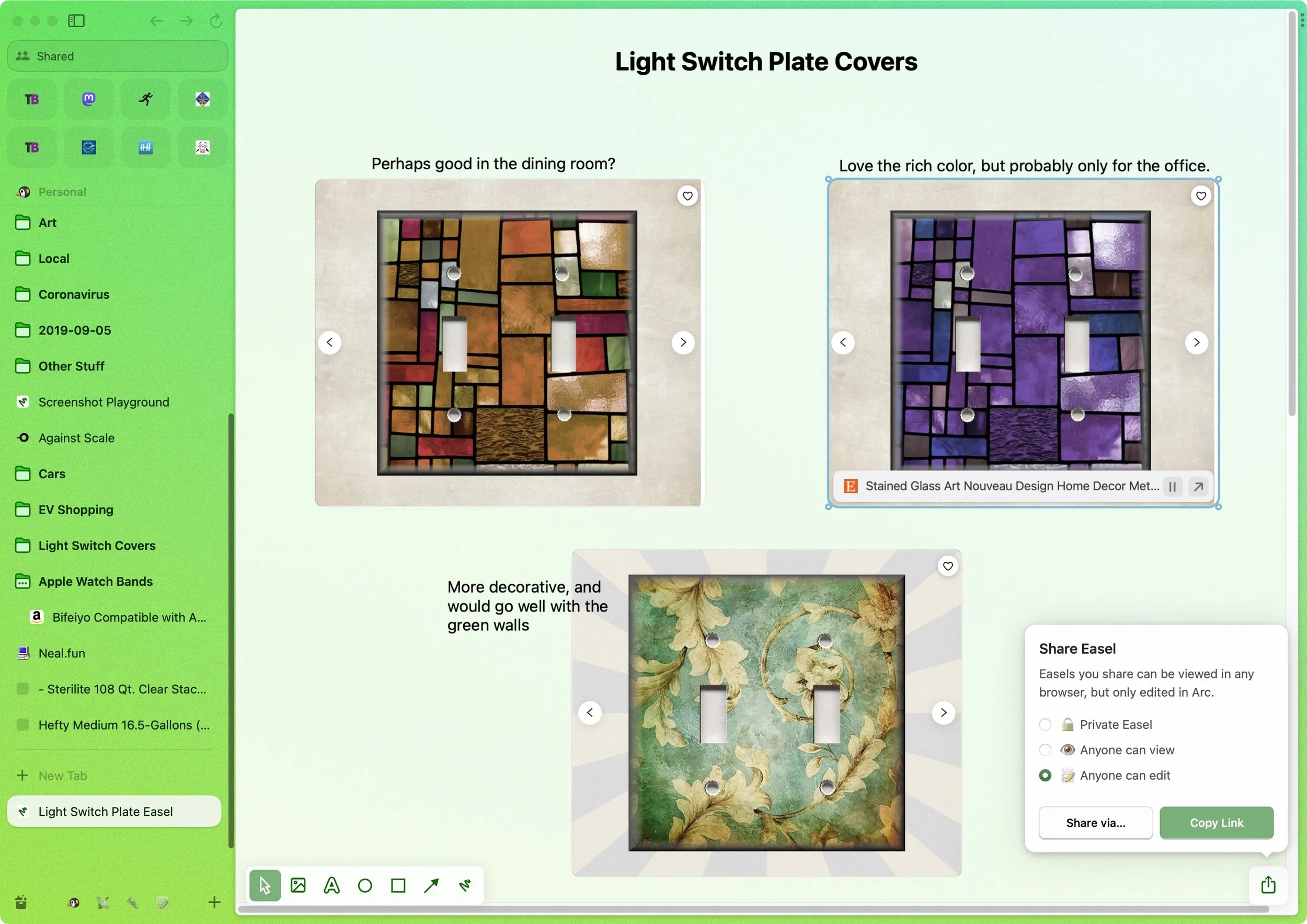
Easels: A Capture command lets you take a snapshot of a portion of a Web page and add it to an Easel, a collaborative digital whiteboard you can share with other users. Captures can be static images that link back to their original pages—helpful for creating a mood board or for comparisons in online shopping—or HTML snippets that act like live windows into their original sites.
Getting Started with Arc
The main hurdle in adopting Arc is figuring out how best to use it. Be sure to import from your current browser when you first launch it, and then set up a few Spaces and organize your old bookmarks into pinned tabs. (Just drag a tab above the divider in the sidebar to pin it.) In a day or two, you should see how having your regularly used sites lined up in the sidebar for quick access saves time and makes you more productive.
Currently, Arc runs only on the Mac (macOS 12 Monterey and later), although The Browser Company makes an Arc Mobile Companion app for the iPhone and iPad. It’s not yet a full-fledged browser, but it syncs your Spaces and pinned tabs, making it easy to access your most-used sites on the go. A Windows version of Arc is in beta.
(Featured image based on an original by iStock.com/Bussarin Rinchumrus)
Tips for Getting Back to Work Faster After Restarting Your Mac
Do you avoid restarting your Mac because of how long it takes to set up your apps, documents, windows, and browser tabs again? These macOS and browser settings will restore your working environment after a restart.
All too often, Mac users put off installing updates because of the bother of having to set everything up again afterward. We get it—you’re busy, and it can take time to relaunch apps, reopen documents, and repopulate Web browser tabs.
There’s no avoiding some downtime when installing a full macOS update, which is why we recommend starting such updates at the end of the day or before you leave for lunch. That’s why Apple introduced Rapid Security Responses, which generally install in just 3–4 minutes, including a restart if necessary.
But with a bit of setup, you can pick up where you left off before a restart within a minute or two. There are three settings that can reopen apps, documents, and folders, and all Web browsers have options that reload all previously open tabs.
Apps, Documents, and Folders
If you always want certain apps running or documents open, you can ensure they open at login. In macOS 13 Ventura, open System Settings > General > Login Items (shown below); in macOS 12 Monterey and earlier, look in System Preferences > Users & Groups > User > Login Items.
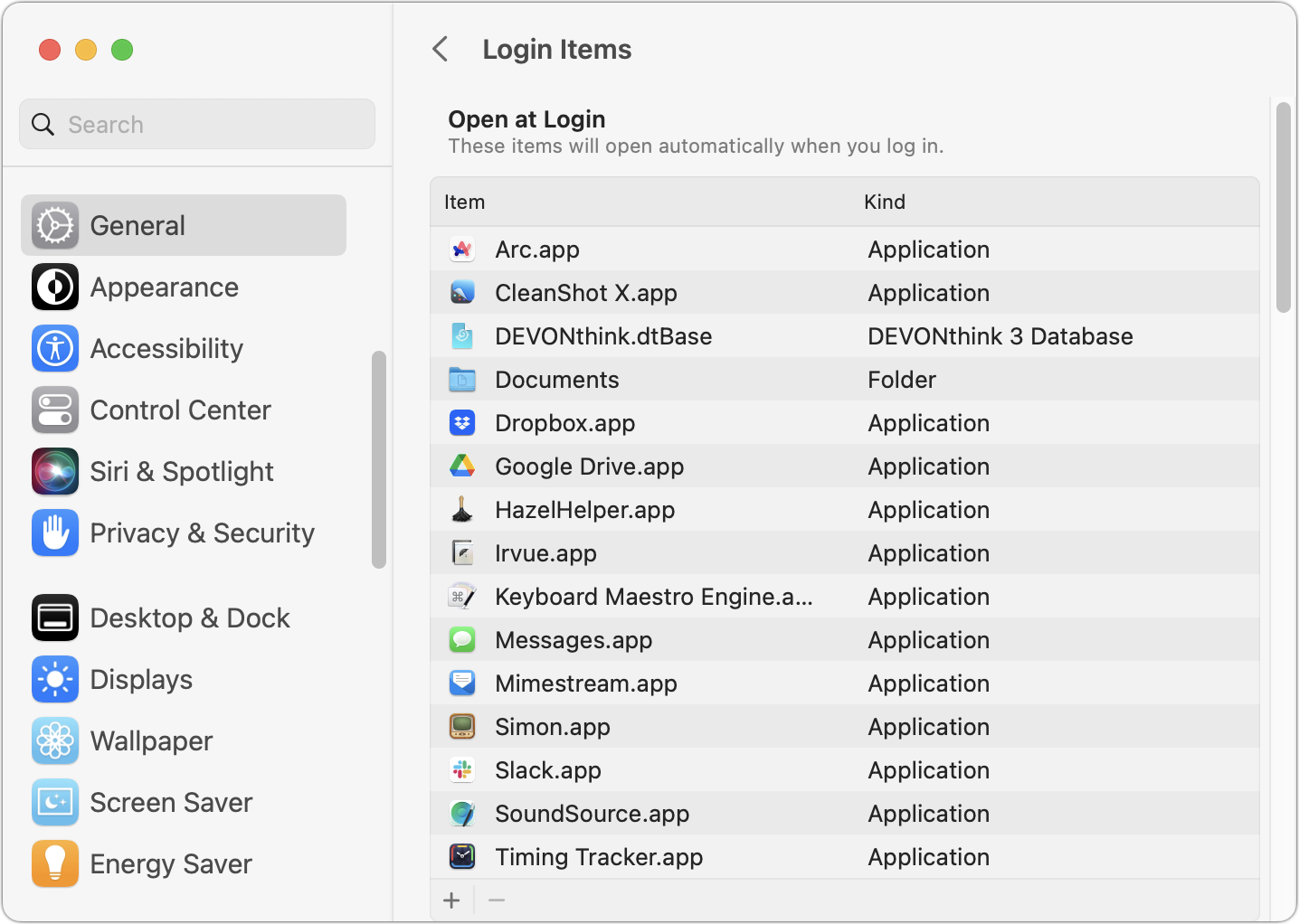
You can add apps, documents, and even folders to the Open at Login list. To remove an unwanted item, select it and click the – button. If there’s anything you don’t recognize, Control-click it and choose Show in Finder to see where it’s located.
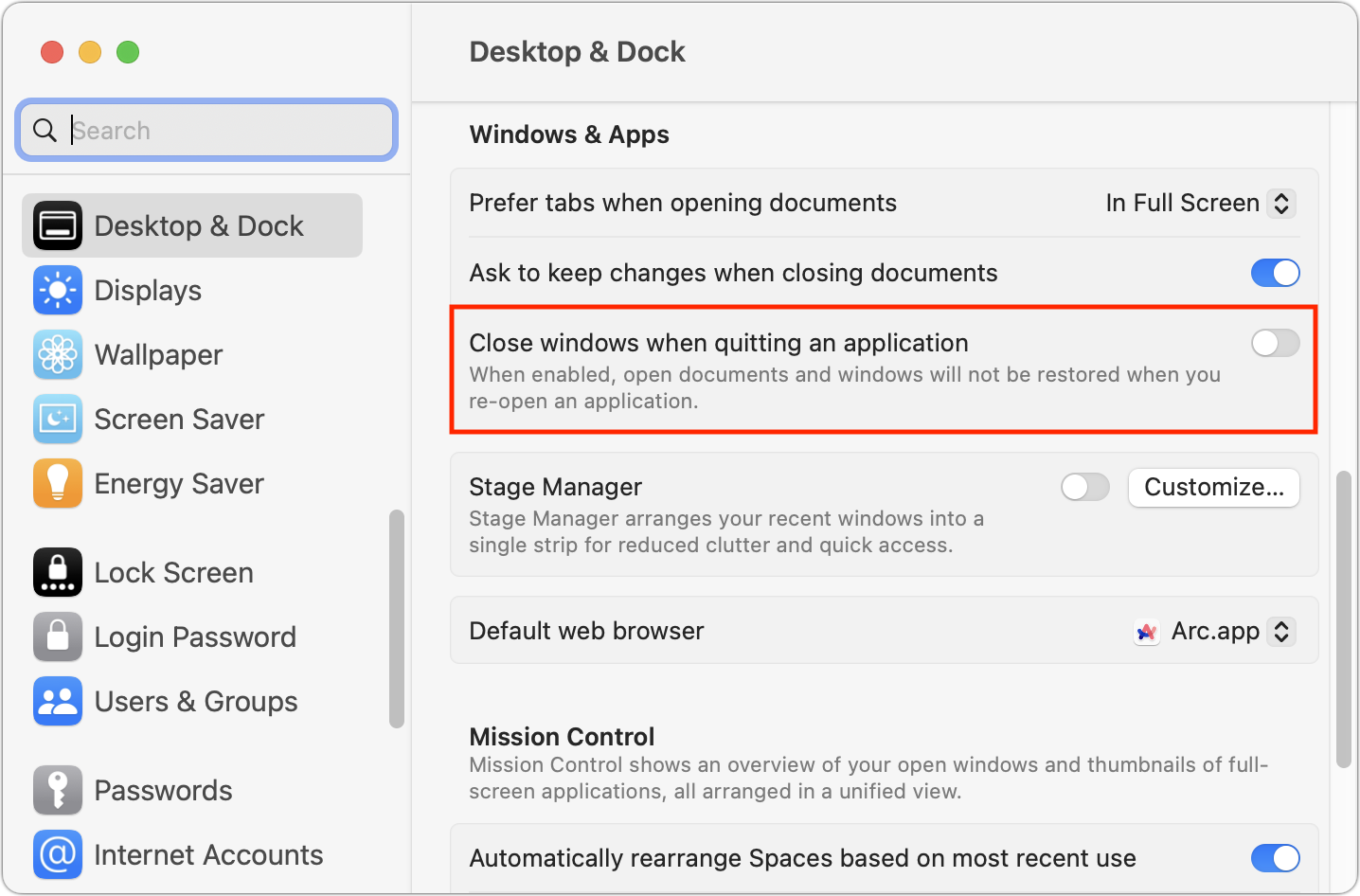
What if you have other apps or documents open that you want to return to immediately after relaunching an app? macOS offers another setting for that. In Ventura, look in System Settings > Desktop & Dock and scroll down to Windows & Apps. Deselect “Close windows when quitting an application” because reopening an app won’t restore its open documents and windows when that's on. In Monterey and earlier, find this setting in System Preferences > General.
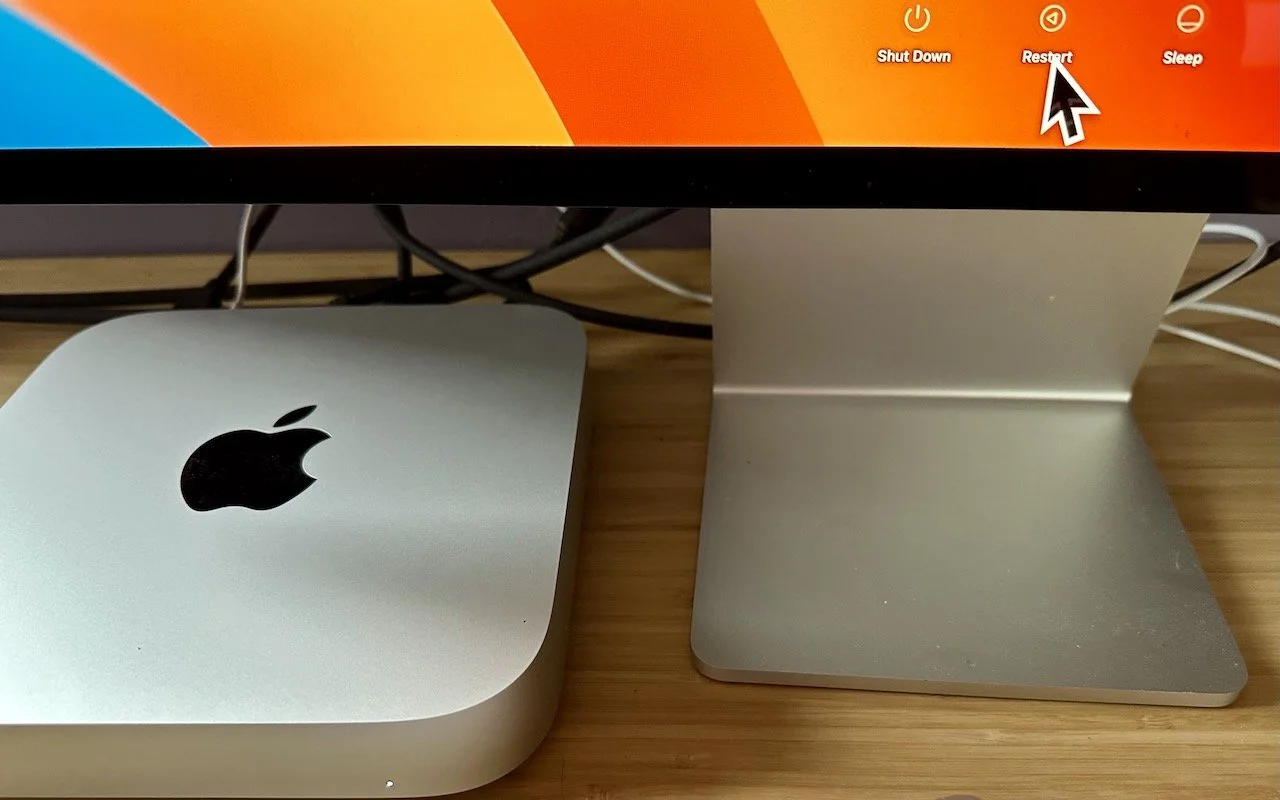
Choose Restart, Shut Down, or Log Out from the Apple menu to reveal the last and most important setting to ensure that your Mac environment is the same after a restart as it was before. In this dialog, select “Reopen windows when logging back in” and click Restart. macOS remembers this setting, so you shouldn’t have to select it each time.

As a bonus, if your Mac crashes or shuts down unexpectedly, it should come back as it was before the crash.
Web Browsers
The macOS settings above should work for most apps, but Web browsers are a special case. Open tabs aren’t quite the same as documents, and you might or might not want all those tabs to come back after relaunching your browser. Control the session settings in these popular Web browsers with the instructions below:
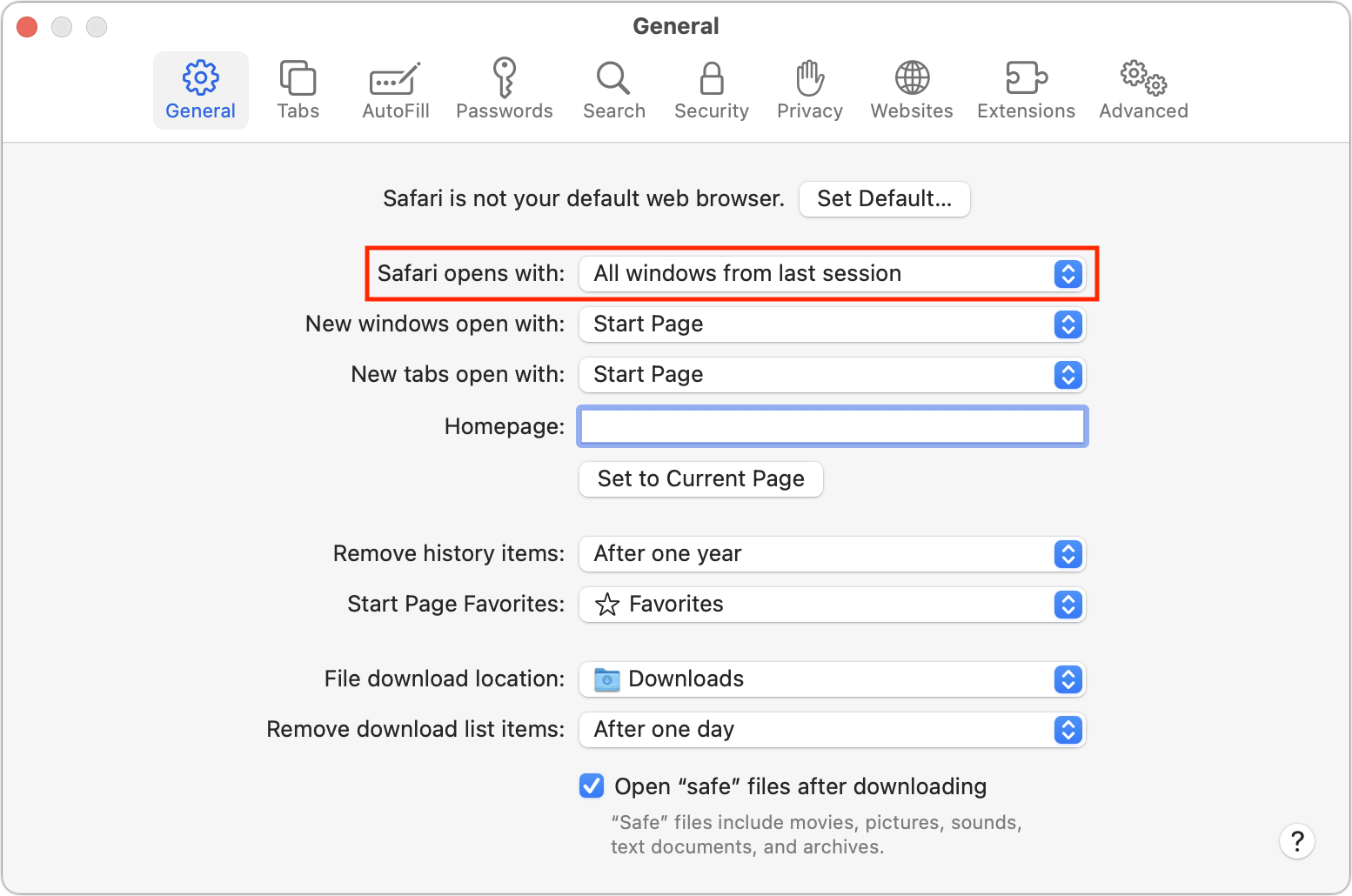
Safari: Recent versions of Safari always open with windows (and tabs) from your last session, though you can choose whether that includes all windows or just non-private ones in Safari > Settings > General.
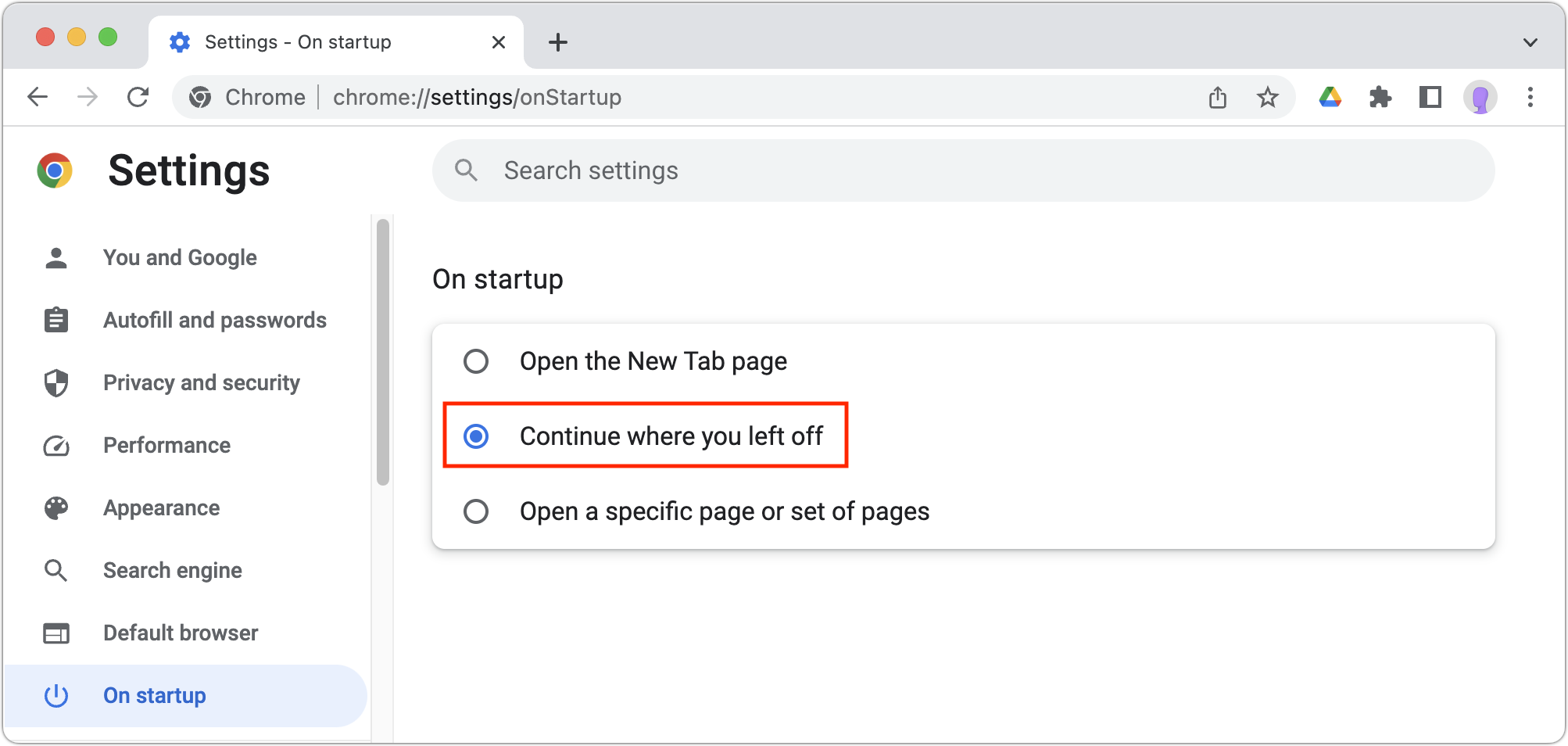
Google Chrome: For Google Chrome, you have additional options, but to make sure your open tabs are restored after relaunching the app, choose Chrome > Settings > On Startup, and select “Continue where you left off.”
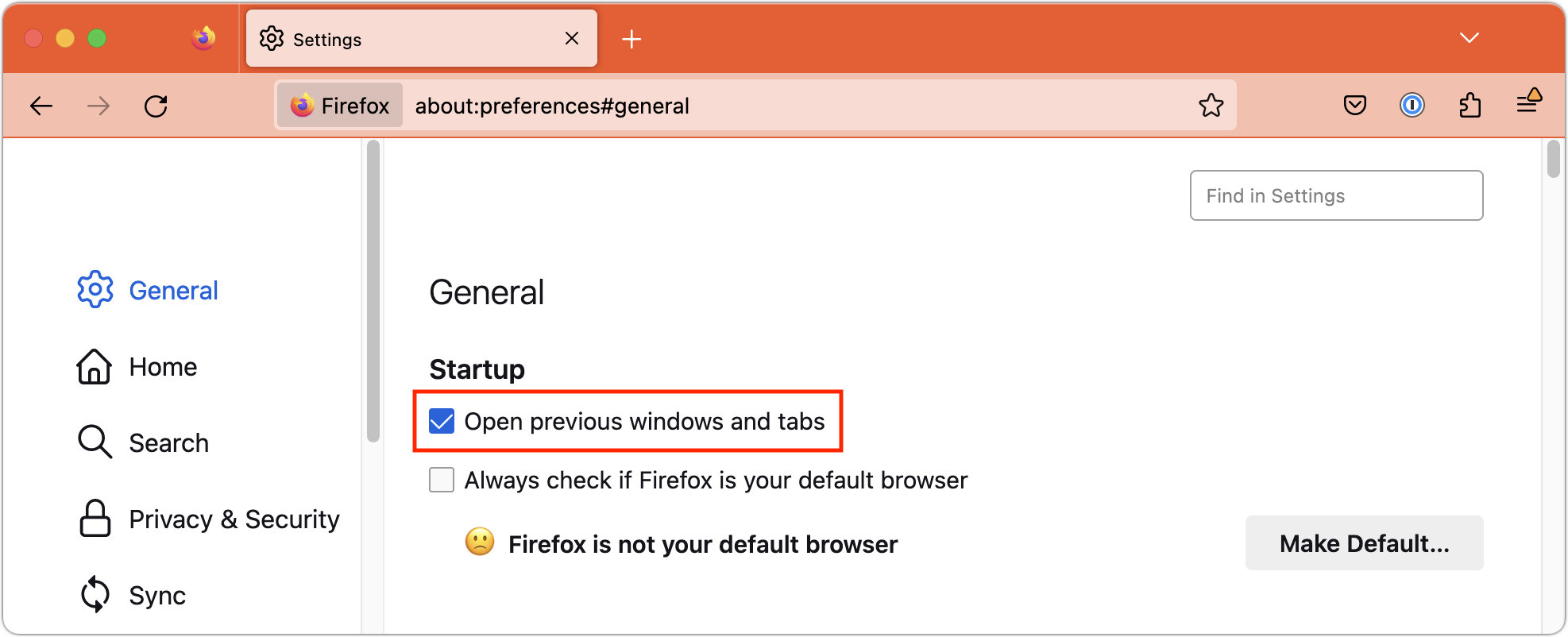
Firefox: Mozilla’s browser puts its session settings front and center. Choose Firefox > Settings > General and select “Open previous windows and tabs.”
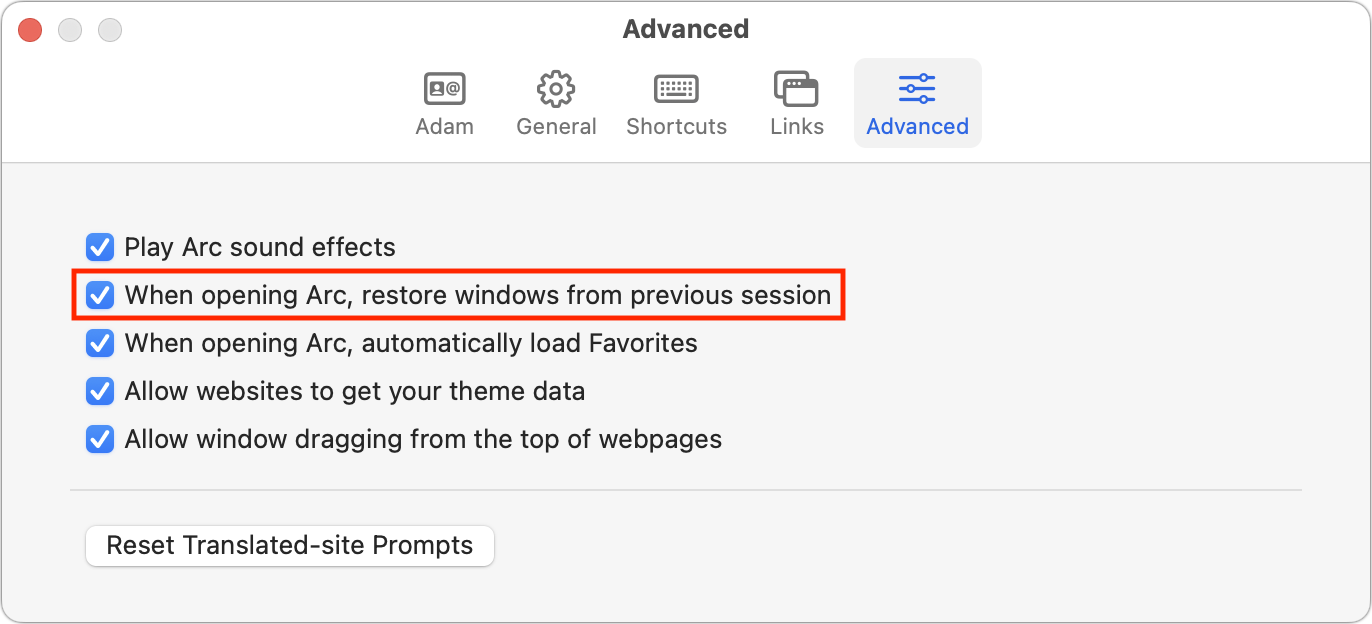
Arc: The new browser Arc encourages users to set up workspaces containing pinned tabs, both of which persist across sessions. However, to ensure all your windows and regular tabs load after relaunching, open Arc > Settings > Advanced and select “When opening Arc, restore windows from previous session.”
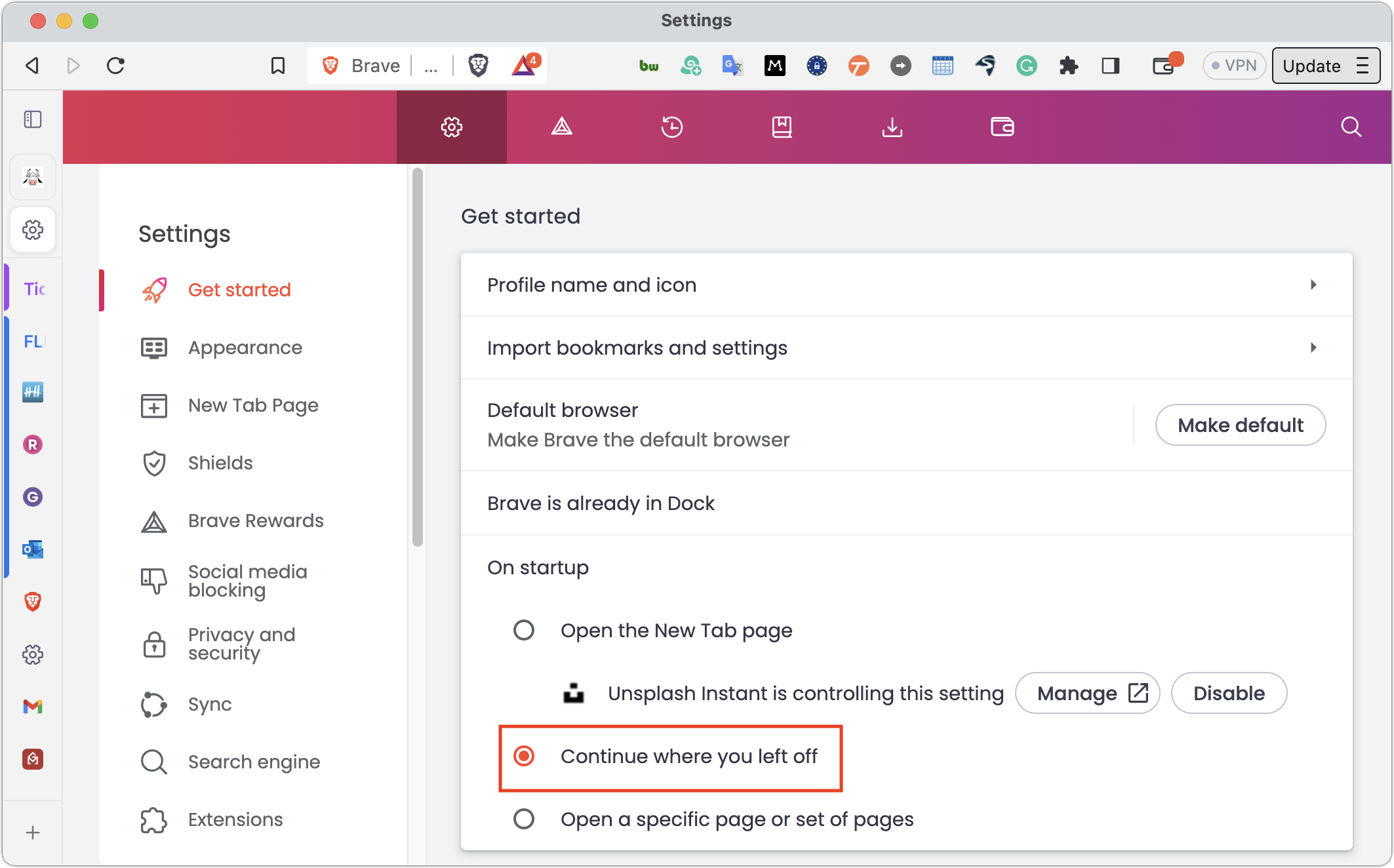
Brave: As a Chrome-based browser, Brave offers a setting similar to Chrome but in a different location. Find it in Brave > Settings > Get Started.
Microsoft Edge: Although it is also based on Chrome, Microsoft Edge stores its session setting in a different location, with a different name. Choose Microsoft Edge > Settings > Start, Home, and New Tabs, and then select “Open tabs from the previous session.”
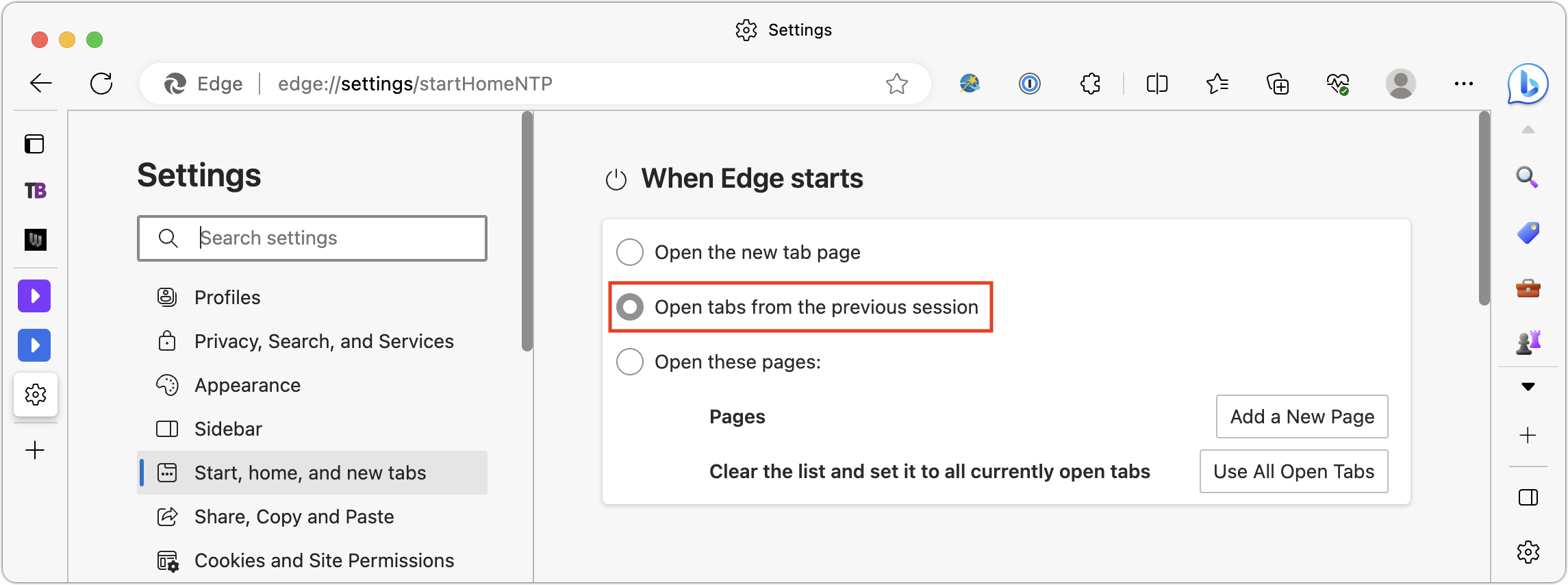
Between these macOS and browser settings, you can ensure that a restart presents the minimum interruption possible, such that when your Mac finishes restarting, all your apps, documents, windows, and browser tabs will be the same as when you left off.
(Featured image by Adam Engst)
Improve Privacy by Removing Metadata from Office Documents and PDFs
You want to share a file, but you don’t want to share details it may have picked up while under construction—who worked on it and when, tracked changes, hidden text, and more. Find out how to remove private metadata from Office documents and PDFs.

When we share data with others, we do so intentionally—a law firm sending a client legal documents, for instance. But those documents shouldn’t include ancillary information that might reveal other, more sensitive details. Because all digital files contain metadata—additional information about the file or its contents—it’s worth knowing what you could share inadvertently and learning how to avoid doing so.
Much metadata is innocuous, like file type and file size. However, some common file types contain additional metadata that can reveal information that you might not want to share. In this situation, the most common file types are Microsoft Office documents and PDF files. Let’s look at each and how you can see what metadata is there and remove it before sharing.
Cleaning Metadata from Microsoft Office Documents
Metadata that you might want to remove from Microsoft Office documents falls into two broad categories: reviewer information, like comments and tracked changes, and document properties.
The first thing to do when removing metadata is to use File > Save As to make a copy of your file and work on the copy. This automatically removes or resets some metadata and allows you to delete other metadata without worrying about losing it from your original.
If you use change tracking in Word or comments in any Office app, you may want to remove those before sharing a document to prevent recipients from seeing internal conversations or information about who worked on the document.
To remove change tracking and comments in Word, click Review in the toolbar. Next, click the arrow next to the Delete button in the comments section and choose Delete All Comments in Document. Finally, click the arrow next to Accept in the change tracking section and choose Accept All Changes and Stop Tracking. Browse through the document to make sure accepting all changes didn’t do something unexpected, and then save.
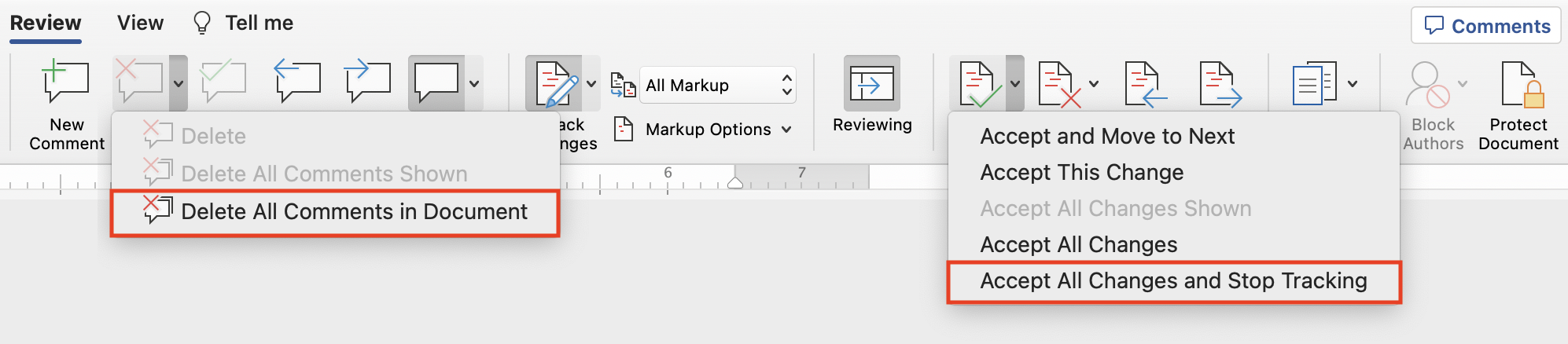
Excel and PowerPoint lack change tracking but let you add comments. Like Word, PowerPoint’s Review toolbar offers a similar menu associated with the Delete button; choose Delete All Comments in Presentation to clear the comments. In Excel, switch to the Review toolbar, choose Edit > Select All (comments can be deleted only from selected cells), and click the Delete button in the toolbar.
To see what metadata is in the document properties of a Word, Excel, or PowerPoint document, choose File > Properties, and look in the Summary, Statistics, and Custom tabs. Generally speaking, these won’t contain anything damning, but they may reveal information like the names of people associated with the document. Don’t assume there’s no metadata here just because you didn’t add anything manually—document control systems can add metadata you don’t expect.
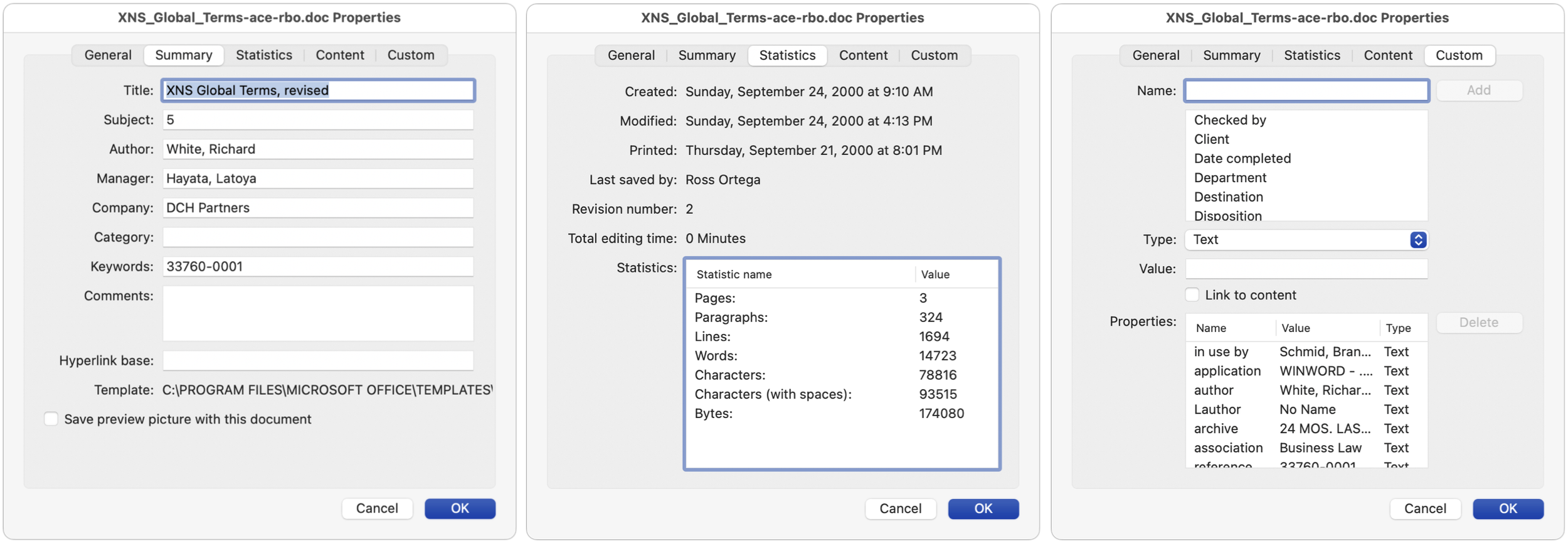
The three Office apps offer different approaches to removing personal information in the Summary and Custom tabs, and the process is extremely different than in the Windows versions. (For Windows, refer to Microsoft’s instructions.) Here’s how you remove personal information:
Word: Choose Tools > Protect Document, and in the Password Protect dialog, select “Remove personal information from this file on save.” Save the document, and then go back to File > Properties to make sure it removed everything that concerns you.
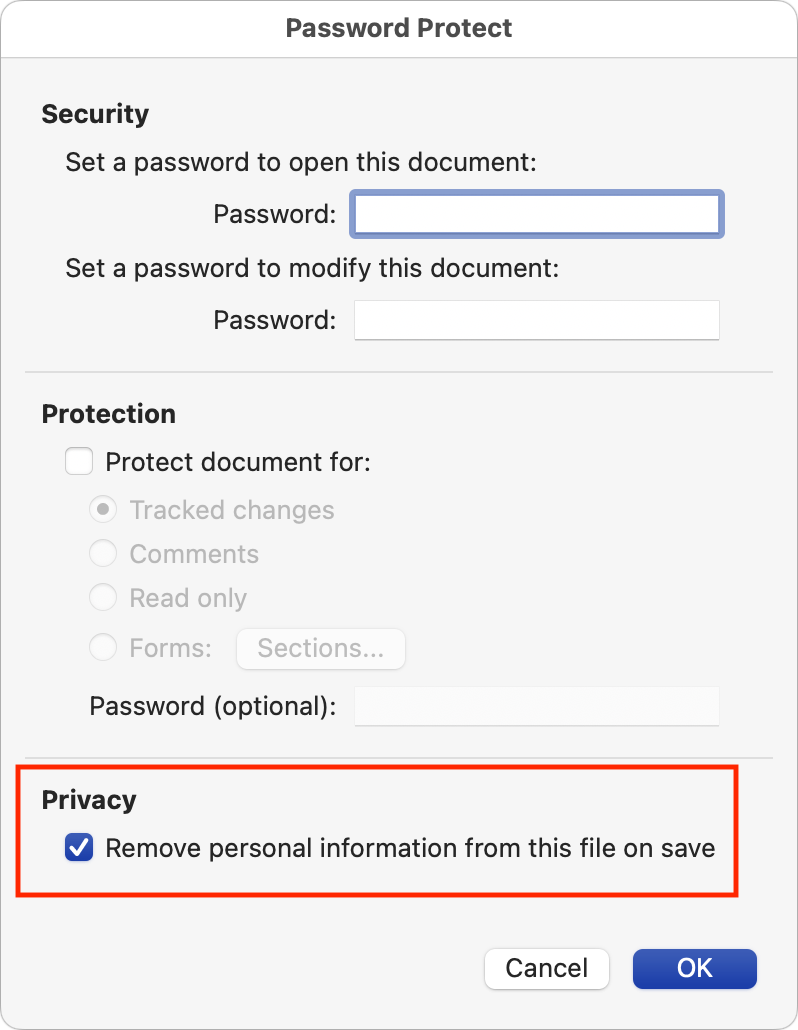
Excel: Choose Excel > Preferences > Security, and select the “Remove personal information from this file on save” checkbox. Then save the document and verify that the desired metadata is gone.
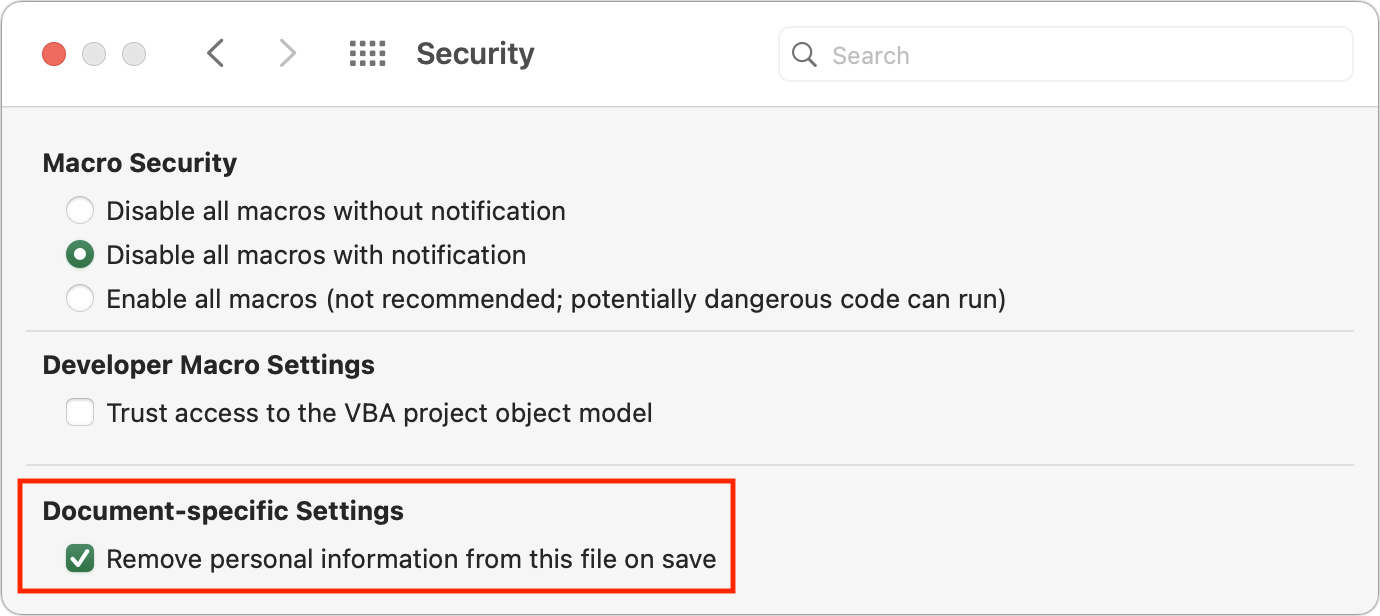
PowerPoint: PowerPoint appears to lack that checkbox, but you can choose File > Properties and manually delete all the information from the Summary and Custom tabs before saving the document.
Information in the Statistics tab is generally cleared or reset by using File > Save As, so you don’t need to do anything more to clear it.
If you’re truly concerned about not revealing additional information in shared Office documents, think about what might appear in headers and footers, footnotes, text that’s white (and thus invisible), hyperlinks, and macros. Finally, remember that you can hide text in Word, columns and rows in Excel, and slides in PowerPoint—that hidden content may reveal sensitive information if it’s allowed to remain in a shared document. In PowerPoint, you may also want to check for presenter notes you don’t want to share; choose View > Notes.
Cleaning Metadata from PDFs
Another way to remove a great deal of metadata from Office documents is to share a PDF of the document instead. By “printing” to PDF, anything that’s invisible automatically disappears. However, PDFs have their own metadata that you might want to review and remove. How you go about it depends on which apps you have available: Adobe Acrobat Pro or just Apple’s bundled Preview.
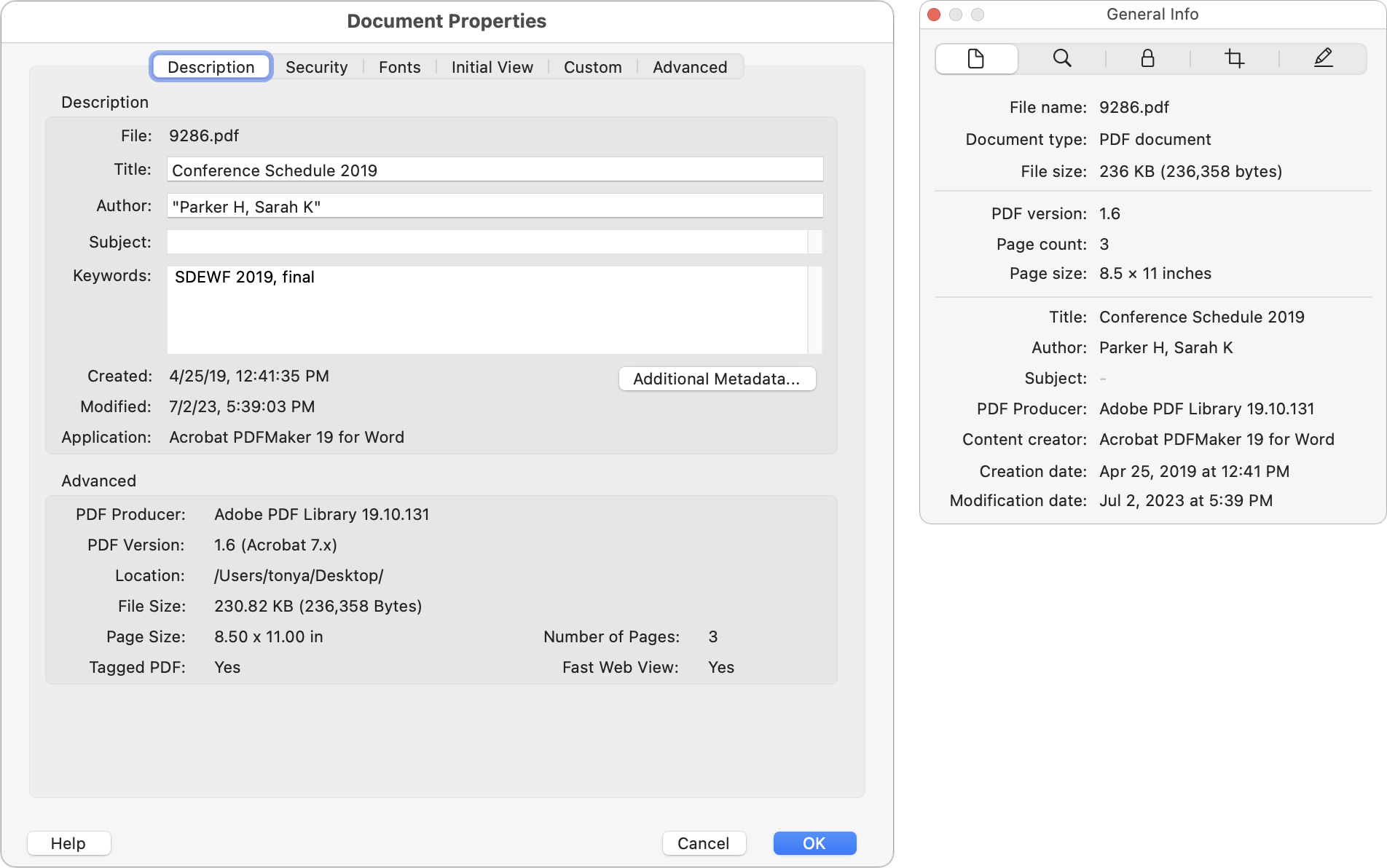
First, to view metadata in Acrobat Pro, choose File > Properties and click the Description tab (left). In Preview, choose Tools > Show Inspector and click the leftmost General Info tab (right).
Adobe Acrobat Pro provides several tools for redacting content (replacing it with a black box) and removing hidden content and metadata. To access them, click the Tools tab at the top of the screen and click Redact to display a pair of buttons on the secondary toolbar. Redact Text & Images lets you redact content, but you’ll most likely want to use Sanitize Document, which removes metadata and a boatload of possible hidden data.
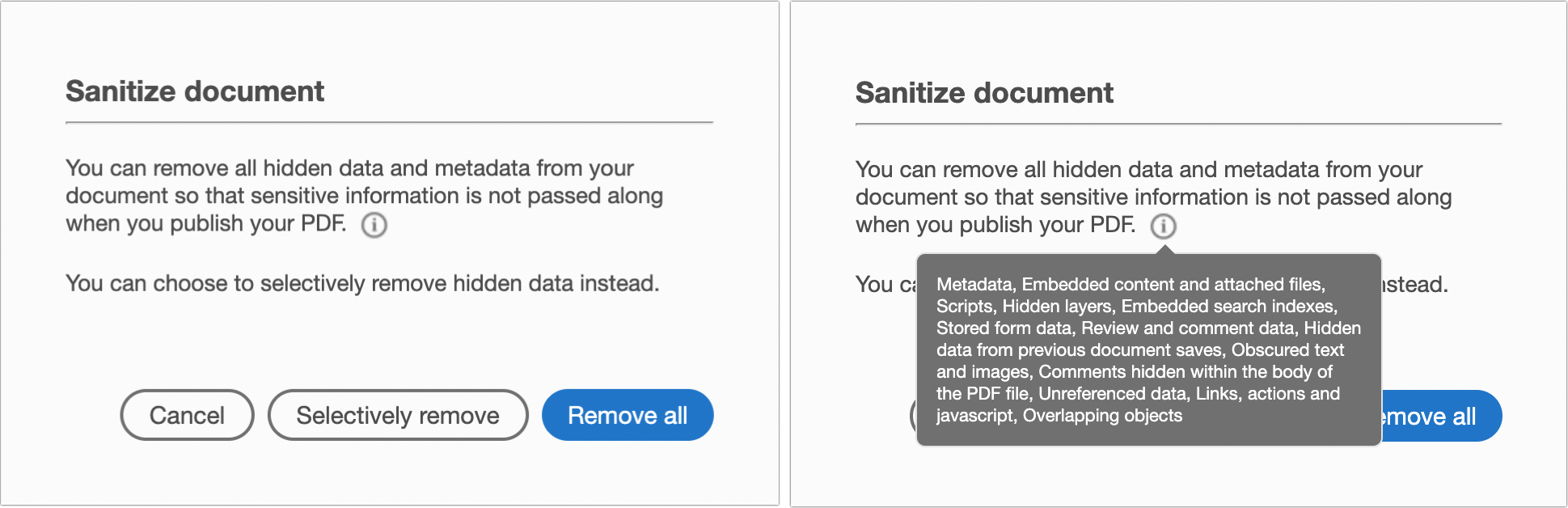
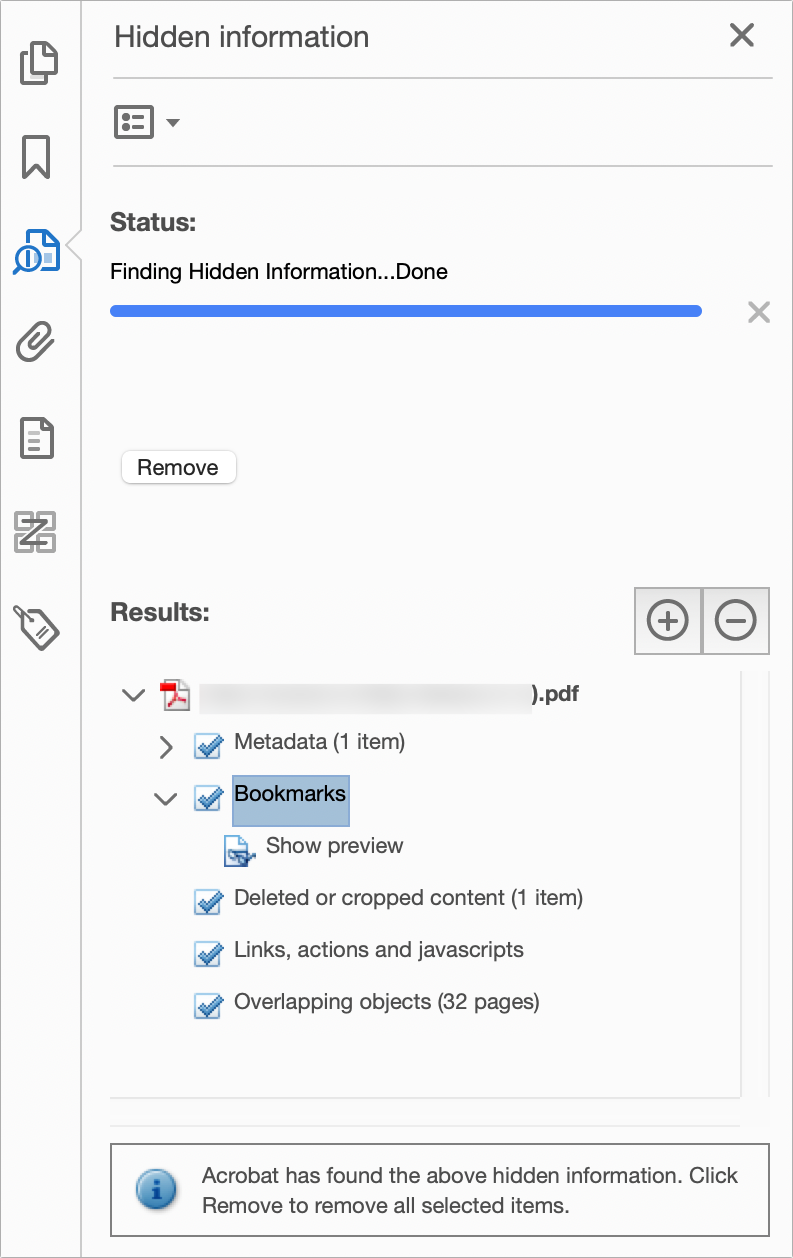
It’s easiest to click Remove All, but you might prefer to click Selectively Remove and look at what Acrobat Pro finds before clicking the Remove button in the Hidden Information tab.
For those who rely on Preview for working with PDFs, there’s a simple process for removing metadata and anything else lurking in a PDF that’s good enough for most situations.
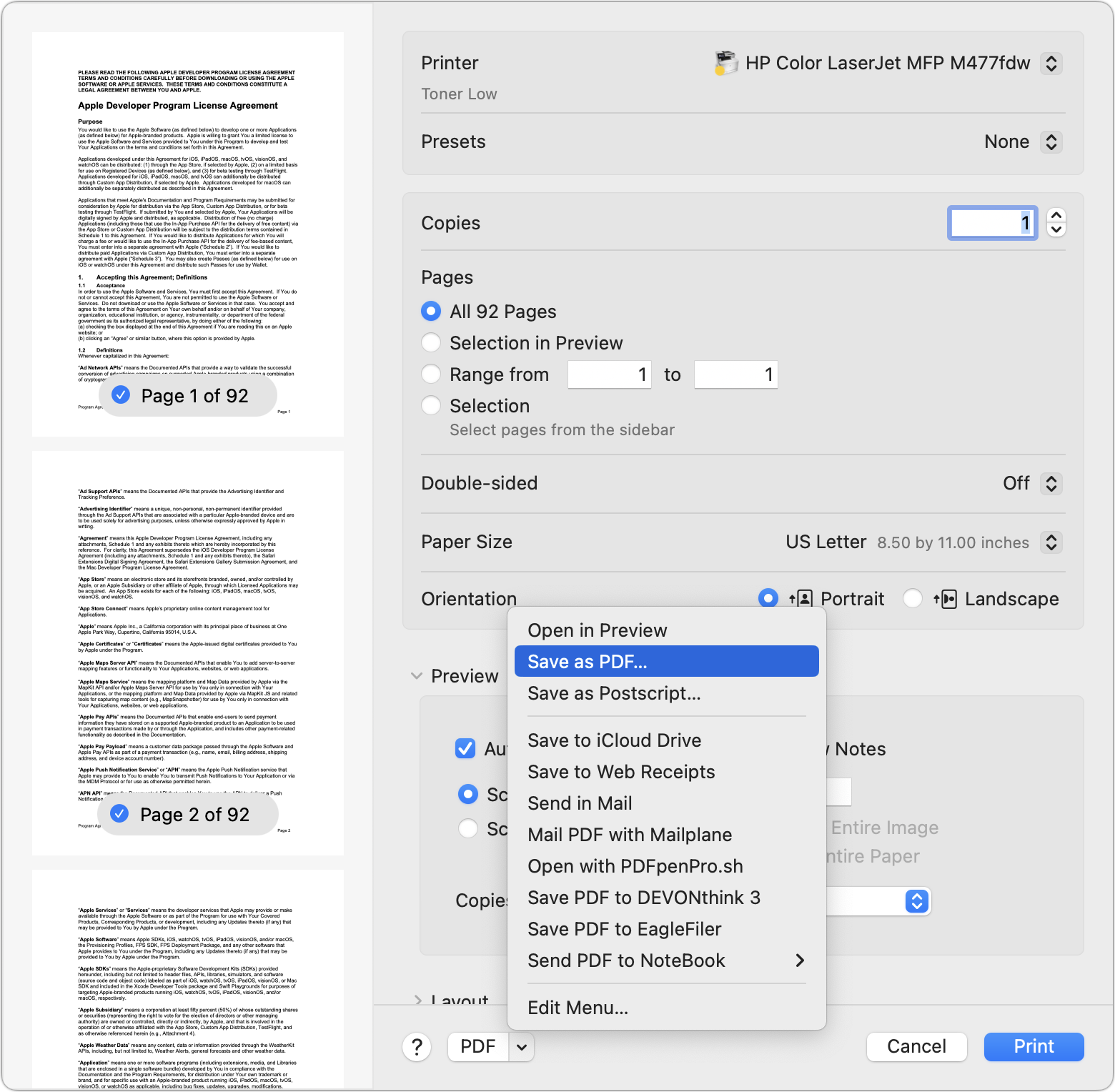
Choose File > Print, and then choose Save As PDF from the pop-up PDF menu at the bottom of the Print dialog. This may seem counterintuitive, but as with any other document type, printing in this way creates a PDF that contains only the visible information in the original, ensuring that all hidden data and metadata are removed.
Although all Mac users have Preview, there is another common option for removing metadata from PDFs—online tools. They’re easily found, but we urge caution. If you’re concerned about the recipient of your PDF being able to see metadata or hidden content, why would you trust a free online service with that information? If you want to head down this path, stick with sites headquartered in the European Union, which has stronger privacy regulations than other parts of the world. For instance, Metadata2Go, which displays all the metadata in a file, is in Germany, and Sejda, whose Edit PDF Metadata tool can remove all metadata, is based in the Netherlands.
One last thought. If you’ve gotten to this point and are thinking that you need an enterprise-wide solution to removing metadata, look for services like Adarsus’s MetaClean, which can automatically remove metadata from files sent as email attachments or stored on file servers.
(Featured image by iStock.com/Imilian)
The Hardware You’ll Need to Run Apple’s 2023 Operating Systems
Later this year, Apple will release macOS 14 Sonoma, iOS 17, iPadOS 17, watchOS 10, and tvOS 17. Here’s the hardware you’ll need to run these operating systems—and to support some of the whizzier features.

At Apple’s Worldwide Developer Conference in June, the company unveiled the upcoming versions of its operating systems: macOS 14 Sonoma, iOS 17, iPadOS 17, watchOS 10, and tvOS 17. They won’t be available until September or October of 2023, and even once they ship, we recommend waiting a few weeks before upgrading your smaller Apple devices and holding off on macOS upgrades for a couple of months.
Regardless, it’s worth considering how these operating systems might impact your plans to buy new hardware in the next six months. Any Apple device you purchase now—or have bought in the last five years—can run the new operating systems. But some devices that can run the current macOS 13 Ventura, iOS 16, and iPadOS 16 won’t be upgradable to their replacements later this year. More importantly, some older devices that can be upgraded won’t support all the new features.
Here’s what you’ll need and compatibility gotchas to keep in mind.
macOS 14 Sonoma
For macOS 14 Sonoma, Apple has dropped support for Mac models released before 2018. That works out to five models across the iMac, MacBook Pro, and MacBook product lines. If you rely on one of those Macs and want to run Sonoma, think about when it would make sense to buy a new Mac, perhaps in early 2024. By then, all new Macs will likely ship with Sonoma. These Macs can run Sonoma:
iMac: 2018 and later
iMac Pro: 2017
MacBook: None
MacBook Air: 2018 and later
MacBook Pro: 2018 and later
Mac mini: 2018 and later
Mac Pro: 2019 and later
Mac Studio: 2022 and later
The specific 2017 Mac models that are stuck at Ventura are:
iMac: 21.5-inch and 27-inch
MacBook Pro: 13-inch and 15-inch
MacBook: 12-inch
Unsurprisingly, some new features in Sonoma require sufficient processing power that they work only on Macs with Apple silicon—one of the M1 or M2 chips.
Game Mode: This special mode automatically gives games top priority on the CPU and GPU, lowering usage for background tasks. It also reduces latency for wireless accessories, like game controllers and AirPods, for improved responsiveness.
Just “Siri”: Although dropping “Hey” from the “Hey Siri” trigger phrase works on all iPhones with iOS 17 and iPads with iPadOS 17, it requires a Mac with Apple silicon or when using the AirPods Pro (2nd generation).
Made for iPhone hearing aids: Apple-compatible hearing aids can now be paired directly with Macs, but only those with an M1 Pro, M1 Max, M1 Ultra, or M2. That works out to the MacBook Pro (14-inch, 2021), MacBook Pro (16-inch, 2021), Mac Studio (2022), and all Macs with the M2.
Presenter Overlay: You can keep your image visible while sharing your screen on a video call, either in front of the shared screen or in a small movable bubble.
React with your hands: During video calls, 3D augmented-reality reaction effects like hearts, confetti, and fireworks can be triggered with hand gestures, but only on Macs with Apple silicon or when using Continuity Camera with an iPhone 12 or later.
Screen Sharing performance improvements: Apple has radically improved the performance of the Screen Sharing app over high-bandwidth connections, but it requires the advanced media engine in Apple silicon.
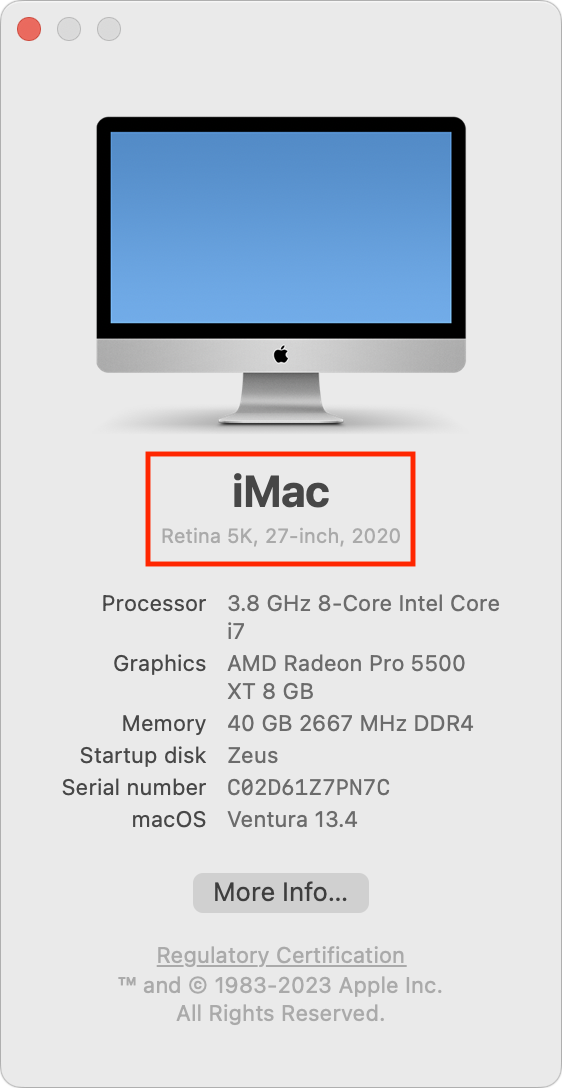
If you’re unsure which Mac you have, choose About This Mac from the Apple menu.
iOS 17
With iOS 17, Apple has maintained the same cutoff date as Sonoma, supporting all iPhone models released in 2018 and later. That means you’ll be able to run iOS 17 on these iPhones:
iPhone 14/Plus/Pro/Pro Max
iPhone 13/mini/Pro/Pro Max
iPhone 12/mini/Pro/Pro Max
iPhone 11/Pro/Pro Max
iPhone SE (2nd generation or later)
iPhone XR/XS/XS Max
Practically speaking, these iOS 16-compatible devices won’t be able to upgrade to iOS 17:
iPhone X
iPhone 8/8 Plus
Several new iOS 17 features have more restrictive system requirements.
Enhanced autocorrect: iOS 17 enhances autocorrect so it works better (and yes, it will let you use curse words), and it temporarily underlines autocorrected words so you can see which ones were changed. It requires an iPhone 12 or later.
Inline predictions: Similarly, inline predictions of what you’re going to type—so you can just accept the suggestion rather than tapping out all those letters—require an iPhone 12 or later.
Point and Speak: Those with vision disabilities might appreciate the Point and Speak feature that makes it easier to interact with physical objects that have text labels, but it works only on the Pro models of the iPhone 12, iPhone 13, and iPhone 14.
React with your hands: The hand-triggered video call reactions require an iPhone 12 or later.
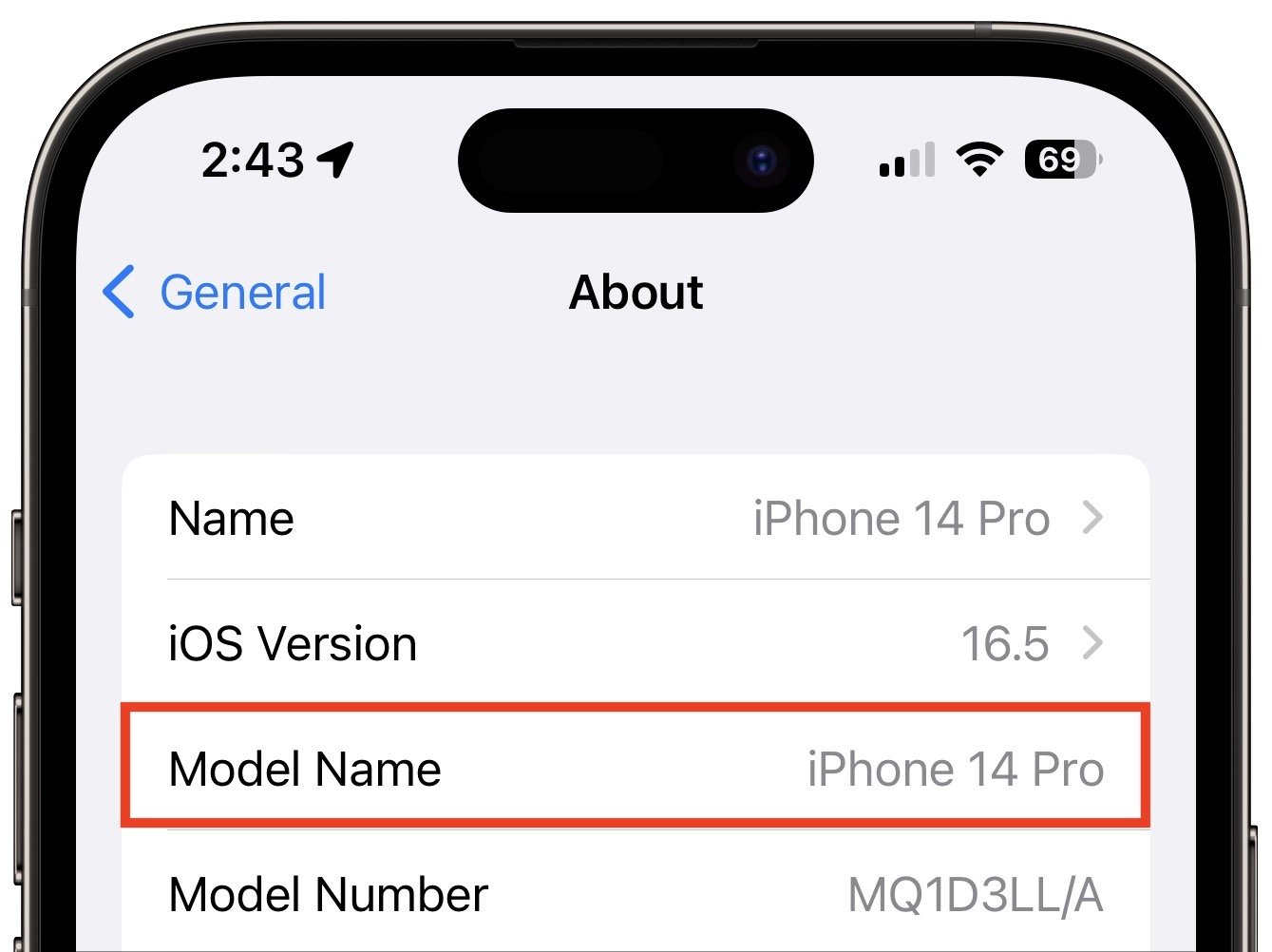
If you can’t remember which iPhone model you have, go to Settings > General > About and look next to Model Name. This works for the iPad, too.
iPadOS 17
It’s more involved to determine whether your iPad can upgrade to iPadOS 17 because there are four different iPad model types with varying capabilities. These models can run iPadOS 17:
iPad Pro 12.9-inch (2nd–6th generation)
iPad Pro 11-inch (1st–3rd generation)
iPad Pro 10.5-inch
iPad Air (3rd–5th generation)
iPad (6th–10th generation)
iPad mini (5th & 6th generation)
While that list encompasses a lot of iPads, a simpler way to look at it is that only three iPad models that can run iOS 16 won’t be able to upgrade to iOS 17:
iPad Pro 12.9-inch (1st generation)
iPad Pro 9.7-inch
iPad (5th generation)
Because Apple extended overall iPadOS 17 compatibility somewhat further back than it did with iOS 17 and macOS Sonoma, quite a few iPadOS 17 features work only on select models:
Back-to-back Siri requests: Although all iPhones will let you issue multiple requests to Siri without reactivating it, on the iPad, the feature works only on an iPad Pro 12.9-inch (3rd generation and later), iPad Pro 11-inch (1st generation and later), iPad Air (3rd generation and later), iPad mini (5th generation and later), or iPad (8th generation and later).
Enhanced autocorrect: This improvement to typing requires an iPad Pro 12.9-inch (5th generation and later), iPad Pro 11-inch (3rd generation and later), iPad (10th generation), iPad Air (4th generation and later), or iPad mini (6th generation).
External display cameras: If you want to take advantage of an external display’s camera while it’s attached to the iPad, you’ll need an iPad Pro 12.9-inch (3rd generation and later), iPad Pro 11-inch (1st generation and later), iPad (10th generation), iPad Air (4th generation and later), or iPad mini (6th genera-tion).
FaceTime with Apple TV: Using an iPad’s mic and camera for FaceTime on an Apple TV 4K (2nd generation) requires an iPad Pro 12.9-inch (3rd generation and later), iPad Pro 11-inch (1st generation and later), iPad (8th generation and later), iPad Air (3rd generation and later), or iPad mini (5th generation and later).
Inline predictions: Getting suggestions about what to type next on the iPad requires an iPad Pro 12.9-inch (5th generation and later), iPad Pro 11-inch (3rd generation and later), iPad (10th generation), iPad Air (4th generation and later), or iPad mini (6th generation).
PDF AutoFill: iPadOS 17 will use machine learning to analyze PDFs, and if it detects a form, you can fill it out automatically using your contact information. But only if you’re using an iPad Pro 12.9-inch (3rd generation and later), iPad Pro 11-inch (1st generation and later), iPad Air (3rd generation and later), iPad mini (5th generation and later), or iPad (8th generation and later).
React with your hands: As with the iPhone and Mac, only some models let you trigger reactions with gestures: the iPad Pro 12.9-inch (5th generation and later), iPad Pro 11-inch (3rd generation and later), iPad (10th generation), iPad Air (4th generation and later), and iPad mini (6th generation).
Screen Distance: This health-related feature is supposed to encourage kids to hold the iPad farther away to reduce the likelihood of developing myopia. But how many kids read on an iPad Pro 12.9-inch (3rd generation and later) or iPad Pro 11-inch (3rd generation and later)?
watchOS 10
The Apple Watch has a simple upgrade story: every model compatible with watchOS 9 can also run watchOS 10. That means everything from the Apple Watch Series 4 up through the Apple Watch Ultra, including the Apple Watch SE. (Look in the Watch app on your iPhone if you can’t remember which model you have.)
Two of the new features promised for watchOS 10 work only on specific models:
The NameDrop feature that lets you transfer contact information wirelessly with just proximity works with all iOS 17-compatible iPhones, but it can communicate only with an Apple Watch SE, Apple Watch Series 6 or later, or Apple Watch Ultra.
The Time in Daylight feature that helps parents track whether their kids are spending the recommended 80–120 minutes per day outside requires an Apple Watch SE (2nd generation), Apple Watch Series 6 or later, or Apple Watch Ultra.
tvOS 17
As with the Apple Watch, the Apple TV upgrade situation is easy to understand: tvOS 17 will run on the Apple TV HD and Apple TV 4K (1st and 2nd generation), just as with tvOS 16.
However, note that the promised option to let you use the mic and camera from an iPhone or iPad for FaceTime calls on the Apple TV works only if you have an Apple TV 4K (2nd generation). That might be the first real reason to upgrade from an older Apple TV.
(Featured image by Apple)
Learn to Identify and Eliminate Phishing Notifications
Did you know that a phishing website can send you a notification right on your Mac? Learn how this could happen and how to prevent it in your favorite Web browser.

Email may be the most common form of phishing, but it’s not the only one. Modern Web browsers support a technology that enables websites to display system-level notifications just like regular apps. These push notifications have good uses, such as letting frequently updated websites inform users of new headlines, changed discussion threads, and more.
Unfortunately, push notifications can be subverted for malicious purposes, notably phishing. Here’s what happens. You visit a website that asks you if you’d like to receive notifications.
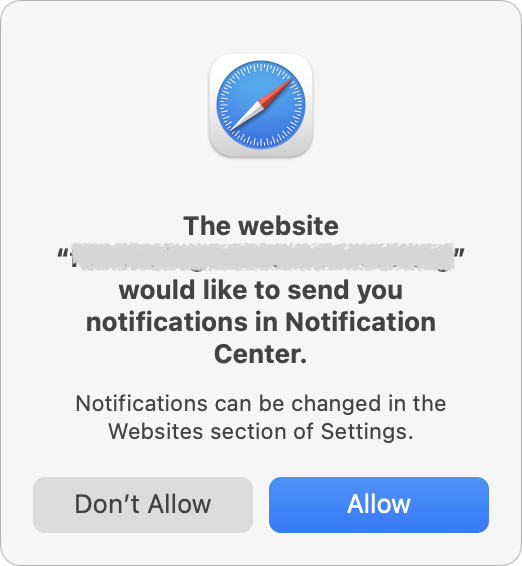
That request may be introduced with language that implies you must agree in order to get desired content, or it may be a bald-faced request to show notifications. If you agree, the website will be able to display alarming or deceptive phishing notifications even when it’s not open.

The goal is to trick you into clicking the notification, which will load a fake site that attempts to get you to enter login credentials or credit card information to facilitate identity theft.
The danger of phishing notifications is that they come from the system, so they may seem more legitimate than email messages trying to sucker you into revealing personal information. Nevertheless, as you can see in the examples above, they may still look sketchy in ways reminiscent of phishing emails:
No legitimate website would use emoji or symbols in a notification, much less multiple ones.
Although there are no glaring spelling or grammar mistakes, the use of all caps in the top notification is a giveaway. Similarly, standard notifications wouldn’t use exclamation points.
The use of “Click here” is poor information design that’s unlikely to come from a professional programmer or Web designer.
Phishing notifications, although problematic, aren’t a malware infection, and anti-malware packages won’t detect or remove them. Luckily, they’re easy to control and block in Safari and other Web browsers.
Prevent Phishing Notifications
The easy way to ensure you don’t see phishing notifications is to allow only trusted websites to send notifications. In general, we recommend keeping that list small so you’re not frequently interrupted by unnecessary notifications.
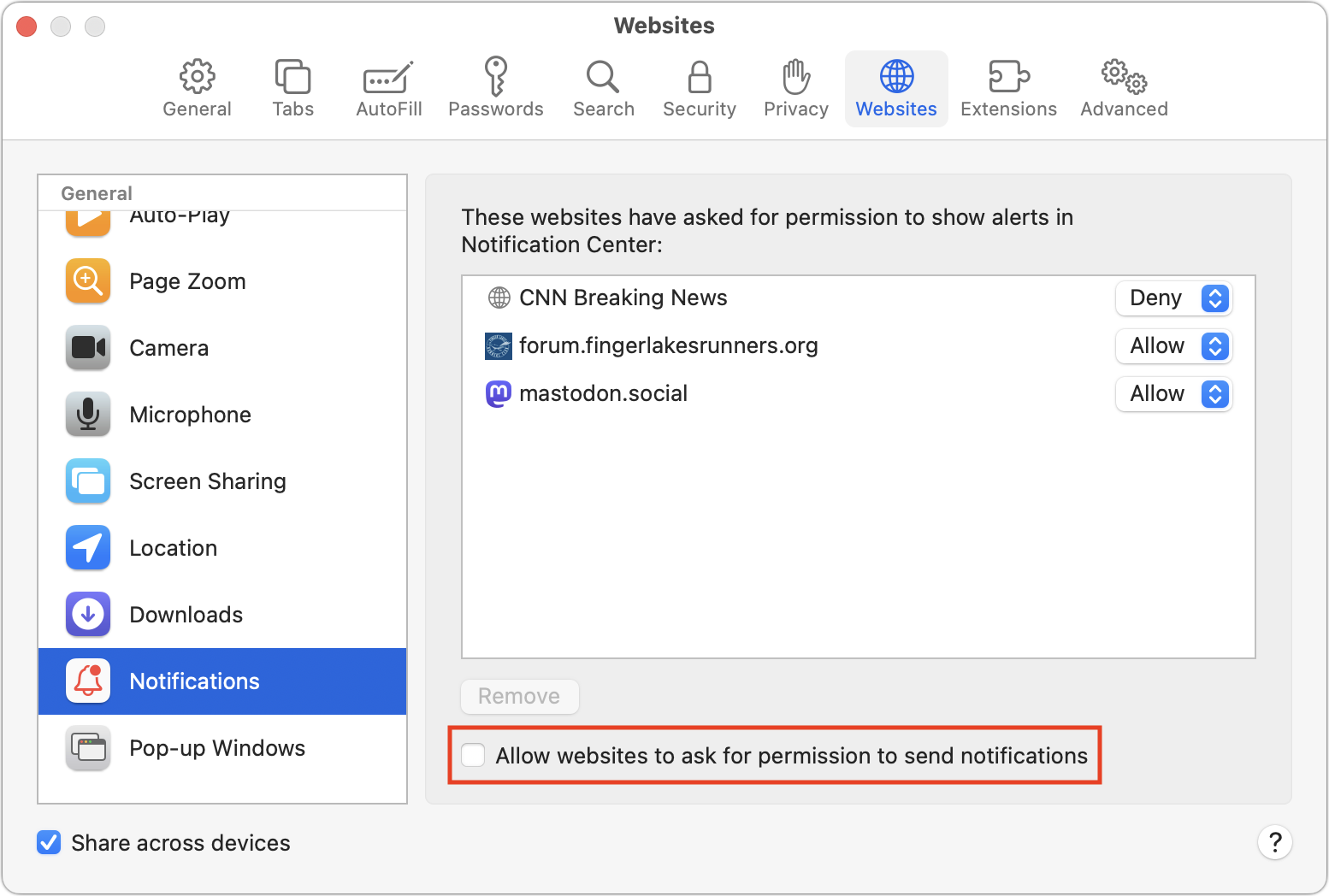
If you’re unsure that you’ll be able to identify malicious websites, you can enable a browser setting that prohibits all websites from asking for permission to send notifications. In Safari, choose Safari > Settings > Websites > Notifications, and deselect “Allow websites to ask for permission to send notifications” at the bottom.
Other browsers have similar options, and most will look like Google Chrome, as shown below:
Arc: Choose Arc > Settings > General > Notifications and select “Don’t allow sites to send notifications.”
Brave: Navigate to Brave > Settings > Privacy and Security > Site and Shield Settings > Notifications and select “Don’t allow sites to send notifications.”
Firefox: Go to Firefox > Settings > Privacy & Security > Notifications and select “Block new requests asking to allow notifications.”
Google Chrome: Navigate to Chrome > Settings > Privacy and Security > Site Settings > Notifications and select “Don’t allow sites to send notifications.”
Microsoft Edge: Choose Microsoft Edge > Settings > Cookies and Site Permis-sions > Notifications and turn off “Ask before sending.”
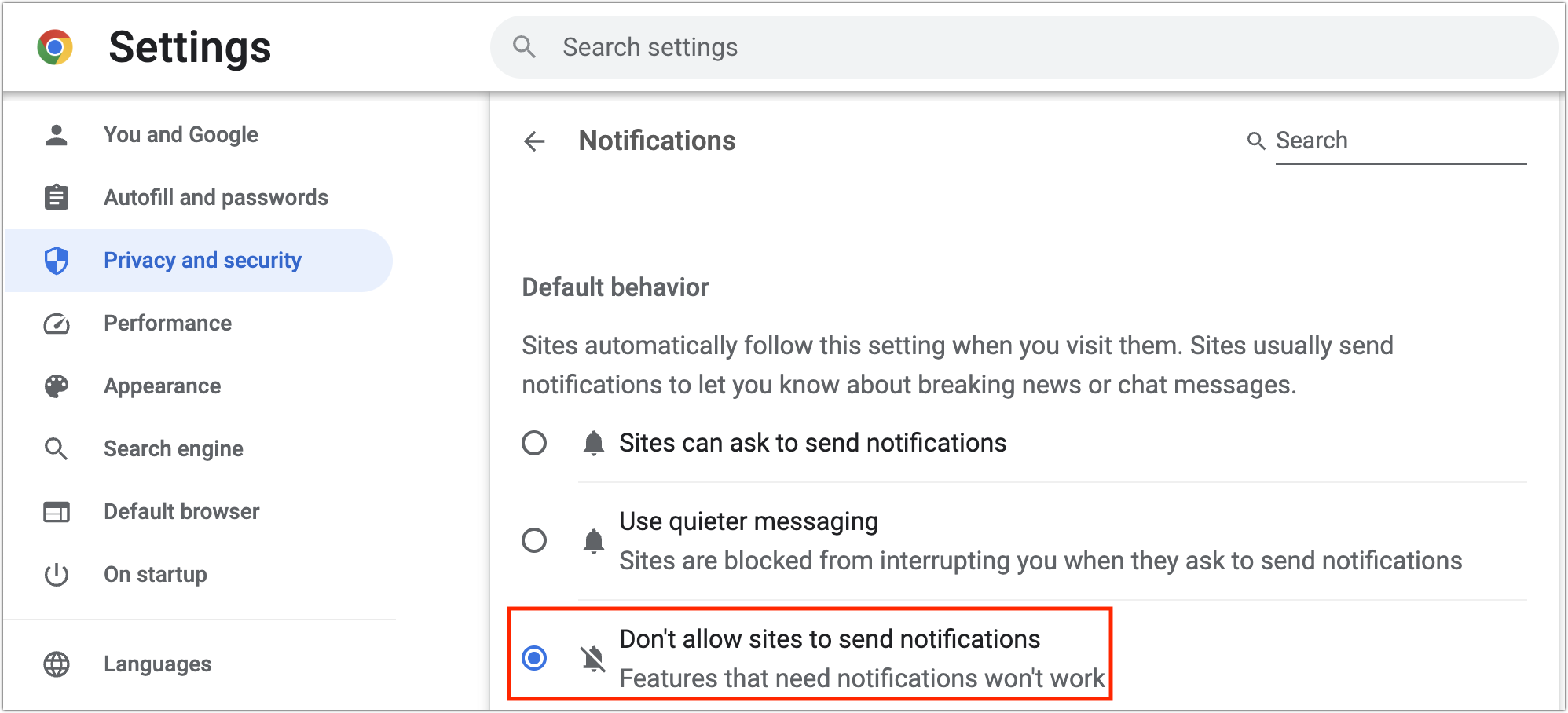
Browsers based on Chrome (everything except Firefox in the list above) offer a “Use quieter messaging” option that replaces the permission dialog with a bell icon next to the site name in the address bar—click it to allow notifications from that site.
Eliminating Phishing Notifications
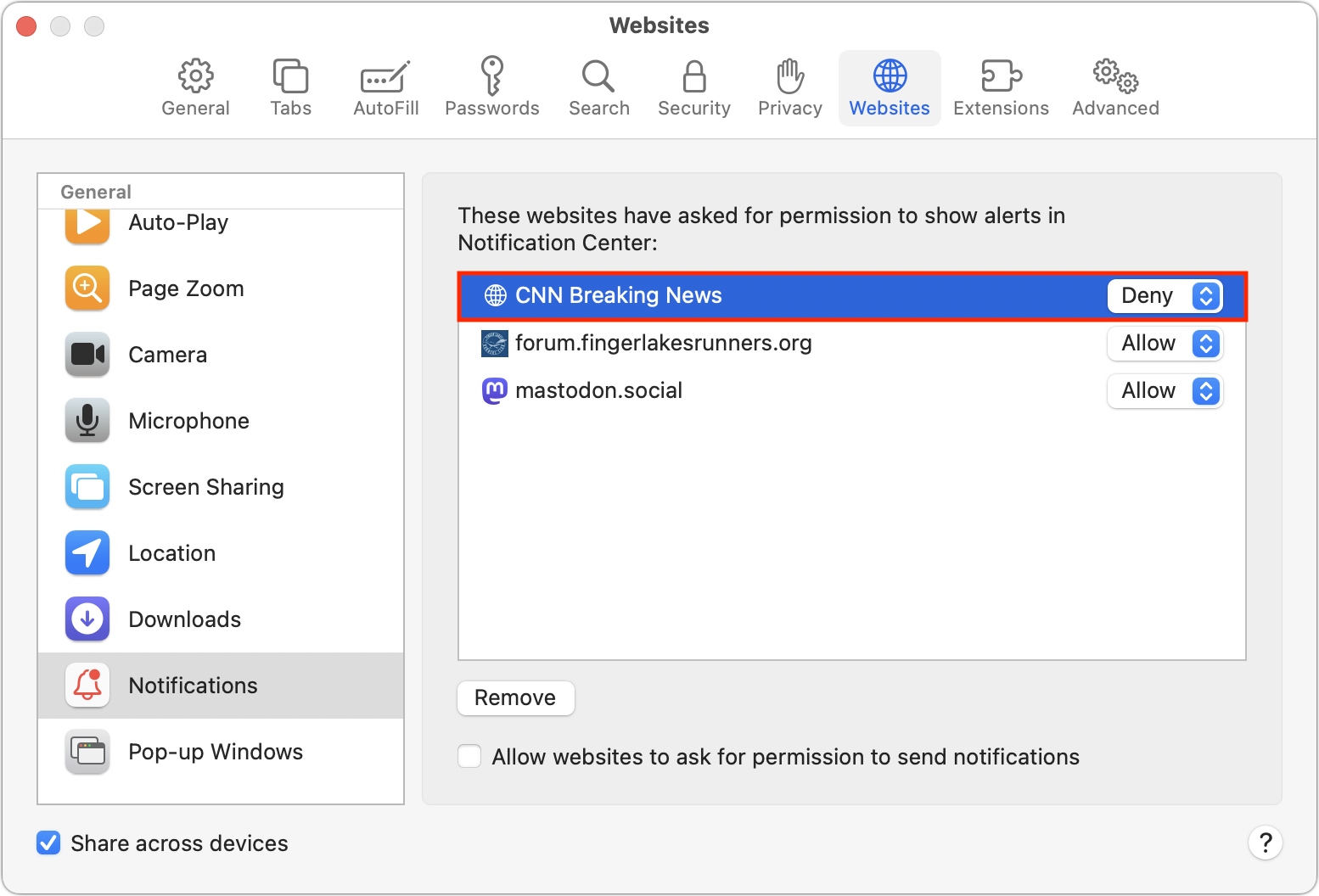
Now you know how to prevent new sites from requesting permission to display notifications. What about sites that already have permission? It’s easy to block them in Safari’s Notifications settings screen. If you have any undesirable sites with Allow in the pop-up menu to the right of their name in the Notifications screen, choose Deny from that menu. You could remove the site instead, but that would allow it to ask for permission again.
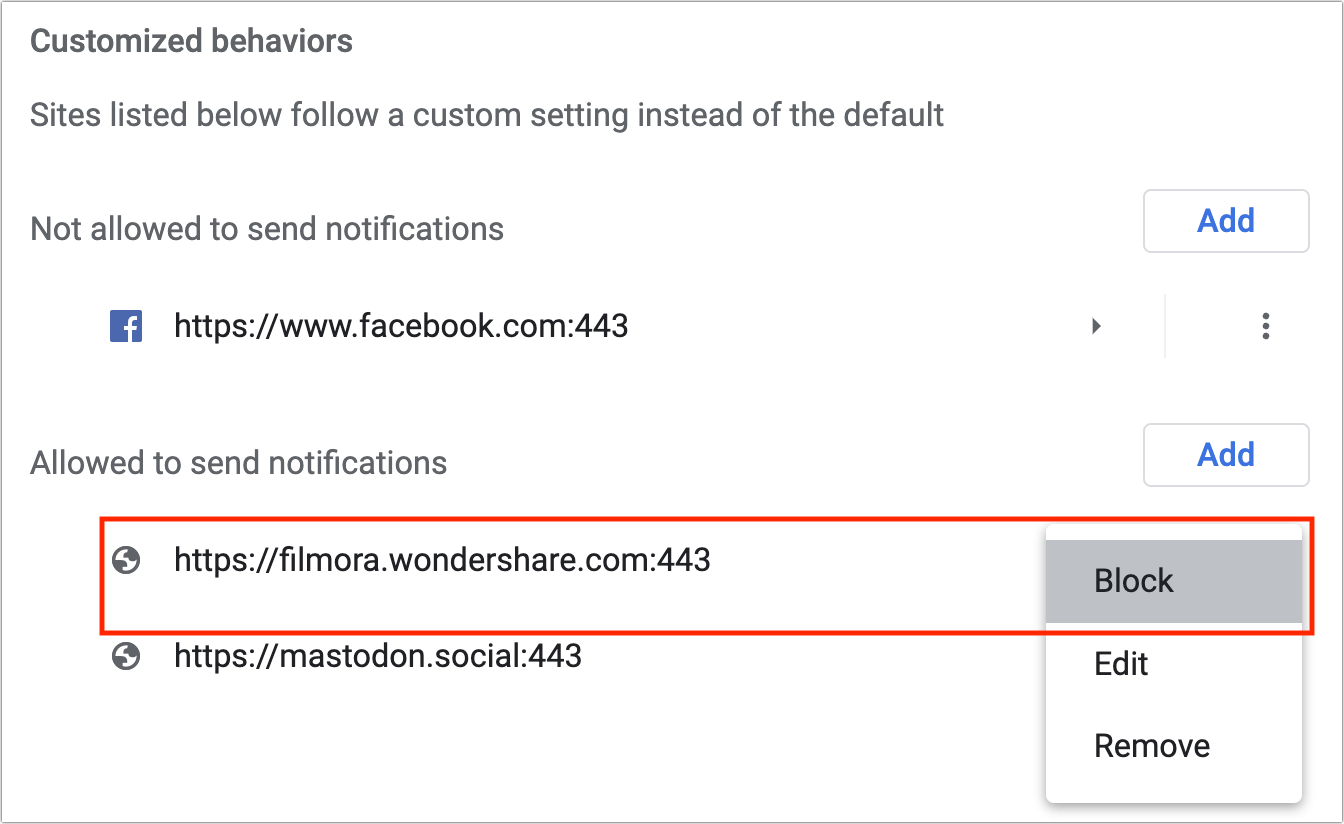
Firefox’s interface is similar to Safari’s, but Chrome-based browsers have a different interface that separates the blocked and allowed sites. To block a website whose notifications you no longer want to receive, click the button to the right and choose Block. Again, you could remove undesirable sites if you prefer, but remember that if your notification settings ever change, doing so could allow the site to ask for permission once more.
Ultimately, it’s easy to avoid phishing notifications by paying attention as you browse the Web. Steer clear of websites that make an unexpected request to display notifications. Notifications aren’t necessary on hardly any websites, so there’s no harm in denying such requests unless you’re sure they’re legitimate.
(Featured image based on an original by iStock.com/tadamichi)
Choosing the Best Mac for a College-Bound Student in 2023
Which Mac is best for a college student in 2023? Our short answer: either the 13-inch or 15-inch M2 MacBook Air, although students with significant processing needs (like audio or video editing) might look at the 14-inch MacBook Pro.

Do you have a child starting college soon? It’s likely that your kid has been relying heavily on a computer throughout high school, but if it was a school-provided laptop or shared family computer, now’s the time to get them something of their own. Even if they had their own laptop throughout high school, if it’s old or unreliable, college is a good excuse to bring them up to date. If you haven’t been paying close attention to Apple’s Mac lineup, you might wonder which model makes the most sense.
First, don’t buy anything without first checking with the college. Many college departments have specific requirements based on the software students use in their classes. Generally, these revolve around processor type, amount of RAM, and storage space. Current Macs should meet or exceed all those requirements. Second, see if the college provides access to education pricing—most will—to save a few hundred dollars off the prices listed below. Regardless, Apple often has a Back to School offer.
Colleges often specify—and students usually prefer—laptops instead of desktop machines. Although the M1 24-inch iMac is an excellent machine with a gorgeous screen, it’s too big and unwieldy for the nomadic lifestyle of the typical college student. The same applies to an M2 Mac mini or Mac Studio with an external display. Students can take a laptop to class daily, and bringing it home on breaks is a lot easier. A student accustomed to taking notes on an iPad with a keyboard and Apple Pencil might be able to use that along with a desktop Mac, but most students should focus on laptops.
In the past, deciding which model was best for a given student was more challenging, but Apple’s move to the speedy and power-efficient M1 and M2 chips makes the decision easier. We see three primary scenarios:
Most students: Buy Apple’s MacBook Air. It’s Apple’s lightest and least expensive laptop. Within the MacBook Air line, you have three choices. The least expensive is the 13-inch M1 MacBook Air from 2020, which starts at $999, but the 13-inch M2 MacBook Air is a better choice for most people, thanks to its bigger-brighter-better 13.6-inch screen, faster performance, 24 GB memory ceiling, and higher-resolution webcam. It now starts at $1099. Those who want a larger screen should look at the just-released 15-inch M2 MacBook Air, which starts at $1299. Apart from the 15.3-inch screen, the only difference from the 13-inch model is a six-speaker system, up from four speakers.
Better specs: If performance is more important than cost—especially if your student will be working with processor-intensive tasks like video editing—look to the 14-inch MacBook Pro. It features a powerful M2 Pro chip or an even faster M2 Max chip, and it can be configured with more memory. Although its 14.2-inch screen is physically a little smaller than that of the 15-inch MacBook Air, it has a somewhat higher resolution. Its price starts at $1999.
Windows compatibility: The only downside of the transition to Apple silicon is that it’s somewhat more difficult to run Windows using virtualization software like Parallels Desktop (half-price for students and officially supported by Microsoft) or VMware Fusion (free for students but much harder to set up and not officially supported by Microsoft). If Windows compatibility is a bonus but not essential, Parallels Desktop and Windows 11 on Arm should work. However, if Windows compatibility is paramount, your choices are a used Intel-based MacBook Pro or—much as we hate to say it—a PC laptop that runs Windows natively.
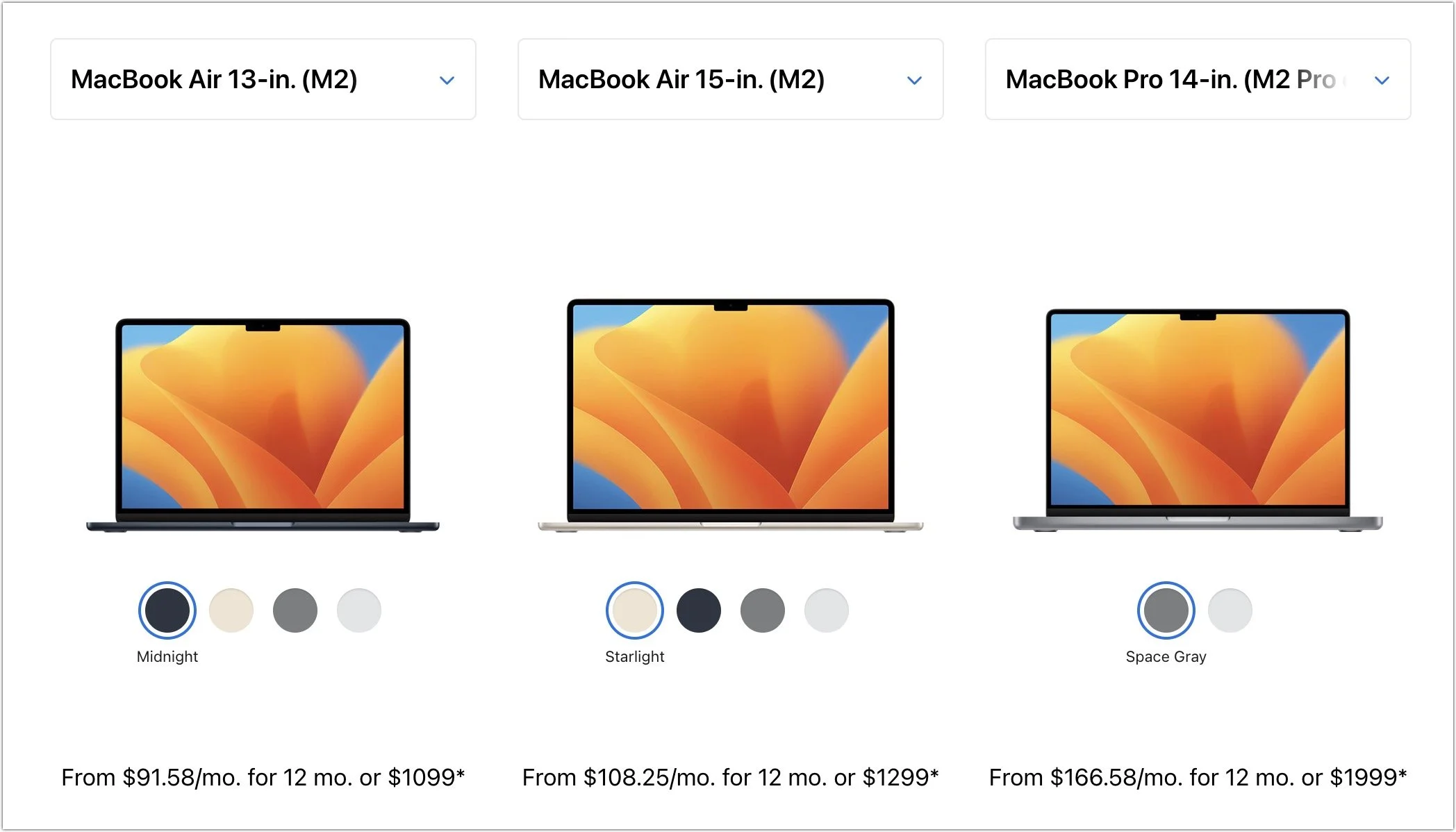
Regardless of which laptop you decide on, you’ll have to pick a processor, amount of memory, and storage capacity:
Processor: With the 13-inch M1 MacBook Air, you’re limited to the M1 chip with an 8-core CPU and 7-core GPU. With the 13-inch M2 MacBook Air, the M2 chip always has an 8-core CPU, but you can pay $100 to upgrade from an 8-core GPU to a 10-core GPU. The 15-inch M2 MacBook Air always comes with a 10-core GPU. The performance difference isn’t likely noticeable with everyday apps, but for $100, it might be worth upgrading, just in case. The 14-inch Mac-Book Pro has two M2 Pro options and two more M2 Max options, and choosing between them is probably best done by weighing likely performance needs against the (significantly) increased cost.
Memory: The 13-inch M1 MacBook Air offers the choice of 8 GB or 16 GB. 8 GB is acceptable for most college students, but we’d encourage 16 GB to reduce the chance that memory becomes a limiting factor in performance. The M2 MacBook Air lets you choose from 8 GB, 16 GB, or 24 GB, and again, we’d default to 16 GB unless there’s some particularly memory-hungry software in play. With the 14-inch MacBook Pro, the amount of memory goes with the chip. The M2 Pro comes with 16 GB standard, but you can opt for 32 GB. With the M2 Max, 32 GB is standard, with options to upgrade to 64 GB or 96 GB.
Storage: For all the MacBook Air models, 256 GB is the lowest storage level, and you can upgrade to 2 TB. The 14-inch MacBook Pro starts at 512 GB and offers upgrades up to a whopping 8 TB. Choose the amount of storage based on two considerations: budget (it gets expensive fast) and anticipated usage (audio and especially video can consume a lot of space, as can large numbers of photos, but most other uses don’t). Remember that it’s easy to connect an external Thunderbolt SSD or hard drive to offload large files that don’t have to be kept available at all times. Large files can also be kept in cloud-based storage.
To our thinking, the most obvious choice for a Mac that’s likely to last for four years of college would be either the 13-inch or 15-inch M2 MacBook Air with a 10-core GPU, 16 GB of memory, and 512 GB of storage. Be sure to budget for AppleCare+, too; it’s almost guaranteed that some mishap will befall a student laptop, and AppleCare+ covers up to two incidents of accidental damage every year.
You’ll need to have some conversations with your child to find out what they think they’ll need—and be sure to double-check that against the college’s recommendations—but if you have any questions after that, don’t hesitate to contact us.
(Featured image by Apple)
What to Do If You’re a Mac User Who Needs Some Windows Software
You use a Mac for nearly everything but still need to run Windows software occasionally. Here’s how you can do that in 2023 on either an Intel-based Mac or an M-series Mac.
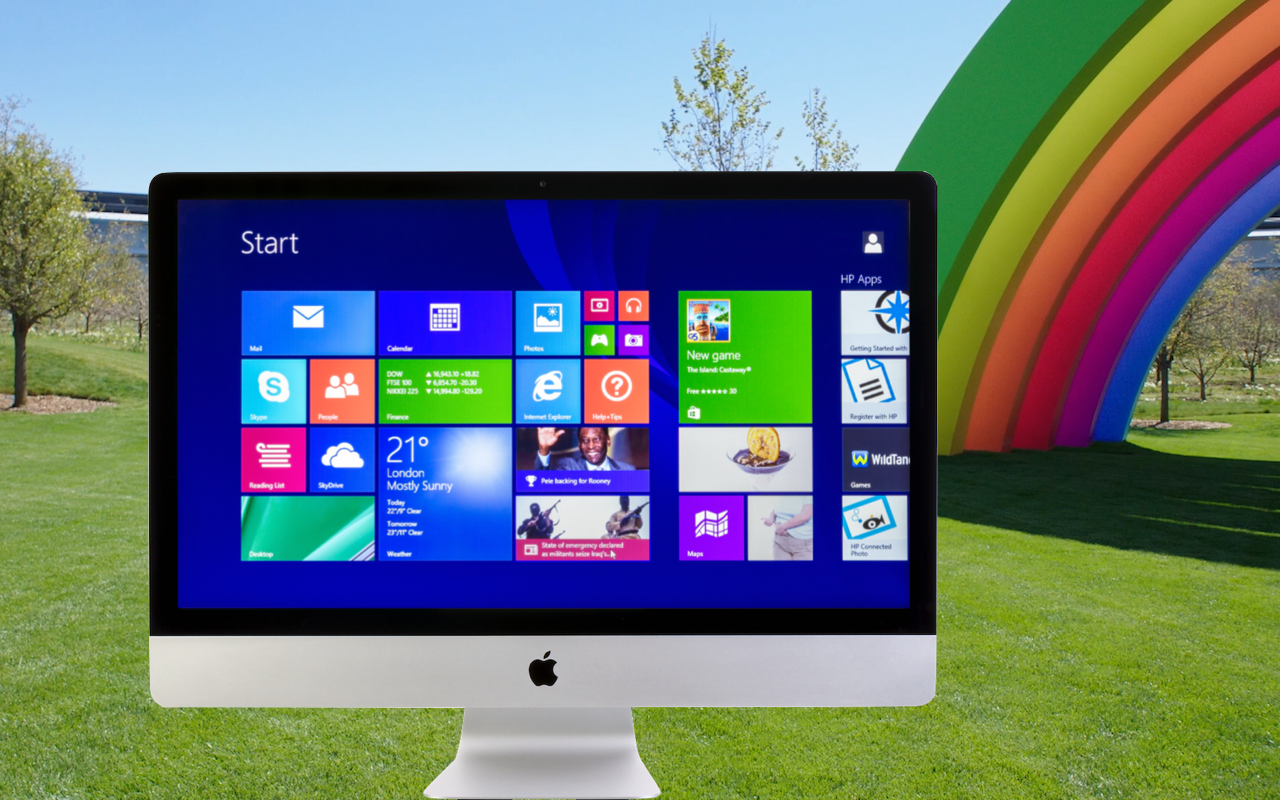
For the most part, the days of Mac versus PC are over. Common apps now exist on both platforms, and when they don’t, there are plenty of alternatives in nearly every app category. Plus, many apps either run entirely on the Web in any browser. Large organizations now regularly run “employee choice” programs that allow people to pick the platform where they’re the most comfortable.
But the fact remains that there are many more Windows-based PCs out there than Macs, and particularly for an old or unusual app, or for software needed for specific hardware peripherals, sometimes the only available option is a Windows app. What’s a modern Mac user to do? Here are a few possibilities.
Use Boot Camp on an Intel-based Mac
The cheapest approach to running Windows software on a Mac is to use Apple’s free Boot Camp. However, it comes with a number of limitations compared with the virtualization software we’ll discuss next:
Boot Camp works only on Intel-based Macs; it’s not available for M-series Macs.
You must choose between macOS and Windows every time you turn on or restart your Mac, rather than being able to run both side-by-side.
Boot Camp creates its own partition on your drive, and you can’t resize it later. You must guess how much space you need and leave enough for future expansion, all without wasting too much available space.
Installing Windows 11 is involved and can’t be accomplished on a Mac with a Touch Bar. You can install Windows 10 and then update it to Windows 11.
The main advantage of Boot Camp over virtualization software is that it provides the best performance for Windows apps because no resources are being shared with macOS. Also, a few apps, primarily games, won’t run on a virtual machine.
Given that Intel-based Macs are on the way out, we recommend the Boot Camp approach mostly if you have an extra Intel-based Mac that can be dedicated to your Windows task.
Use Virtualization Software on an Intel-based Mac
Shortly after Apple switched Macs from PowerPC processors to Intel chips in 2006, virtualization apps appeared, notably Parallels Desktop, VMware Fusion, and VirtualBox. Because Windows runs natively on those same Intel chips, virtualization software can create a virtual machine (VM) that Windows runs on just as though it were running on a physical PC. A few of the significant advantages of virtualization software include:
You can run Windows apps alongside Mac apps, switching back and forth with a click.
You can install Windows on a disk image that you can resize as necessary.
You can move data from macOS to Windows with copy-and-paste and by drag-ging files, plus you can specify a shared folder whose contents are accessible to both macOS and Windows.
You can install different versions of Windows or other Intel-compatible operating systems, and maintain multiple virtual machines for testing.
The main downside of virtualization software is that its performance can’t be quite as good as Boot Camp because it must share some CPU and RAM resources with macOS. Plus, Parallels Desktop and VMware Fusion aren’t free, although VMware Fusion offers a free personal license. VirtualBox is free but more complicated, and it’s not yet compatible with macOS 13 Ventura.
Parallels Desktop (starting at $99.99) and VMware Fusion (starting at $149; free for personal use) provide the best user experience for most Windows needs if you have an Intel-based Mac.
Use Parallels Desktop on an M-series Mac
When Apple introduced the first Macs based on Apple silicon, people wondered what would happen to virtualization software, which could no longer just pass the software commands down to an Intel chip. The solution was to create a new virtualization engine that leverages the M-series chips’ hardware-assisted virtualization to run Arm-based virtual machines. (Apple’s M-series chips are based on the Arm architecture, which differs from the x86 architecture used by Intel chips.)
The upshot is that the latest versions of Parallels Desktop and VMware Fusion can run on M-series Macs, but you can install only Arm-based operating systems, not Intel-based operating systems. Luckily, Microsoft makes Windows 11 on Arm, a full-fledged version of Windows that can run most Windows apps, even those designed for Intel chips.
In early 2023, Microsoft announced that it is officially supporting Windows 11 on M-series Macs when run in Parallels Desktop. Although VMware Fusion can run Windows 11 on Arm Insider Preview—a beta version—installation is challenging. We recommend sticking with Parallels Desktop for an experience that’s significantly easier and officially supported.
Use a Windows 365 Cloud PC
Virtualization enables you to run Windows not just on a Mac, but also in the cloud. Microsoft’s Windows 365 service is another alternative that lets you stream Windows to any device with a Web browser. While the concept of Windows 365 is compelling, the pricing is not. The cheapest plan costs $31 per user per month, or $372 per year, for a virtual PC with 2 CPUs, 4 GB of RAM, and 128 GB of storage. Parallels Desktop is about a quarter the price.
Buy a Cheap PC
We know, we know. The entire point of running Windows on a Mac is so you don’t have to buy a PC. But there are situations where it makes more sense to purchase an inexpensive PC than to fuss with virtualizing Windows on a Mac. Perhaps multiple people in your office need access to your essential Windows app, or maybe some hardware device can be controlled only from a PC. In such cases, a dedicated PC may be the better part of valor. Contact us for configuration and buying advice—the PC world can be a confusing place for those accustomed to buying from Apple.
(Featured image based on originals by iStock.com/manaemedia)